

Before these jobs had titles, six people were already busy doing them.
What do you tell people when your job does not technically exist yet?
These six people found out the difficult way. They investigated crimes, escaped restraints, designed books, and wrote instructions for computers before the world had proper names for any of it.
#6 William Addison Dwiggins, Graphic Designer

William Addison Dwiggins had a problem. His work involved typography, illustration, advertising, calligraphy, and book design, but there was no single job title that covered all of it.
At the time, people doing similar work were often called commercial artists. Dwiggins felt that description missed the planning behind it. He was not simply decorating pages. He was deciding how words, images, and spacing should work together to guide the reader.
In a 1922 article, he used the term “graphic design” to describe that process. Earlier examples of the phrase have since been found, so he may not have invented it completely, but he is widely credited with helping turn it into the name of a profession.
Dwiggins also designed typefaces, created hundreds of book designs, and wrote about advertising layouts. By the time graphic designer became a familiar job title, he had already spent years showing everyone what the job actually involved.
#5 Nellie Bly, Undercover Investigative Reporter

In 1887, Nellie Bly walked into a boardinghouse in New York City and began acting strangely. She stared into the distance, refused to sleep, and told people she had lost her memory.
It worked alarmingly well.
Doctors declared her insane, and Bly was committed to the Women’s Lunatic Asylum on Blackwell’s Island. What they did not know was that she was a 23 year old reporter working undercover for the New York World.
Bly spent ten days inside the asylum, where she witnessed freezing baths, spoiled food, forced silence, and cruel treatment from staff. She also met women who appeared perfectly sane but had little chance of convincing anyone in authority.
Her resulting series, later published as Ten Days in a Mad House, caused a public uproar. A grand jury investigated the institution, and New York City increased funding for the care of people with mental illness.
Undercover reporting existed in limited forms before Bly, but she pushed it somewhere far more dangerous and public. She did not simply interview people about abusive conditions. She had herself locked inside them and trusted that her newspaper would eventually come back for her.
#4 Eugène François Vidocq, Private Detective

Before Eugène François Vidocq started catching criminals, he spent years learning how they operated from unusually close range…. His name is a mouthful, so here at ListImmerse we will be calling him Vidocq before someone checks our pronunciation.
Vidocq was a thief, smuggler, prison escapee, and talented impersonator who repeatedly found himself on the wrong side of French law. In 1809, he offered his services to the Paris police as an informant. His knowledge of disguises, criminal networks, and prison life made him remarkably effective.
He eventually became the first chief of the Sûreté, an early plainclothes criminal investigation unit. Vidocq recruited former criminals, used undercover officers, and experimented with methods that would later become common in detective work, including detailed record keeping and studying physical evidence.
After leaving the police, he opened Le Bureau des Renseignements in Paris in 1833. It is widely described as the first known private detective agency. Businesses and private clients hired Vidocq to investigate fraud, theft, and other matters they did not want handled publicly.
The profession still had no established rules, and Vidocq’s own methods were not always comfortably legal. Still, he had created something recognizable: a private investigator working for paying clients, drawing on experience that no respectable employer would normally request.
#3 Ray Newby, Radio Disc Jockey
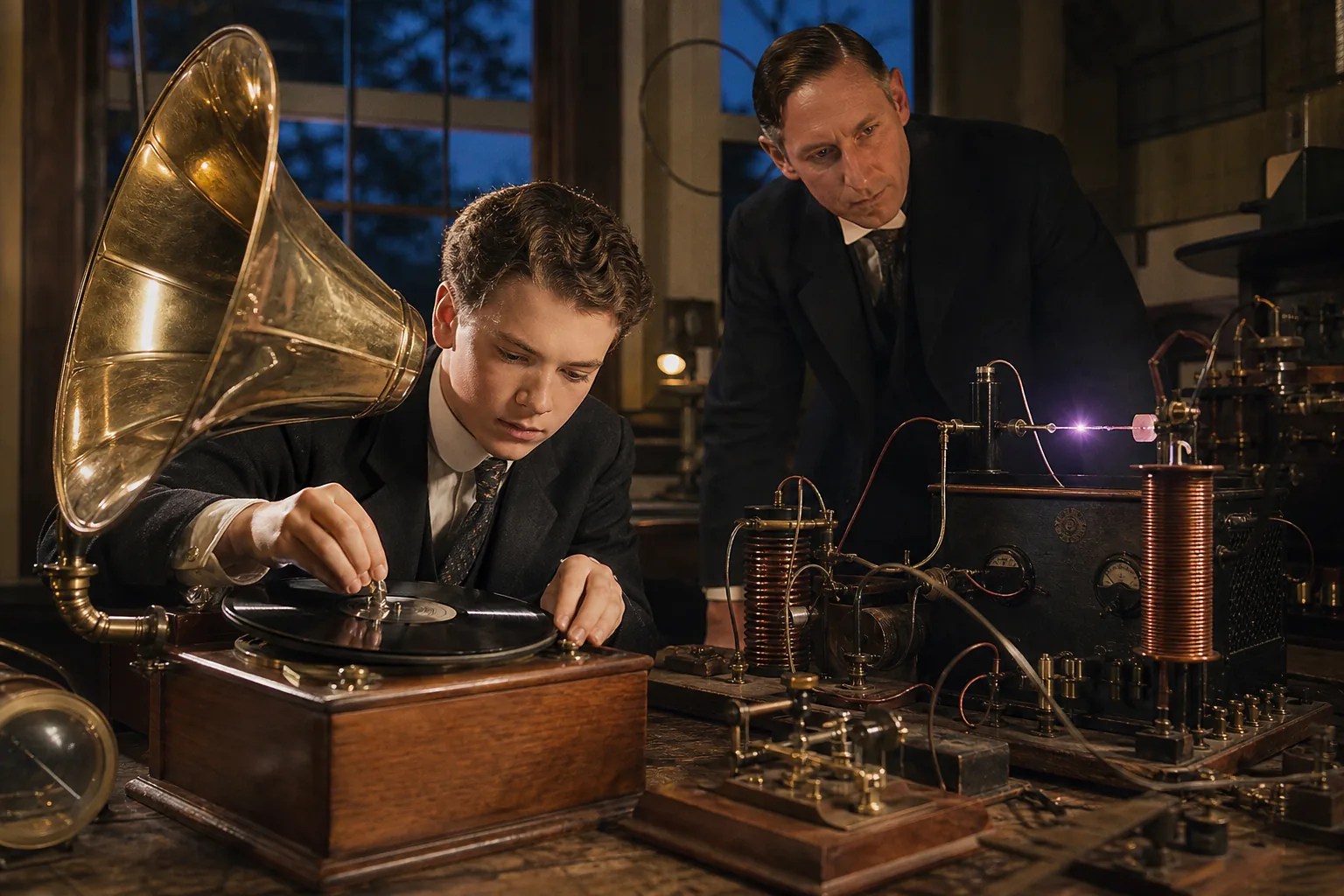
In 1909, 16 year old Ray Newby sat beside a small radio transmitter in San Jose, California, and began playing records for anyone capable of receiving the signal.
This was before commercial radio stations, scheduled music programs, or the term “disc jockey.” Most early radio transmissions consisted of coded messages, technical experiments, or the occasional human voice fighting its way through static.
Newby was a student of inventor Charles “Doc” Herrold, who operated an experimental radio school. Using Herrold’s equipment, Newby regularly broadcast music from phonograph records. The audience was tiny because radio receivers were hardly standard household equipment, but the basic format would now be instantly recognizable: one person choosing recorded music and sending it out to listeners.
The phrase “disc jockey” would not appear until decades later. By then, radio hosts had become celebrities capable of launching songs, shaping musical tastes, and talking confidently between records whether anyone asked them to or not.
Newby never became famous for doing it. He simply helped demonstrate that radio could be more than a tool for sending information. It could also be somewhere people went to hear music.
#2 Ada Lovelace, Computer Programmer

Ada Lovelace wrote a computer program nearly a century before anyone could sit down and use a computer.
In the 1830s, English mathematician Charles Babbage designed the Analytical Engine, a mechanical machine intended to perform complex calculations using gears, punched cards, and an internal memory. It was never fully built, but Lovelace understood what it could become.
In 1843, she translated an Italian article about the machine and added a series of her own notes. Her additions were far longer than the original paper. One included a detailed method for using the Analytical Engine to calculate Bernoulli numbers, often described as the first published computer algorithm intended for a machine.
Lovelace also recognized that such a device might eventually manipulate more than numbers. If music or language could be translated into symbols, she reasoned, a machine could potentially work with those too. That was an extraordinary leap at a time when Babbage’s computer still existed mainly as plans, partial mechanisms, and a very expensive disagreement with the British government.
Historians continue to debate how much of the algorithm came directly from Lovelace and how much developed through her work with Babbage. What is clear is that she described a way to instruct a general purpose machine long before computer programmer became a profession anyone could actually pursue.
#1 Harry Houdini, Professional Escape Artist

Harry Houdini did not invent escaping from restraints. He did, however, turn it into a full time profession, an international spectacle, and one of the most recognizable personal brands in entertainment history.
Born Erik Weisz in 1874, Houdini began as a conventional magician. The tricks earned him work, but the escapes made people remember his name. He challenged local police to lock him inside their cells, invited officers to inspect his handcuffs, and escaped while reporters watched closely enough to provide free publicity afterward.
Soon, ordinary restraints were no longer enough. Houdini escaped from straitjackets while suspended above crowds, jumped from bridges in chains, broke out of locked packing crates, and freed himself from a sealed milk can filled with water. His Chinese Water Torture Cell placed him upside down behind glass with his ankles secured above him, because apparently being locked underwater was starting to look too comfortable.
Other performers had included escapes in their acts, but Houdini made the escape itself the main event. The location, the restraints, the danger, and the publicity surrounding each attempt were all carefully arranged to make audiences believe they might witness the one challenge he could not beat.
He inspired generations of escape artists, stunt performers, and illusionists who built careers around surviving impossible situations in public. Plenty of people on this list worked before their professions had settled on a name. Houdini went a step further and made his own name inseparable from the job.
Sources & Image Credits
Sources and Further Reading
• William Addison Dwiggins, Letterform Archive
• Nellie Bly’s Blackwell’s Island Investigation, Library of Congress
• Eugène François Vidocq, Encyclopaedia Britannica
• Ray Newby and the Early History of Radio, Bay Area Radio Museum
• Ada Lovelace and the Analytical Engine, Science Museum
• Harry Houdini’s Famous Escapes, Library of Congress
Image Credits
The images in this article are AI-assisted historical reenactments created for ListImmerse. They are based on documented events, period details, and archival likeness references. They should not be interpreted as authentic photographs of the scenes depicted.
Leave a Reply