

Sometimes the smallest crime exposes the biggest one.
The arrest that ends a major criminal case does not always begin with a major clue.
Sometimes it starts with shoplifting, reckless driving, or an officer noticing something slightly off. These seven criminals were caught when an ordinary encounter suddenly became something much bigger.
#7 Ted Bundy’s Suspicious Volkswagen

Ted Bundy’s first arrest did not begin with detectives closing in or a witness finally identifying him. It began with a patrol officer wondering why a Volkswagen Beetle was sitting outside a house at 2:30 in the morning.
On August 16, 1975, Utah Highway Patrol Sergeant Bob Hayward noticed the vehicle in a residential area of Granger, near Salt Lake City. Hayward knew that young women lived in the house nearby, so he pointed his lights toward the Volkswagen.
Bundy immediately drove away.
He ran through stop signs and tried to lose the patrol car before finally pulling into a gas station. The attempt to avoid Hayward had turned a suspicious parked car into a traffic stop with considerably more explaining required.
Inside the Volkswagen, Hayward found handcuffs, rope, a crowbar, an ice pick, a ski mask, another mask made from pantyhose, and other items that appeared to be burglary tools. The front passenger seat had also been removed, leaving extra space inside the car.
Bundy offered explanations for the objects, but investigators soon noticed that both he and the Volkswagen resembled descriptions connected to the attempted kidnapping of Carol DaRonch. In November 1974, a man posing as a police officer had tried to abduct DaRonch from a Utah shopping mall. She escaped after he placed a handcuff on her wrist.
DaRonch later identified Bundy in a police lineup. He was convicted of her aggravated kidnapping in 1976, giving investigators their first successful case against a man eventually linked to murders across several states.
Hayward had no idea who was inside the Volkswagen when he switched on his lights. He simply saw a vehicle where it did not belong and a driver far too eager to leave.
#6 Charles Ng and the Stolen Salmon

Charles Ng was already the subject of an international manhunt when he walked into a Calgary department store and tried to steal groceries.
This was not even the first shoplifting incident connected to his downfall.
On June 2, 1985, Ng was spotted stealing a vise from a lumber store in South San Francisco. He threw it into the trunk of a car and escaped on foot, leaving his accomplice, Leonard Lake, behind.
When police examined the vehicle, they found an illegally modified firearm and discovered that Lake was carrying identification belonging to a missing man. The car itself was registered to another person who had disappeared.
Those details led investigators to a remote property near Wilseyville, California. Evidence found there connected Lake and Ng to multiple disappearances and murders. Lake died after swallowing cyanide while in custody, while Ng fled the country and eventually reached Canada.
For more than a month, Ng avoided the FBI, Canadian authorities, and an international search.
Then, on July 6, he entered a Hudson’s Bay department store in Calgary and placed a can of salmon, soft drinks, and other food into a bag. Store security guards stopped him as he tried to leave.
Ng pulled a handgun during the confrontation and wounded one guard in the hand. The guards still managed to overpower him and hold him until police arrived. Inside his backpack, authorities found a mask, rope, knife, firearm, ammunition, and cyanide capsules.
His fingerprints confirmed that the suspected shoplifter was the fugitive investigators had been searching for.
Ng fought extradition for several years before being returned to California in 1991. He was later convicted of 11 murders and sentenced to death.
A nationwide investigation had failed to locate him. A department store security guard watching the grocery aisle finally did.
#5 The Manson Family and the Burned Bulldozer

When officers arrived at Barker Ranch in October 1969, they were not looking for the people behind the Tate and LaBianca murders.
They were investigating stolen vehicles, vandalism, and a burned government bulldozer.
Members of Charles Manson’s group had moved into the isolated ranch in Death Valley after an earlier police raid at Spahn Ranch. The area gave them distance from Los Angeles and plenty of space to hide stolen cars, motorcycles, and dune buggies.
Then someone set fire to an earthmover belonging to Death Valley National Monument.
The damaged machine drew the attention of park rangers, who began following vehicle tracks and gathering evidence around the desert. On October 10 and 12, a combined group of National Park Service rangers, California Highway Patrol officers, and Inyo County deputies raided Barker Ranch.
They arrested 26 people on suspicion of auto theft, arson, and vandalism.
Manson was not standing with the others. An officer eventually found him squeezed inside a tiny cupboard beneath a bathroom sink. At just over five feet tall, he had managed to fold himself into the space and remain hidden until someone checked closely.
Authorities still did not understand what they had found.
The Tate and LaBianca murders had taken place two months earlier, but investigators had not connected them to Manson’s group. That link emerged later, after Family member Susan Atkins spoke about the killings while jailed on unrelated charges. Her statements reached investigators, who began pulling together the witnesses and evidence surrounding the group.
Manson and several followers were eventually charged. In 1971, he was convicted of murder and conspiracy for directing the killings, even though he had not personally carried out the attacks inside the homes.
The raid that placed him in custody began because his followers burned a bulldozer and left stolen vehicles scattered around the desert. Police arrived expecting vandals and car thieves. They found the group behind some of the most notorious murders in American history.
#4 The Traffic Stop That Found Timothy McVeigh

This list contains a suspicious amount of license plate trouble. Apparently, some of history’s most dangerous criminals were meticulous about everything except basic vehicle paperwork.
Ninety minutes after the Oklahoma City bombing, Timothy McVeigh was driving north on Interstate 35 in a yellow Mercury Marquis.
Oklahoma State Trooper Charlie Hanger was heading toward the blast site when he noticed that the Mercury did not have a rear license plate. He turned around, caught up with the car, and initiated what appeared to be a routine traffic stop.
Hanger had not seen a description of the bombing suspect. At that point, investigators did not yet know who they were looking for.
During the stop, Hanger noticed a concealed handgun beneath McVeigh’s jacket. McVeigh did not have a permit for it, so Hanger arrested him and took him to the Noble County jail in Perry, Oklahoma.
For the next two days, McVeigh sat in custody on firearm and traffic-related charges while the bombing investigation developed elsewhere.
At the ruins of the Alfred P. Murrah Federal Building, investigators recovered part of the Ryder truck used in the attack. A vehicle identification number on its rear axle allowed the FBI to trace the truck to a rental location in Junction City, Kansas.
Employees helped create a composite sketch of the renter. A nearby motel operator recognized the man and gave investigators the name Timothy McVeigh.
When the FBI searched law-enforcement records, agents discovered that McVeigh was not missing.
He was already in jail.
Authorities reached the courthouse shortly before McVeigh was expected to be released. Evidence later connected him to the truck, the explosives, and the bombing that killed 168 people and injured hundreds more.
McVeigh was convicted on federal murder and conspiracy charges in 1997 and executed in 2001.
One of the largest investigations in FBI history ultimately reached a suspect who had already been taken off the road by a state trooper and an empty space where a license plate should have been.
#3 Peter Sutcliffe’s Fake Registration
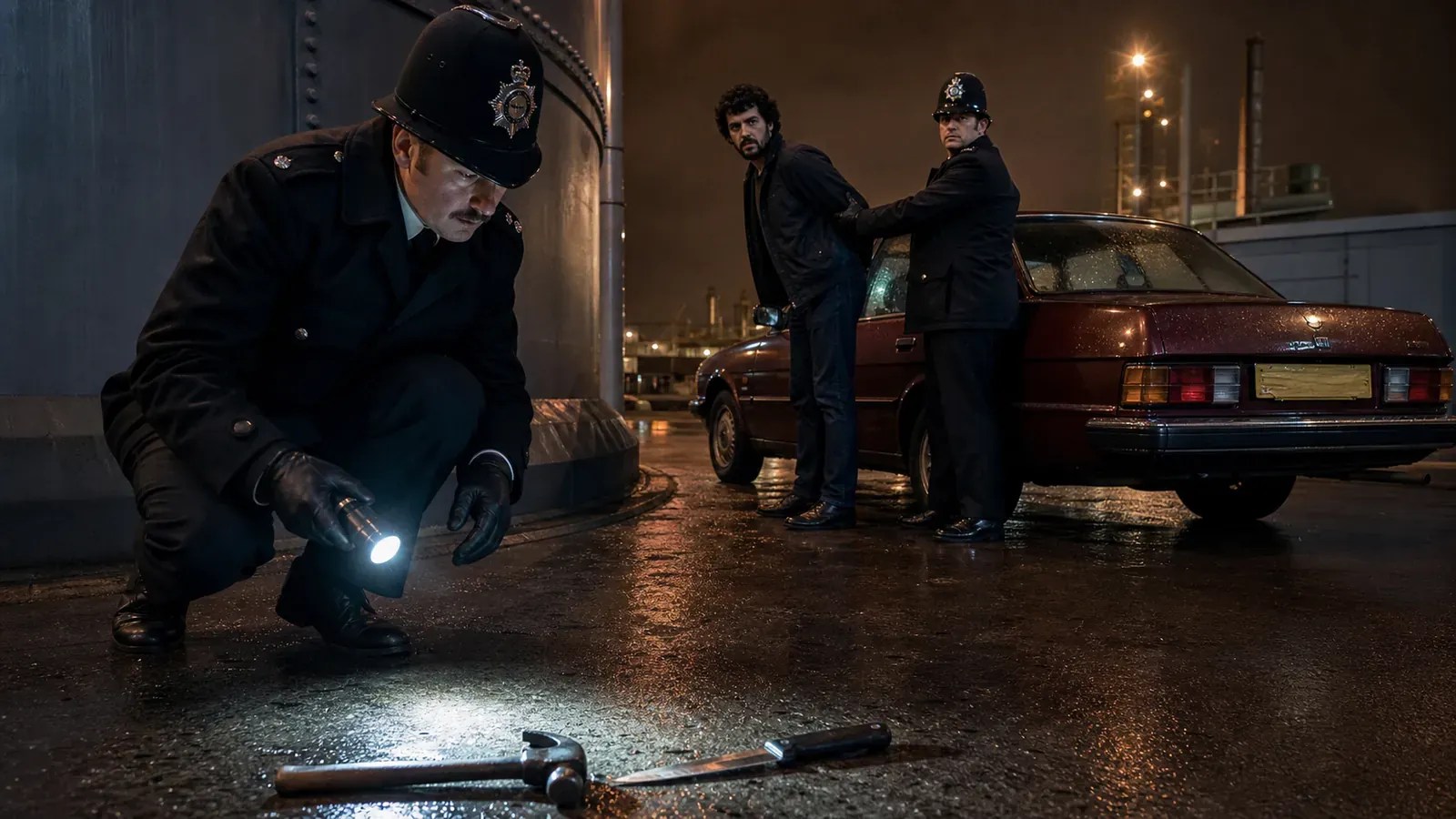
Peter Sutcliffe had already been questioned repeatedly during one of the largest murder investigations in British history.
He was finally caught because two patrol officers checked his license plates.
On January 2, 1981, Sergeant Robert Ring and probationary constable Robert Hydes were patrolling an area of Sheffield known for prostitution. They noticed Sutcliffe sitting in a brown Rover with 24-year-old Olivia Reivers and approached the vehicle.
Sutcliffe initially gave the officers a false name. When Hydes checked the Rover’s registration, he discovered that its plates belonged to a different car.
That was enough to arrest Sutcliffe.
Before officers placed him in the police car, Sutcliffe claimed that he urgently needed to urinate. They allowed him to walk behind a nearby oil-storage tank, where he secretly discarded a ball-peen hammer, a knife, and a length of rope.
At the police station, Sutcliffe hid another knife inside a toilet cistern.
His name was passed to detectives working on the murders. They discovered that Sutcliffe had been interviewed several times before and matched much of the physical description investigators had collected. He had remained free partly because police had become focused on a recording sent by a hoaxer with a northeastern English accent. Sutcliffe spoke with a Yorkshire accent, so investigators repeatedly looked elsewhere.
The following night, Sergeant Ring remembered the moment Sutcliffe had disappeared behind the oil tank. He returned to the arrest site and found the hammer, knife, and rope.
Faced with the recovered weapons and further questioning, Sutcliffe confessed. He was convicted in May 1981 of murdering 13 women and attempting to murder seven others.
Years of interviews, profiles, recordings, and paperwork had failed to stop him. The break finally came when two officers on routine patrol noticed that the plates on a Rover did not match the car.
#2 The Passenger in Randy Kraft’s Car

At about 1 a.m. on May 14, 1983, two California Highway Patrol officers noticed a Toyota Celica weaving along Interstate 5 near Mission Viejo.
Sergeant Michael Howard and Officer Michael Sterling pulled the car over expecting to deal with a drunk driver.
Randy Kraft was behind the wheel. He smelled of alcohol, struggled through a field sobriety test, and was placed under arrest for driving under the influence.
There was another man sitting in the front passenger seat.
Kraft described him as a hitchhiker and reportedly asked the officers how his friend was doing. The passenger appeared to be asleep or unconscious, with a jacket partially covering him.
Howard knocked on the window and tried to wake him. When he opened the car and checked more closely, he discovered that the man had no pulse and was not breathing.
The passenger was 25-year-old Marine Terry Lee Gambrel. He had been killed before the traffic stop.
What began as a suspected DUI immediately became a homicide investigation. A search of Kraft’s car uncovered prescription drugs, photographs of young men, personal belongings, and a handwritten list containing coded entries. Investigators came to believe that the list recorded victims and locations connected to years of unsolved killings.
Forensic evidence from the car and Kraft’s home eventually linked him to numerous cases involving young men whose bodies had been found near roads and freeways across Southern California.
In 1989, Kraft was convicted of 16 murders and sentenced to death. Authorities have suspected him in many more cases, including killings outside California, although he was never convicted of those additional crimes.
Howard and Sterling had no reason to believe they were approaching a serial killer when they activated their lights. They saw a car drifting across its lane and made a routine stop. Before it was over, they had ended a killing spree that had lasted more than a decade.
#1 The Chase That Exposed Joel Rifkin

At 3:15 a.m. on June 28, 1993, New York State Troopers Deborah Spaargaren and Sean Ruane noticed a tan Mazda pickup traveling on the Southern State Parkway without a rear license plate.
They attempted to pull it over.
The driver, Joel Rifkin, accelerated instead.
What followed was a chase through several Long Island roads, with Rifkin reportedly reaching speeds of roughly 90 miles per hour. Other police units joined before the pickup lost control while making a turn and crashed into a utility pole.
Rifkin survived the collision and was taken into custody. The damaged truck needed to be impounded, so troopers began examining its contents.
Inside the covered bed, they found the body of 22-year-old Tiffany Bresciani.
Rifkin had killed her in Manhattan several days earlier and was apparently trying to decide where to leave her body. Instead, he drove onto a major highway in a truck missing one of the first things a patrol officer would notice.
The discovery immediately expanded beyond Bresciani’s murder.
During questioning, Rifkin began describing other killings. He eventually confessed to murdering 17 women between 1989 and 1993, most of whom had been sex workers in New York City and Long Island. He provided information that helped investigators connect him to previously unsolved cases and locate additional remains.
Searches of his home and property uncovered identification cards, jewelry, clothing, and other belongings connected to victims. Investigators across several jurisdictions then faced the difficult task of matching Rifkin’s statements to women who had disappeared or whose remains had never been identified.
He was ultimately convicted of nine murders and received consecutive sentences totaling more than 200 years in prison.
Rifkin takes the number one spot because the original violation was almost unbelievably minor compared with what it exposed. Two troopers noticed a missing rear plate. Within hours, they had uncovered one murder. Before the investigation was finished, they were dealing with one of the largest serial-murder cases in New York history.
Sources & Image Credit
Sources
Ted Bundy’s Campaign of Terror — FBI
Reference Re Ng Extradition — Supreme Court of Canada
Barker Ranch and the Manson Family — National Park Service
Timothy McVeigh’s Arrest — FBI
Peter Sutcliffe’s Arrest — Byford Report
People v. Kraft — California Supreme Court
Joel Rifkin Arrest — New York State Police
Image Credits
Ted Bundy FBI photograph — Wikimedia Commons

Charles Ng FBI photograph — Wikimedia Commons

Clem Grogan Barker Ranch photograph — Wikimedia Commons

Charles Manson prison photograph — Wikimedia Commons

Timothy McVeigh FBI photograph — Wikimedia Commons

Randy Kraft’s Toyota interior — Wikimedia Commons

Main scenes are AI assisted historical reenactments. Archival photographs are identified above and were integrated as supporting insets.
Leave a Reply