

History has a bad habit of not letting famous people rest.
Death is supposed to be the quiet part.
Not always.
Sometimes famous people die, get buried, and then history immediately starts acting like that was only the beginning. Bodies are stolen, hidden, moved, misidentified, guarded, or turned into political symbols.
Here are five famous bodies that went missing after death.
#5 Oliver Cromwell’s Head

Oliver Cromwell managed to have a rough political career, die, get buried, and then somehow still get punished later. That is commitment from your enemies.
To understand why, you have to remember that Cromwell was not just disliked. To Royalists, Catholics, and plenty of people in Ireland, he represented a whole historical nightmare with a face attached.
He helped lead Parliament’s side during the English Civil Wars, fought against King Charles I, and became tied forever to the king’s execution in 1649. After that, England briefly stopped being a monarchy, and Cromwell eventually ruled as Lord Protector. If you were loyal to the crown, Cromwell was not just a political opponent. He was one of the men who helped break the old world.
Then there was Ireland. Cromwell’s 1649 campaign became infamous, especially because of the killings at Drogheda and Wexford. His name became linked to massacre, conquest, anti-Catholic repression, and land confiscation. For many Irish Catholics, Cromwell was not just another English ruler. He became a symbol of brutality that lasted for generations.
So when Cromwell died in 1658 and was buried in Westminster Abbey, his enemies were not exactly ready to let the man rest.
After the monarchy was restored, Charles II and the Royalists wanted revenge against the men connected to his father’s execution. In January 1661, Cromwell’s body was dug up, taken to Tyburn, hanged, and beheaded.
Again, he had already been dead for more than two years. This was not justice in the normal sense. This was revenge theater with official paperwork.
His head was put on a pole above Westminster Hall, where it stayed for years before eventually disappearing into private hands. From there, it became one of history’s strangest collectibles, passed around and examined before finally being buried at Sidney Sussex College, Cambridge, in 1960.
So yes, Cromwell’s head was displayed, lost, collected, studied, and finally buried again.
His enemies could not change what he had done in life, but they made very sure his death was not simple either.
#4 Charlie Chaplin
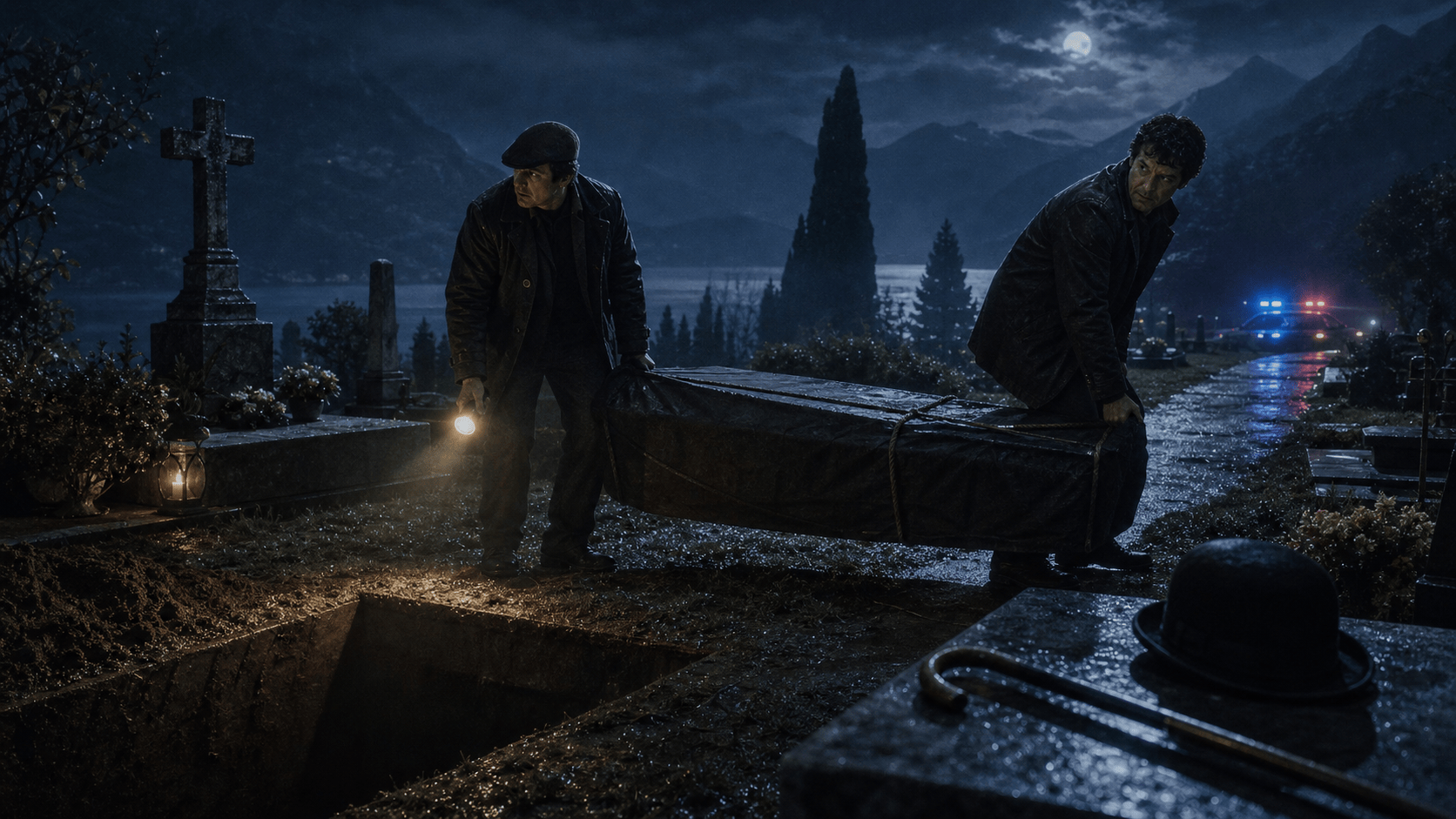
Charlie Chaplin spent his life turning silence into comedy, which makes it extra strange that one of the loudest scandals around him happened after he was already gone.
Chaplin died on Christmas Day in 1977 at the age of 88. He was buried in the cemetery at Corsier-sur-Vevey, Switzerland, near the home where he had spent his later years.
Then, in March 1978, someone stole his body.
Two men dug up Chaplin’s coffin and hid it in a field near Lake Geneva. The plan was not political or symbolic. It was ransom. They demanded money from Chaplin’s widow, Oona, hoping the family would pay to get him back.
Oona Chaplin refused.
That detail makes the story feel a little less like a crime movie and a little more like a woman who had absolutely no patience for idiots with shovels.
Police eventually tracked the ransom calls, arrested the men, and found Chaplin’s coffin buried in a cornfield. After that, his body was returned to the same cemetery, but this time the grave was reinforced with concrete.
So Chaplin was not missing forever. But for a few months, one of the most famous entertainers in the world became the center of a wild kidnapping plot.
After that, the concrete around his grave made a lot more sense.
#3 Eva Perón

Eva Perón did not just become famous in Argentina. She became a symbol, which is much harder to bury.
Before she was Evita, she was a poor girl who became an actress, married Juan Perón, and turned herself into one of the most powerful public figures in the country. To millions of working-class Argentines, she was not just the president’s wife. She was the woman who spoke to them, fought for labor rights, supported women’s suffrage, and handed out aid through her foundation.
That is why people loved her so intensely.
It is also why her enemies feared her.
When Evita died of cancer in 1952 at only 33, her body was embalmed and put on display while a monument was planned. Crowds mourned her like a saint, and her image became tied to Peronism, class struggle, and loyalty.
After Juan Perón was overthrown in 1955, Argentina’s new anti-Peronist military government had a problem. Evita’s body was not just a body anymore. As long as people knew where she was, they had somewhere to gather, mourn, and remember what she represented.
So they made her disappear.
For years, her embalmed body was moved from hiding place to hiding place. Eventually, it was secretly sent to Italy and buried in Milan under a false name: María Maggi de Magistris.
That means one of Argentina’s most famous women spent years in a foreign cemetery pretending, on paper, to be someone else.
Her body was finally returned to Juan Perón in Spain in 1971, then later brought back to Argentina. But by then, Evita’s remains had become part of the political war around her memory.
In life, people fought over what she represented.
After death, they fought over where she was allowed to exist.
#2 John Wilkes Booth
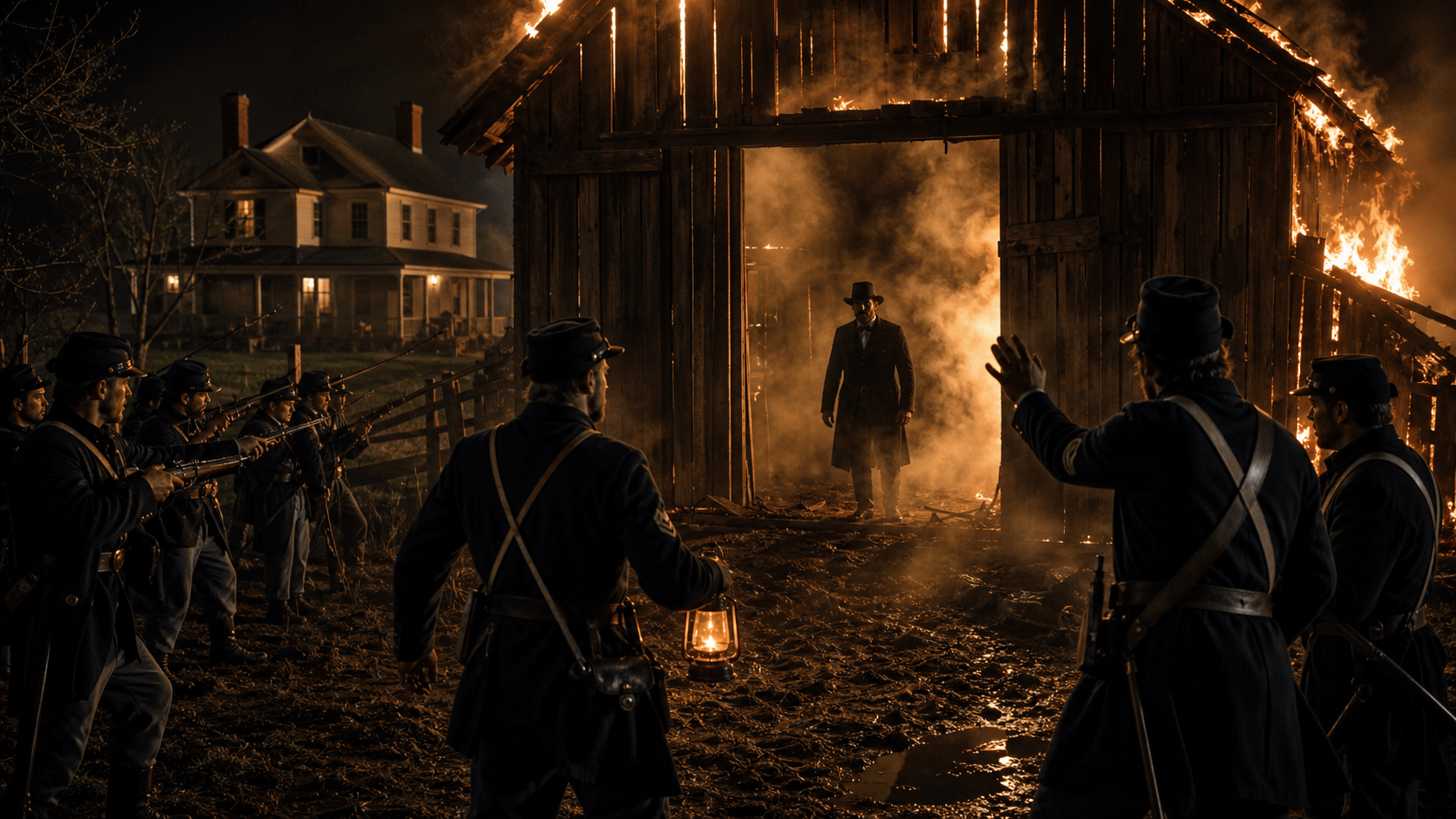
Wilkes Booth is supposed to have one of the clearest endings in American history. He assassinated Abraham Lincoln, ran, was tracked down, and died in a Virginia barn.
Except the story kept refusing to stay buried.
After Booth shot Lincoln at Ford’s Theatre on April 14, 1865, he fled Washington with co-conspirator David Herold. For nearly two weeks, federal troops hunted them through Maryland and Virginia. On April 26, they found the pair hiding at Garrett’s farm near Port Royal, Virginia.
Herold surrendered. Booth did not.
The barn was set on fire, and Booth was shot by Union soldier Boston Corbett. He died a few hours later. His body was taken back to Washington, examined aboard the USS Montauk, and officially identified as John Wilkes Booth.
That should have ended it.
But the government handled his remains quietly, partly to keep his grave from becoming a shrine for Lincoln’s enemies. That secrecy gave rumors room to breathe. Some people claimed the wrong man had been killed. Others believed Booth escaped, lived under fake names, and died decades later.
One of the strangest versions involved a man named David E. George, who died in Oklahoma in 1903. A rumor spread that George was actually Booth, and his mummified body was later displayed as a carnival attraction.
That is where this story gets its spot on the list. Booth’s body was not exactly “missing” in the same way as some others, but the secrecy, identification arguments, escape theories, and traveling mummy rumor turned his death into a posthumous mess.
Officially, Booth died in 1865.
Unofficially, people spent more than a century trying to give him a second ending.
#1 Abraham Lincoln’s Body

Abraham Lincoln’s body was never missing for long, but the fact that anyone tried to steal it at all is enough to put this at number one.
Lincoln was assassinated in 1865, mourned across the country, and buried in Springfield, Illinois. His tomb became a national symbol almost immediately. For most people, that would be enough reason to leave it alone.
A group of Chicago counterfeiters disagreed.
In 1876, their skilled engraver, Benjamin Boyd, was sitting in prison. Without him, their counterfeit money operation was in trouble. So crime boss “Big Jim” Kinealy came up with a plan that sounds less like a criminal strategy and more like someone lost a bet in a saloon: steal Abraham Lincoln’s body, hide it in the Indiana dunes, and demand Boyd’s release plus $200,000 in ransom.
The plan was timed for Election Night, when the thieves hoped everyone would be distracted.
They broke into Lincoln’s tomb at Oak Ridge Cemetery, opened the sarcophagus, and started pulling out the cedar coffin. What they did not know was that one of the men involved, Lewis Swegles, was actually an informant working with the Secret Service.
The sting almost worked perfectly, except the arrest turned messy in a very human way. In the darkness, one of the agents’ pistols accidentally fired, everyone panicked, and the grave robbers escaped. They were arrested later in Chicago.
After that, Lincoln’s body became a security problem. His remains were moved, hidden, guarded by a secret group, and eventually sealed beneath concrete to make sure nobody tried anything like that again.
That is why this gets the top spot.
Most stolen-body stories are strange because the person was famous.
Lincoln’s is stranger because the target was not just a body. It was one of the most sacred symbols in American memory, and somehow a counterfeiting gang looked at that and saw leverage.
Leave a Reply