

Fish falling from the sky is somehow not the strangest thing on this list.
Most things that fall from the sky are predictable. Rain. Snow. The occasional tree branch having a very bad afternoon.
Then there are the fish, spiders, golf balls, chunks of meat and pieces of spacecraft. Some were carried by storms. Others came from much farther away.
Here are six bizarre things that actually fell from the sky.
#6 When Golf Balls Rained on Florida

On September 1, 1969, residents of Punta Gorda, Florida, experienced a rainstorm that left more than puddles behind. When they stepped outside, they found golf balls scattered across streets, lawns, sidewalks, gutters and parts of Punta Gorda Isles.
Not one or two, either. A newspaper report described “dozens and dozens and dozens” of them.
Nobody produced a confirmed explanation, but the leading theory involves a waterspout passing over a nearby golf course or water hazard. If it picked up balls sitting in shallow water, it could have carried them inland before dropping them over town. Florida had apparently found a way to combine severe weather with its favorite recreational activity.
The waterspout theory makes sense, but it was never conclusively proven. Residents were left with streets full of golf balls and one question that probably did not need an immediate answer: who was going to collect all of them?
#5 Fish Fell Over Texarkana
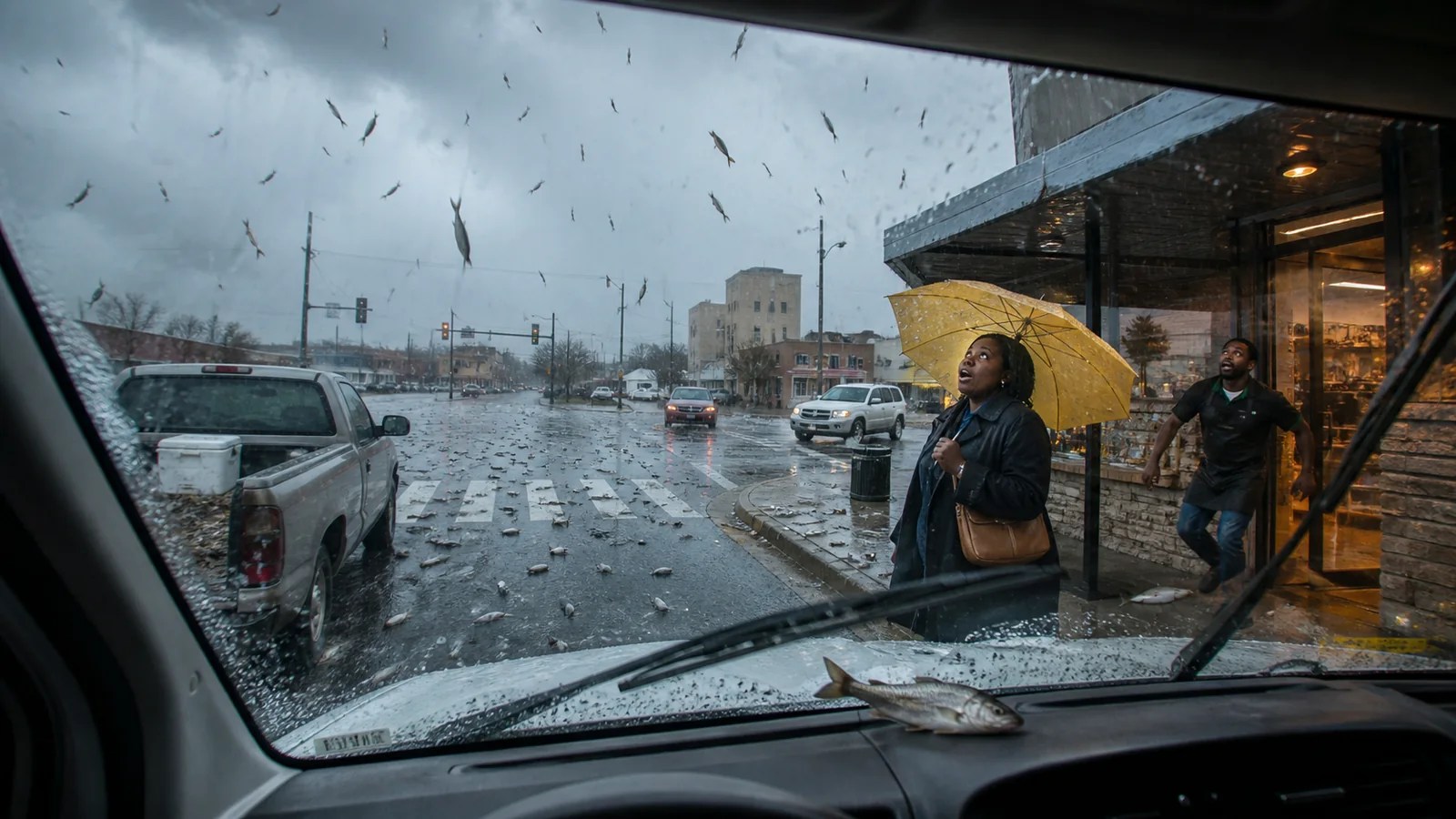
On December 29, 2021, a thunderstorm swept through Texarkana and dropped something that was definitely not included in the forecast: fish.
Residents reported small fish landing on sidewalks, parking lots, rooftops and vehicles across a roughly four-mile stretch of the city. Some people saw only a few. Others watched dozens hit the ground at once. The city eventually confirmed that everyone was seeing the same deeply strange thing.
The first explanation was “animal rain,” a phenomenon in which waterspouts or strong updrafts lift small creatures into the air and deposit them somewhere else. It sounded reasonable, especially during a storm.
There was one problem. Meteorologists found no evidence of a nearby waterspout or sufficiently powerful updraft. Two researchers later suggested the fish may have been regurgitated by a large flock of birds startled by the storm. The fish were reportedly similar in size and species, and some were partially digested, which gave that theory an unpleasant amount of credibility.
The exact cause remains disputed. Either way, Texarkana experienced a rainstorm that required residents to check both the weather radar and the condition of whatever had just landed beside their cars.
#4 The Kentucky Meat Shower

On March 3, 1876, a farmer’s wife named Mrs. Allen Crouch was making soap outside her home in Bath County, Kentucky, when pieces of meat began falling around her.
The shower reportedly lasted several minutes and covered a patch of land roughly 100 yards long. The pieces ranged from small flakes to chunks several inches wide. According to contemporary newspaper reports, two men even tasted some and decided it resembled mutton or venison. Nobody had asked them to do that.
Samples were sent away for examination, but the results only made the story stranger. Different experts identified the material as lung tissue, cartilage and muscle, with proposed sources ranging from horses to human infants. Victorian science had apparently narrowed it down to almost anything with a pulse.
The most accepted explanation came from naturalist L. D. Kastenbine. He suggested that a flock of vultures had regurgitated partially digested meat while flying overhead. Vultures sometimes empty their stomachs when startled or when they need to become light enough to escape quickly.
That explanation is credible, although nobody witnessed the birds responsible. A preserved sample still exists, leaving the Kentucky Meat Shower in an unusual position: the event was real, the meat was examined, and the least ridiculous explanation is still vomiting vultures.
#3 Australia’s Spider Rain

In May 2015, residents around Goulburn, Australia, looked outside and found strands of silk drifting through the air. Tiny spiders appeared to be falling from the sky, while fences, fields and homes became coated in a thin white layer of webbing.
It was not technically raining spiders. That distinction probably offered limited comfort to anyone brushing them out of their hair.
The event was caused by ballooning, a real method spiders use to travel. A spider climbs to an exposed point, releases strands of silk and lets the wind carry it away. Young spiders do this frequently, but when enormous numbers launch around the same time, the result can look like snowfall with considerably more legs.
Weather can help trigger these mass movements. Heavy rain and flooding drive spiders from the ground, while favorable winds allow them to relocate. Similar events have covered parts of Wagga Wagga, Victoria and Tasmania in sheets of silk.
Most of the spiders involved are tiny and harmless. Still, watching millions of them descend while the landscape slowly disappears beneath their webs is the kind of experience that makes “harmless” feel like a technicality.
#2 The Woman Hit by Space Debris

Early on January 22, 1997, Lottie Williams was walking through a park in Tulsa, Oklahoma, when a bright streak crossed the sky. She assumed it was a shooting star and kept walking.
About thirty minutes later, something lightly struck her shoulder.
Williams initially thought someone had thrown an object at her, but nobody was close enough. On the ground lay a blackened, woven fragment roughly six inches long. It weighed so little that she was not injured, which was fortunate considering it had just completed the least organized delivery in human history.
That same morning, a Delta II rocket stage was breaking apart as it reentered the atmosphere over the central United States. Larger pieces were recovered elsewhere, including a propellant tank that landed on a Texas farm. Experts found that Williams’s fragment was consistent with material used on the rocket, and the timing and location matched its path.
The fragment was never identified with absolute certainty, but the evidence was convincing enough that Williams is widely recognized as the first person known to have been struck by human-made space debris. She survived without a scratch and kept the object, because after something travels from orbit to hit you personally, throwing it away would feel almost rude.
#1 The Meteorite That Hit Ann Hodges
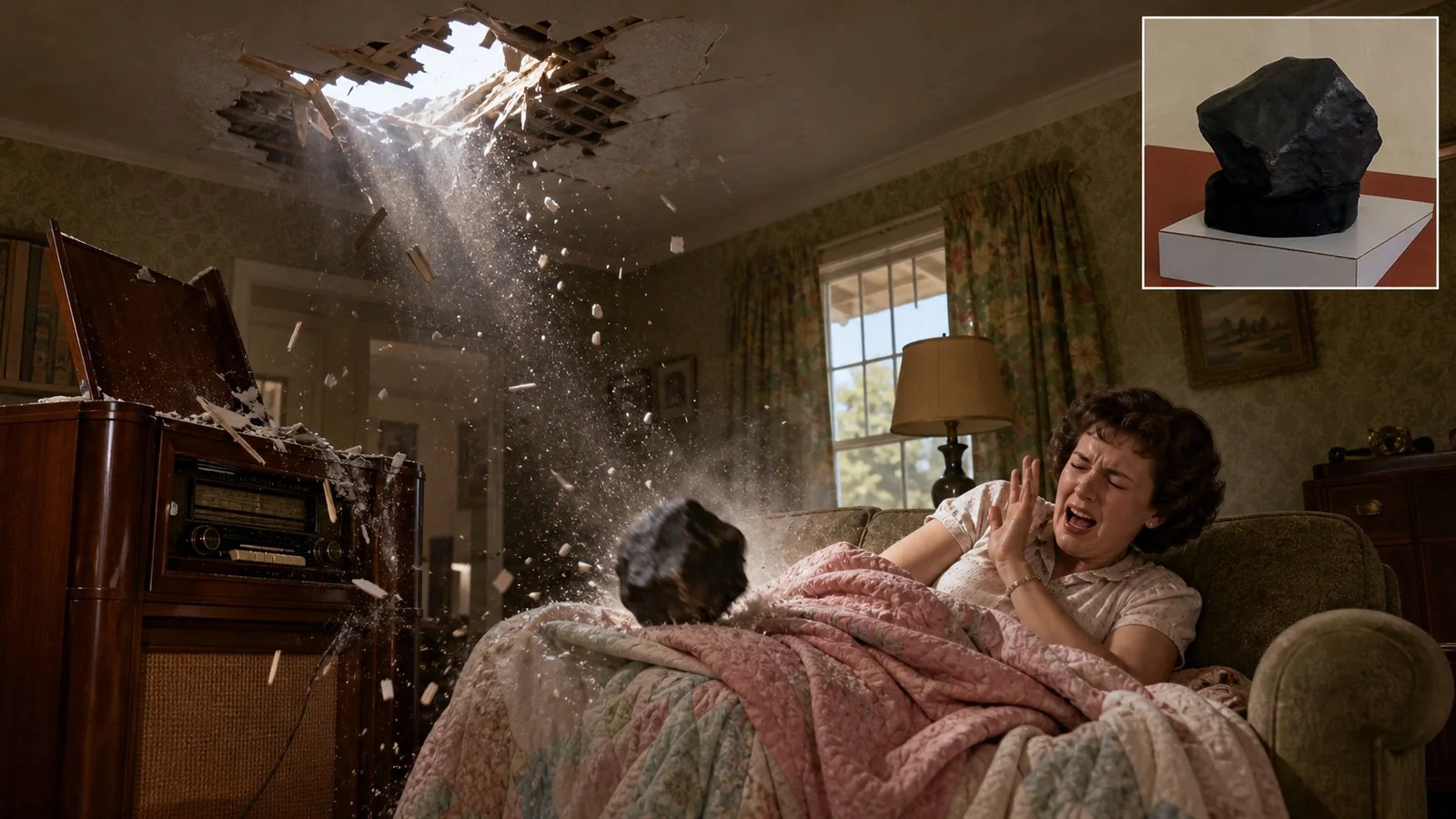
On November 30, 1954, Ann Hodges was resting on her couch in Oak Grove, Alabama, when an object from space chose her living room as its landing site.
An approximately nine-pound meteorite tore through the roof, struck a large wooden radio and ricocheted into Hodges’s side. It left an enormous bruise across her hip and abdomen but caused no life-threatening injuries. She had just survived the only widely verified case of a person being directly struck by a meteorite.
The commotion began before she had much time to process that. Reporters crowded around the house, curious visitors arrived and the meteorite was taken by authorities for examination. Then Hodges’s landlord, Birdie Guy, claimed the rock belonged to her because she owned the house it had entered without permission.
Hodges and her husband eventually paid Guy $500 to settle the dispute, believing they could sell the meteorite for considerably more. By then, however, much of the public attention had faded and no worthwhile buyer appeared. In 1956, Hodges donated it to the Alabama Museum of Natural History, where it remains on display.
Ann Hodges survived a direct hit from space, endured a legal dispute over the object that hit her and never received the fortune people assumed would follow. The meteorite became famous. Hodges was left with a damaged home, a painful bruise and a story nobody else in recorded history could honestly claim.
Sources & Image Credits
Research sources
• Transylvania University: Kentucky Meat Shower
• Florida Climate Center: The 1969 Punta Gorda Golf-Ball Shower
• KSLA: Fish Fall From the Sky in Texarkana
• American Entomologist: Australia’s Spider Rain
• Smithsonian Air & Space: Lottie Williams and the Delta II Debris
• Smithsonian: The Meteorite That Struck Ann Hodges
Image credits
• Delta II propellant-tank inset: NASA Orbital Debris Program Office, public domain.
• Spider-silk inset: Stephen Michael Barnett, Wikimedia Commons, CC BY 2.0; cropped for presentation.

• Ballooning-spider reference: Andy Reago and Chrissy McClarren, Wikimedia Commons, CC BY 2.0.

Article illustrations are AI-assisted visual reconstructions. Archival material is identified above and may have been cropped or resized for presentation.
Leave a Reply