

These people did not change the channel. They took it over.
Television is supposed to be predictable. You choose a channel, sit down and trust that the station knows what it is broadcasting.
These six interruptions broke that agreement. Viewers suddenly saw masked figures, political messages, fake emergencies and one very convincing nuclear explosion.
Here are six broadcast hijackings that took over the airwaves.
#6 TV Solidarity

In 1985, television in communist Poland was tightly controlled by the state. That made it a useful place for the government to deliver news, shape public opinion and avoid giving the opposition any screen time whatsoever.
A group of astronomers in Toruń decided to make their own opening.
Using a ZX Spectrum home computer, a homemade transmitter and equipment assembled in secret, they found a way to place their own messages over official television broadcasts without completely replacing the picture underneath.
On September 14, viewers watching state television suddenly saw a message supporting the banned Solidarity movement appear across the screen. It called for an end to rising prices, lies and repression. Another message urged people to boycott the upcoming election.
The group repeated the stunt on September 26 during an episode of the popular detective series 07 zgłoś się. Somewhere inside the government television system, the usual programming was continuing while opposition slogans sat directly on top of it.
The setup had been built by scientists, which helped. Anyone trying this with ordinary household equipment would probably have succeeded only in ruining their own television.
Authorities eventually traced the broadcasts to the group. The men were arrested and charged with possessing an illegal transmitter and spreading material that could cause public unrest. They received fines and probation rather than long prison sentences.
The intrusion lasted only a few minutes, but it allowed an opposition movement to appear on state television using a home computer and a transmitter the government never expected anyone to build.
#5 Captain Midnight

Just after midnight on April 27, 1986, HBO viewers watching The Falcon and the Snowman suddenly lost the movie.
The screen switched to color bars and a message:
“Good evening HBO from Captain Midnight. $12.95 a month? No way!”
There was also a warning aimed at Showtime and The Movie Channel, in case anyone else was considering a price increase.
Captain Midnight was actually John MacDougall, a 25-year-old satellite dish dealer and electrical engineer from Florida. He was angry that HBO had begun scrambling its satellite signal and charging dish owners a monthly fee to decode it.
MacDougall happened to be working alone at a satellite uplink facility that night. He aimed the dish at the same satellite HBO was using and transmitted his message with enough power to overpower the network’s signal.
For roughly four and a half minutes, one man with access to the right equipment replaced HBO across much of the eastern United States. It was an impressively large audience for a complaint about the cable bill.
The FCC launched an investigation and narrowed the possible source to a small number of uplink facilities. Investigators eventually received a tip after MacDougall reportedly talked about the stunt, and he admitted that he was Captain Midnight.
He received a $5,000 fine, one year of probation and a temporary suspension of his amateur radio license. The incident also pushed authorities to tighten satellite security and make this kind of hijacking easier to trace.
MacDougall did not remain mysterious for long, but he proved how vulnerable satellite television could be. For a few minutes, HBO belonged to the customer most determined not to pay for it.
#4 The Czech Nuclear Explosion

On the morning of June 17, 2007, viewers of Czech Television’s Panorama program were watching the usual live images of the Krkonoše Mountains.
The show was not exactly built for suspense. It displayed peaceful camera feeds from scenic locations so viewers could check the weather and decide whether the mountains looked worth visiting.
Then one of the cameras showed a bright flash.
A mushroom cloud rose over the landscape. For a few moments, it appeared that a nuclear weapon had exploded in the Czech countryside during a relaxed Sunday morning weather broadcast.
It had not.
The footage had been inserted by Ztohoven, a Czech art collective known for public stunts. Members of the group interfered with one of the program’s remote camera feeds and replaced the live image with a prerecorded nuclear explosion.
The effect was convincing because almost everything remained normal. The countryside was still. The camera angle looked familiar. Then the horizon produced the sort of weather development no presenter is prepared to explain.
Ztohoven said the stunt was intended to show how easily television images could be manipulated and how quickly viewers accepted what appeared on screen. Police investigated, and several members of the collective were charged with spreading false information.
A Czech court later acquitted them, ruling that the broadcast had not caused the level of public panic required for a conviction.
Nobody believed the explosion for very long, but the group made its point. A trusted live camera stopped showing reality, and viewers had no way to know until someone told them.
#3 The Zombie Emergency Alert

On February 11, 2013, viewers in Great Falls, Montana, were watching an afternoon talk show when the familiar warning tones of the Emergency Alert System interrupted the program.
Then a calm voice announced that “the bodies of the dead are rising from their graves and attacking the living.”
The message warned viewers not to approach or capture the bodies because they were considered extremely dangerous. It sounded official, used the correct alert system and appeared in the same format normally reserved for severe weather and other real emergencies.
For anyone who had somehow missed several decades of zombie movies, it was a difficult afternoon to begin catching up.
The warning was fake. Hackers had gained access to the station’s Emergency Alert System equipment and inserted the recording. Similar alerts also appeared on stations in Michigan, Wisconsin and New Mexico.
Some viewers immediately recognized it as a prank. Others called police to make sure there was not, in fact, a developing problem involving the recently deceased.
Investigators found that vulnerable alert equipment and weak security had made the intrusion possible. Afterward, the FCC and FEMA urged broadcasters to change their passwords and review the security of their emergency systems.
The people responsible were never publicly identified.
The message was ridiculous, but the security failure was not. Someone had taken control of a system designed to deliver urgent instructions and used its trusted voice to announce a zombie outbreak. Had the warning described a more believable emergency, the reaction could have been very different.
#2 The Vrillon Message
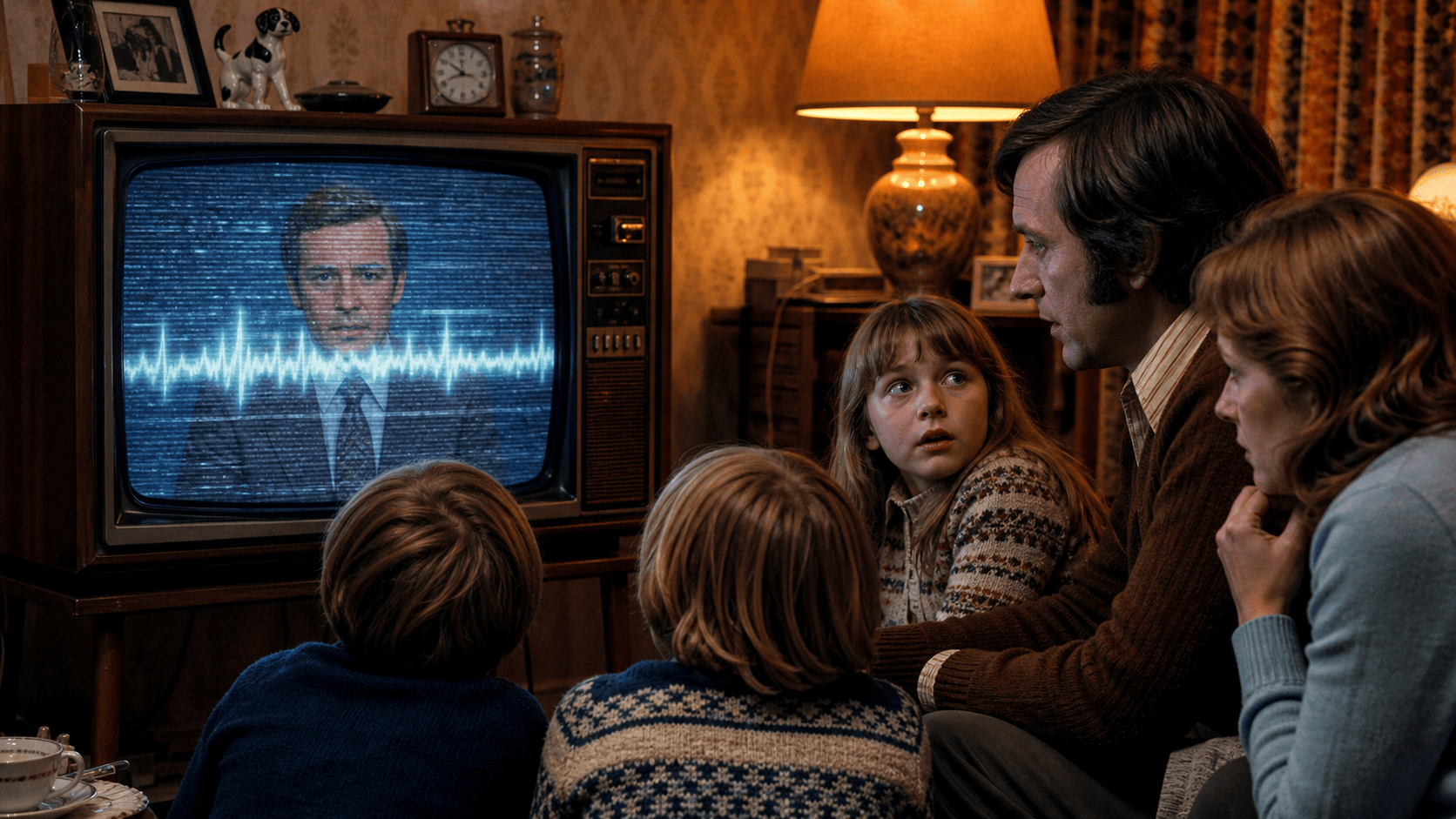
At around 5:10 p.m. on November 26, 1977, viewers watching Southern Television in parts of southern England heard the news audio begin to distort.
The picture remained on screen, but the voice of newsreader Andrew Gardner faded beneath a deep electronic sound. Then another voice took over.
It identified itself as “Vrillon,” a representative of something called the Ashtar Galactic Command.
For nearly six minutes, the speaker delivered a warning to humanity. It urged people to abandon weapons, reject false leaders and prepare for a new era of peace. The message was long, strangely calm and delivered with enough distortion to make the speaker sound less like someone standing near a transmitter.
When it ended, the regular audio returned. The television program continued as though an alien command had not just borrowed the evening news.
Southern Television apologized for the interruption, and engineers began investigating. Authorities concluded that someone had probably transmitted a stronger signal near the Hannington television transmitter, overriding the station’s audio without replacing the picture.
Doing that required technical knowledge and the right location. It also required carrying broadcasting equipment into the countryside to deliver several minutes of interplanetary advice.
Nobody was ever identified. No group took responsibility, and no convincing recording of the culprit preparing the message has surfaced.
The Vrillon interruption remains memorable because it occupied an uncomfortable space between absurd and convincing. The message was almost certainly a human hoax, but for six minutes, thousands of viewers heard a voice on trusted television calmly claim otherwise.
#1 The Max Headroom Intrusion

On the night of November 22, 1987, Chicago television station WGN was airing its evening news when the picture suddenly disappeared.
In its place was a person wearing a rubber mask of Max Headroom, the glitchy computer-generated television character popular during the 1980s. The figure rocked from side to side in front of a spinning metal background while a loud buzzing sound filled the broadcast.
There was no clear message. Just the mask, the movement and the immediate sense that nobody at the station had approved any of it.
WGN engineers regained control after roughly 25 seconds by changing the frequency of the signal linking the studio to its transmitter. The interruption was strange, but brief.
Then the intruder came back.
Around two hours later, the same masked figure interrupted Chicago PBS station WTTW during an episode of Doctor Who. This time, the hijacking lasted about 90 seconds and included audio.
The person delivered a rambling collection of jokes, insults and references to local television. At one point, the figure displayed a can of Pepsi while mocking a Coca-Cola slogan. The video ended with someone off camera striking the masked person’s exposed backside with a flyswatter.
It was less a coherent statement than the kind of performance someone might create after being given expensive broadcasting equipment and absolutely no editorial supervision.
Unlike WGN, WTTW could not stop the intrusion because no engineers were present at the transmitter site that night. Viewers had to watch until the hijacker ended the signal.
The FCC and FBI investigated, but nobody was arrested. Pulling off the stunt likely required technical knowledge, a powerful microwave transmitter and familiarity with the stations’ broadcast links. That narrowed the field, but not enough.
Decades later, the people behind the mask remain unidentified.
The Max Headroom incident takes the number one spot because the hijackers successfully interrupted two different stations on the same night, returned after the first attempt was stopped and left behind one of the strangest recordings in television history. We know exactly what viewers saw. We still do not know who wanted them to see it.
Leave a Reply