

Some messages are found in mailboxes. These were found in streets, pockets, frozen wastelands, and places where the story was already bad enough.
A creepy message does not always need blood on the wall or a dramatic villain monologue. Sometimes it is worse when the message is small.
A few strange words pressed into a city street. A note sealed in a bottle after a shipwreck. A second message added to an expedition record after everything had started falling apart. A coded paper found in a dead man’s pocket. A tiny phrase hidden on a mystery corpse like the universe was trying to be annoying on purpose.
That is what makes these stories stick.
The messages were not sitting neatly on a desk waiting to be read. They turned up in weird places, attached to even weirder circumstances, and usually answered one question by creating five more.
Here are five creepy messages found where nobody expected them.
#5 Toynbee Tiles

Most creepy messages at least have the decency to be hidden in a letter, a drawer, or some dusty attic box.
The Toynbee Tiles were embedded in the street.
Starting around the 1980s, people began noticing strange handmade tiles pressed into asphalt in cities like Philadelphia, New York, Boston, Chicago, and even places in South America. They were usually about the size of a license plate, sitting right there in the road where cars had been driving over them like the world’s weirdest speed bump.
The message changed a little from tile to tile, but the basic idea was usually the same:
“Toynbee idea. In movie 2001. Resurrect dead. On planet Jupiter.”
That is not a normal thing to read while crossing the street.
Nobody fully agrees on what the message means. “Toynbee” may refer to historian Arnold J. Toynbee. “2001” seems to point toward Stanley Kubrick’s 2001: A Space Odyssey. The dead being resurrected on Jupiter is where the whole thing stops sounding like a theory and starts sounding like someone had a corkboard, string, and no plans for the weekend.
The strangest part is how the tiles got there. They were not painted on walls or taped to poles. They were worked into busy streets, slowly becoming part of the road itself. Most people probably walked over them for years without noticing. Others noticed immediately and then had to continue their day like they had not just read a street message about Jupiter-based resurrection.
That is what makes the Toynbee Tiles such a perfect opener for this list. They are not the darkest messages here, but they may be the most casually bizarre.
A creepy note in a pocket is one thing.
A creepy note built into the pavement under your shoes feels like the city briefly whispering something it was not supposed to say.
#4 Alice Bettridge’s Message In A Bottle

A message in a bottle usually sounds like something from a children’s book or a beach wedding decoration that got too confident.
This one was not that.
In December 1927, the SS Kamloops disappeared on Lake Superior during a brutal winter storm. The ship had been carrying cargo near Isle Royale, but somewhere in the freezing chaos, it vanished with everyone aboard.
For months, nobody knew exactly what had happened.
Then, in 1928, a trapper near the Agawa River reportedly found a bottle with a note inside. The message was believed to be from Alice Bettridge, a young assistant stewardess on the Kamloops.
The note said she was the last one left alive, freezing and starving on Isle Royale, and that she wanted her parents to know what happened to her.
That is the kind of sentence that does not need dramatic music. It already brought its own.
What makes it so haunting is the delay. If the note was real, then it was not just a message from a shipwreck. It was a final attempt to reach somebody, anybody, after the disaster had already moved past the part where help was likely.
A lot of creepy messages are scary because they are mysterious. This one is scary because it is painfully clear.
Someone survived long enough to write down the ending.
Then the lake delivered it too late.
#3 The Franklin Expedition’s Victory Point Note
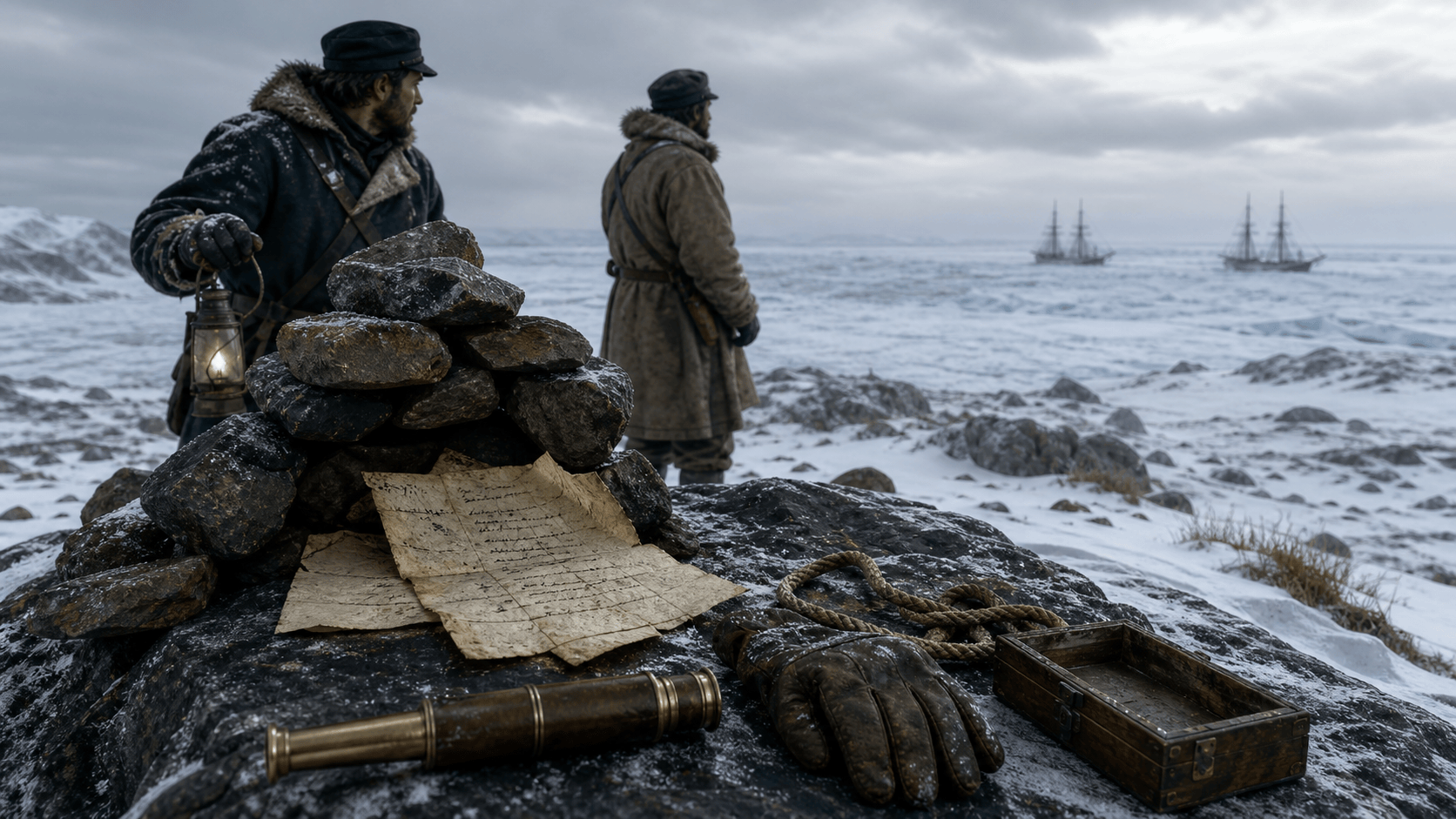
The Franklin Expedition already had the setup of a nightmare.
In 1845, two British ships, HMS Erebus and HMS Terror, sailed into the Arctic looking for the Northwest Passage. The crews were experienced. The ships were reinforced. The expedition had supplies, confidence, and the very British belief that enough planning could make ice behave.
It could not.
The ships vanished.
For years, search parties went looking for them. They found scattered clues, abandoned objects, graves, stories from Inuit witnesses, and eventually one of the most chilling written messages in exploration history.
It became known as the Victory Point Note.
At first, the note was almost boring in the way official expedition records can be boring. It said the ships had wintered in the ice and that everything was fine. Basically: “All well,” which, in hindsight, is doing a heroic amount of work.
Then someone added a second message later.
That update changed everything.
The ships had been trapped. Franklin was dead. More than twenty men were dead. The survivors had abandoned the vessels and were heading south on foot across a frozen landscape that did not care how many medals anyone had.
That is what makes the note so creepy. It is not one message. It is two moments trapped on the same piece of paper.
The first says, “We are fine.”
The second says, “No, we are absolutely not.”
There is something awful about seeing disaster arrive in handwriting. No dramatic explosion. No final speech. Just an official note that starts as routine paperwork and ends as proof that the entire expedition had crossed into survival mode.
By the time searchers found it, the men who wrote it were long gone.
The Arctic had kept the message. It just did not give it back in time.
#2 Ricky McCormick’s Encrypted Notes
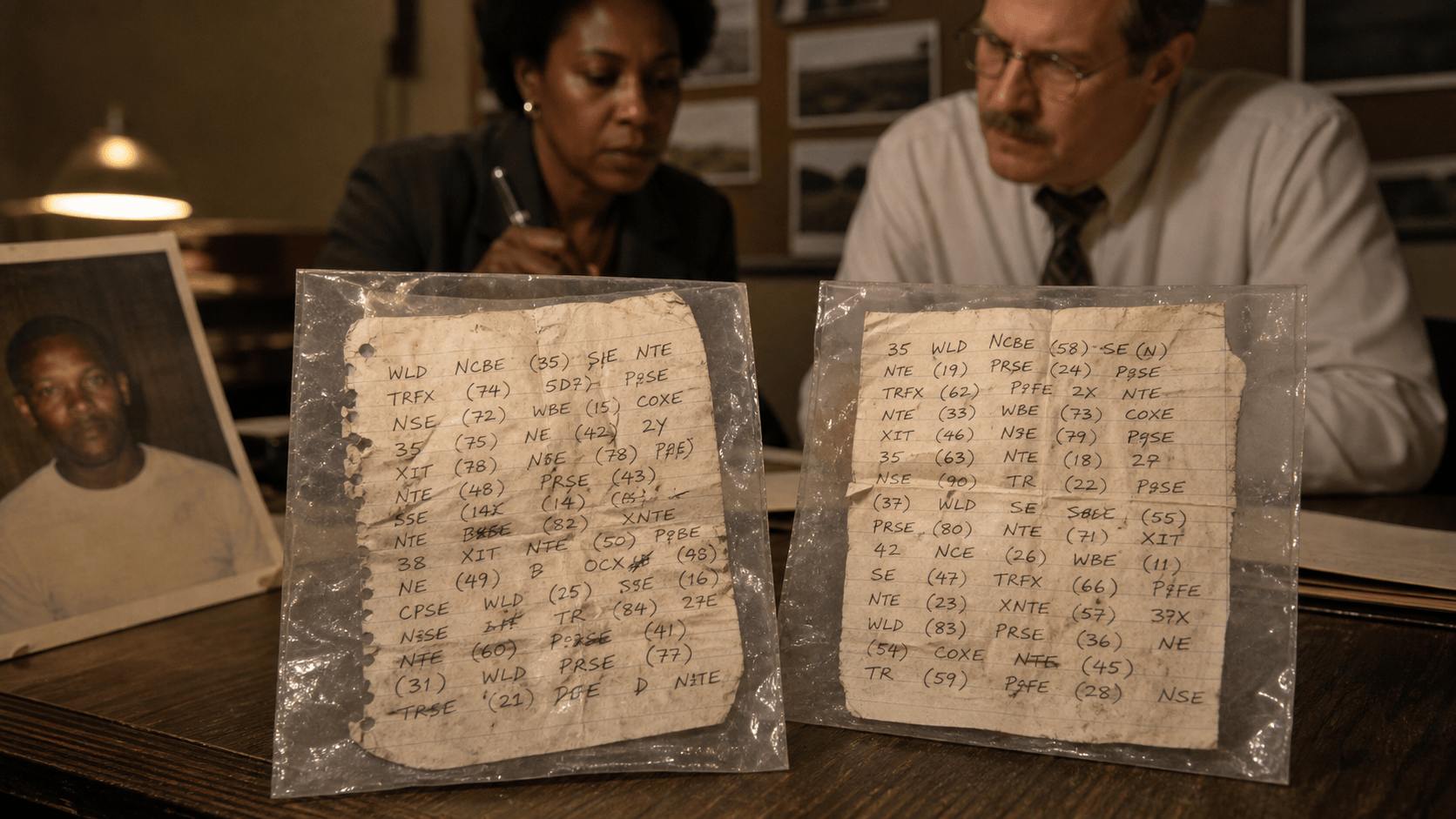
Ricky McCormick’s case sounds like the kind of mystery that starts strange and then quietly removes the floor.
In 1999, McCormick’s body was found in a field in St. Charles County, Missouri. He had not been reported missing. Investigators could not pin down exactly how he died. Already, that is the kind of case that makes everyone in the room start using phrases like “unanswered questions,” which is usually a polite way of saying nobody is sleeping great.
Then they checked his pockets.
Inside were two handwritten notes covered in letters, numbers, dashes, and parentheses. Not regular notes. Not a grocery list. Not “buy milk,” which would have been a mercy.
They looked like code.
The FBI’s codebreakers tried to solve them. Outside cryptography experts tried too. Years later, the FBI even asked the public for help. And still, the notes have never been officially cracked.
That is what makes this one so creepy. The message was not found in a haunted house or carved into a wall. It was folded up in the pocket of a dead man whose final movements were already unclear.
If the notes mean something, they could point to where McCormick had been, who he had seen, or what was happening before he died. If they mean nothing, that is almost worse in a different way, because then everyone has spent decades staring into a paper maze that may not have a door.
His family later said they doubted he could have written a complex code at all. Which does not make the notes less strange. It just moves the question one step back.
If Ricky McCormick did not write them, who did?
And why were they in his pocket?
#1 The Somerton Man’s “Taman Shud” Note
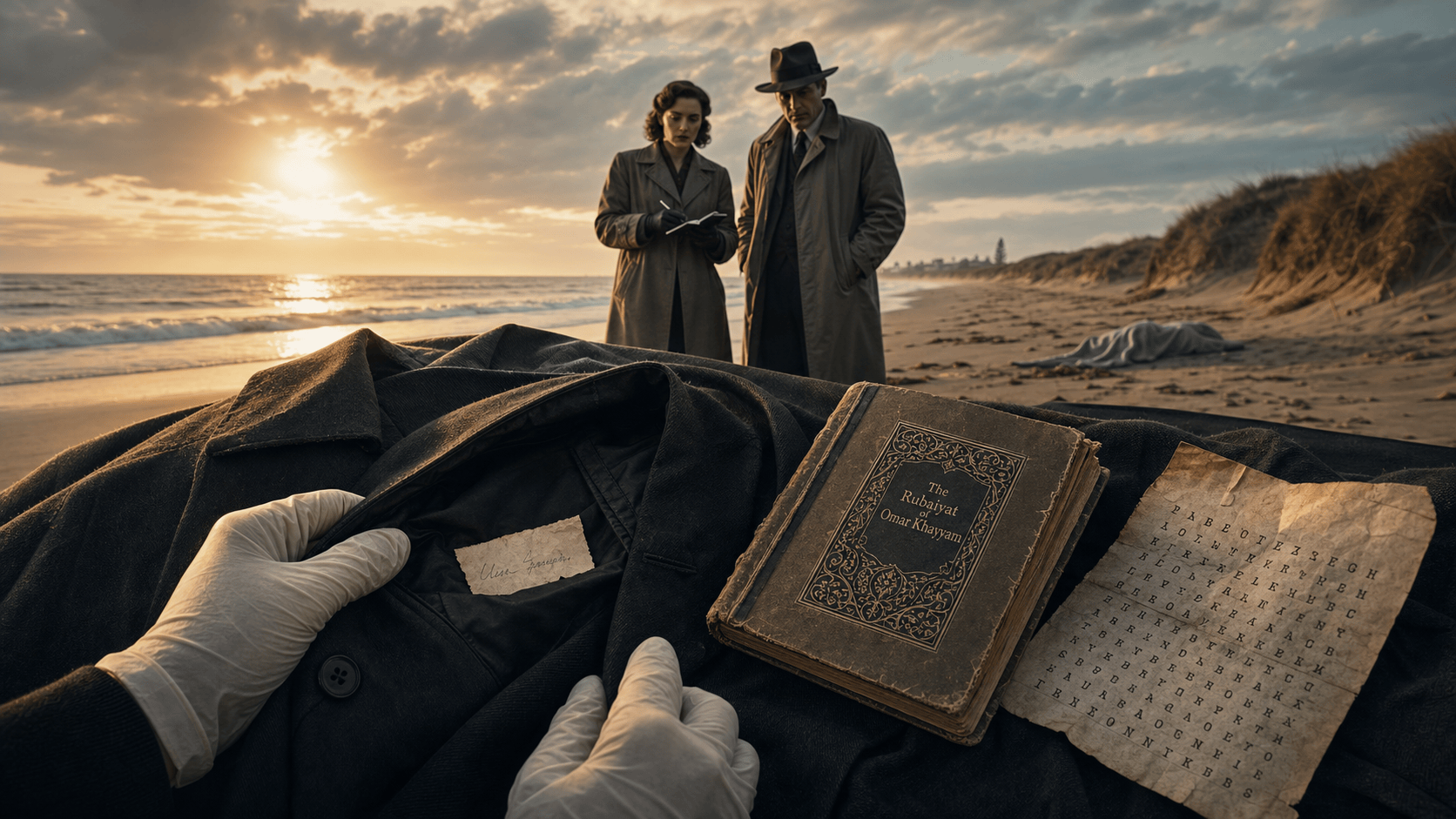
Some mysteries come with a clue that feels almost too dramatic.
The Somerton Man case came with a tiny scrap of paper hidden in a dead man’s clothing.
In 1948, a man was found dead on Somerton Beach in Adelaide, Australia. He had no identification. The labels had been removed from some of his clothes. Nobody could immediately say who he was, why he was there, or exactly what had happened to him.
Already bad.
Then investigators found the hidden note.
It was a small piece of paper tucked into a secret pocket in his trousers. On it were the words “Taman Shud,” often translated as “finished” or “ended.” The phrase came from The Rubaiyat of Omar Khayyam, a book of poetry.
That is an insane thing to find on an unidentified dead man.
Not a name. Not an address. Not “please call this person.” Just two words that basically sound like the universe shutting a door.
And somehow, it got stranger.
Police later connected the scrap to a copy of the Rubaiyat that had been found in a car. In the back of that book were strange handwritten letters that looked like a code, along with a phone number connected to a woman who lived near the beach.
So now the case had a dead man, a hidden pocket, a torn-out phrase, a poetry book, a possible code, and a nearby woman who may or may not have been connected to him.
At that point, the mystery was no longer knocking politely. It had moved in and started rearranging the furniture.
In recent years, researchers have argued that DNA evidence may identify the man as Carl Webb, an electrical engineer from Melbourne. That may answer the question of his name. But it does not make the hidden note feel any less strange.
Because even if we know who he was, that little scrap of paper still sits at the center of the story.
Two words.
Hidden where nobody was supposed to find them.
Finished.
Ended.
And somehow, still not fully explained.
Leave a Reply