

The walls were high. The security was expensive. The escape plans were somehow better.
Prisons are built around a straightforward promise: the people inside stay inside. These five escapes found the weak point in that promise.
One man allegedly weakened metal with miso soup. Three inmates left fake heads in their Alcatraz beds. El Chapo disappeared through a shower into a tunnel equipped with lights, ventilation, and a motorcycle on rails.
Some plans were brilliant. Others needed security to miss exactly the wrong detail. All five worked far better than they had any right to.
#5 Yoshie Shiratori
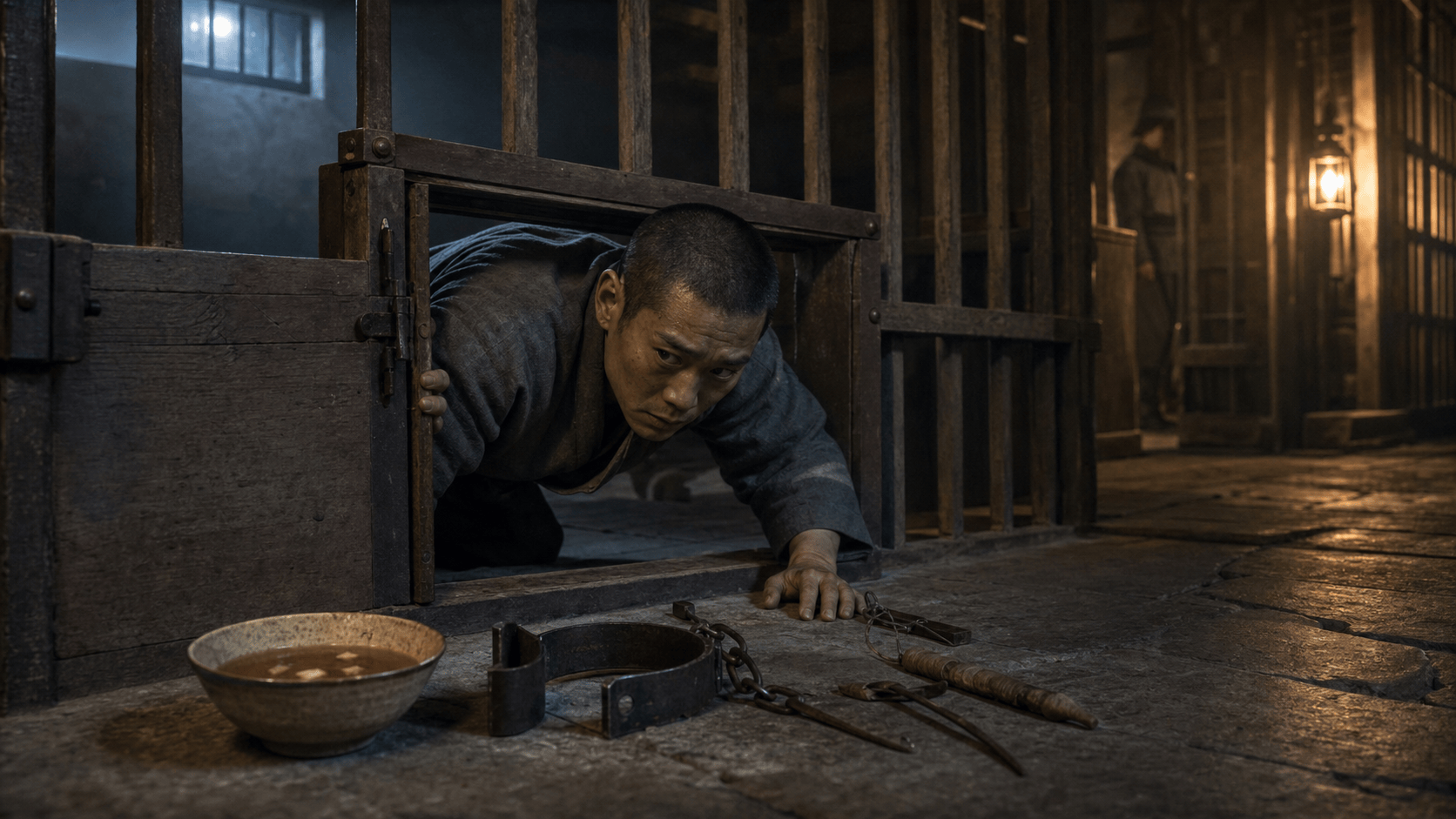
Yoshie Shiratori was the kind of prisoner who made prison designers look personally insulted.
He was a Japanese inmate who became famous for escaping from prison four different times. Not once. Not twice. Four times. At some point, that stops sounding like a crime record and starts sounding like a maintenance issue.
His escapes became almost legendary because they were not all the same trick. He picked locks. He climbed through openings. He studied routines. He used whatever tiny weakness the prison gave him, then waited until the building made a mistake.
One of the most famous stories comes from Abashiri Prison, where Shiratori was reportedly kept in brutal conditions and fitted with special restraints. According to the story, he repeatedly poured miso soup onto parts of the restraints and cell opening, using the salt to help corrode the metal over time.
That is a very patient kind of absurd.
Most people eat soup. Shiratori apparently looked at soup and thought, “This might be my legal team.”
Then there was the physical part. Shiratori was said to be unusually flexible, able to dislocate his joints and squeeze through spaces that should not have worked for a grown man with bones. Which, respectfully, is not a skill most prisons are budgeting for.
The strangest thing about his story is how low-tech it was. No helicopter. No fake passport. No dramatic explosion. Just time, pain tolerance, observation, and an almost offensive refusal to accept architecture.
Some details of Shiratori’s escapes may have been exaggerated over the years, because stories like this tend to pick up extra seasoning as they travel. But the core is real enough: he became known as one of Japan’s most famous prison escape artists.
And as an opening entry, he fits perfectly.
Because if one prison escape is impressive, four starts to feel like the walls were only participating out of politeness.
#4 The Texas Seven
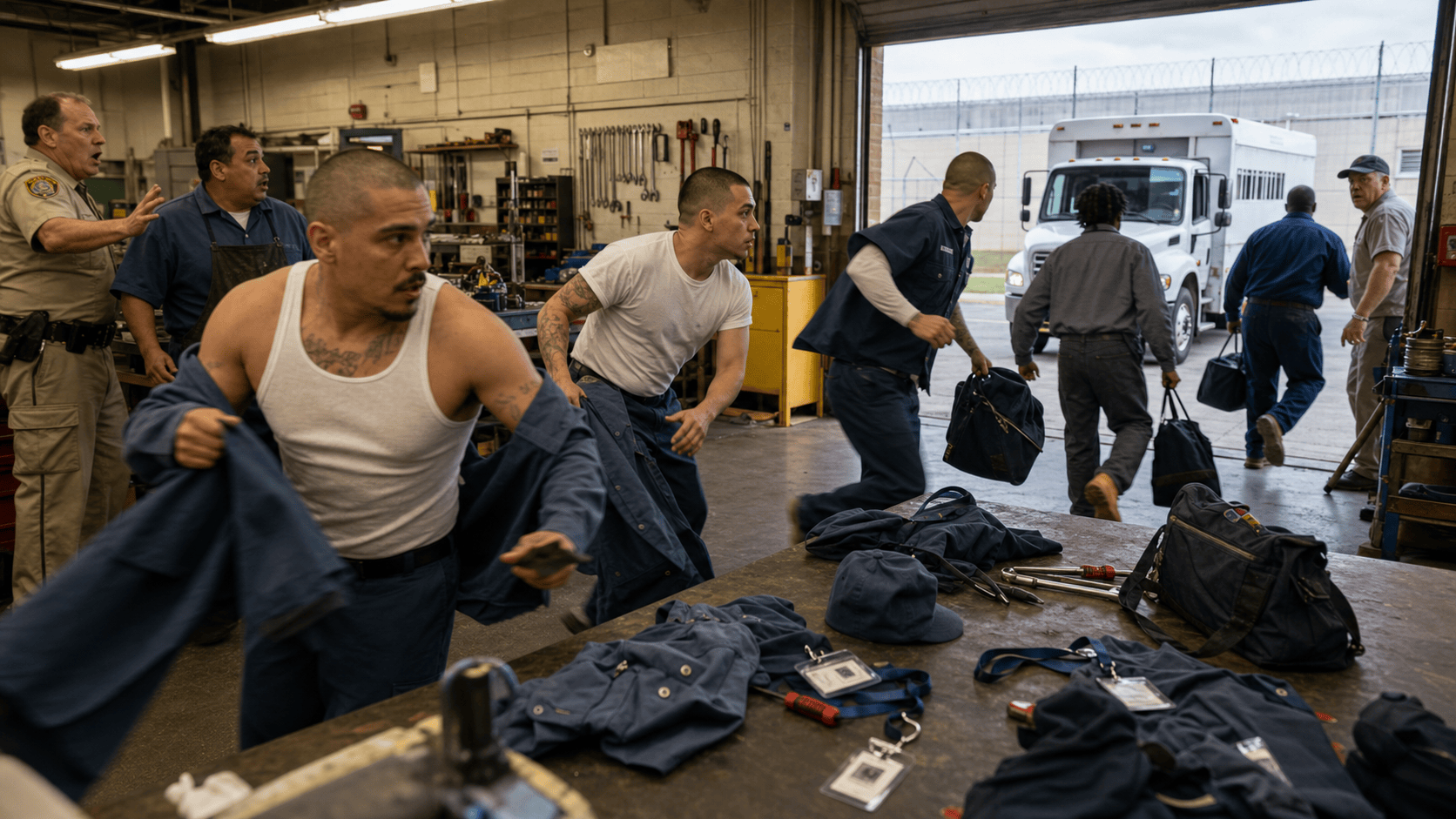
The Texas Seven escape was not subtle.
In 2000, seven inmates broke out of the John B. Connally Unit, a maximum-security prison in Texas. And they did it in a way that makes the whole thing sound less like a quiet escape and more like a prison system having a very bad afternoon.
The men overpowered civilian workers and prison staff, stole clothes, took IDs, grabbed tools, and used the prison’s own routines against it. Then they drove away in a prison maintenance truck.
That is the part that always feels ridiculous.
Not because it was simple. It was not. The escape involved planning, timing, intimidation, and a lot of moving pieces. But still, the image of seven inmates leaving a high-security prison in a prison vehicle has a special kind of “are we sure anyone checked?” energy.
After escaping, the group went on the run and committed robberies to survive. Their case became national news, especially after the murder of police officer Aubrey Hawkins during a robbery on Christmas Eve.
That part matters. The escape itself sounds almost unbelievable, but the aftermath was not funny or harmless. Real people were hurt. A family lost someone. The story turns dark fast.
And that is why this one lands differently from some of the others on the list.
The escape had all the ingredients of an absurd movie scene: stolen uniforms, a maintenance truck, fake authority, people moving through a system that was supposed to stop exactly this kind of thing.
But the consequences were very real.
The Texas Seven did not vanish forever. They were eventually caught after a huge manhunt, helped by tips from the public and America’s Most Wanted.
Still, for a short time, seven men walked out of a maximum-security prison by turning the place’s own structure against it.
That should not have worked.
And yet, somehow, the door might as well have held it open.
#3 El Chapo’s Tunnel Escape
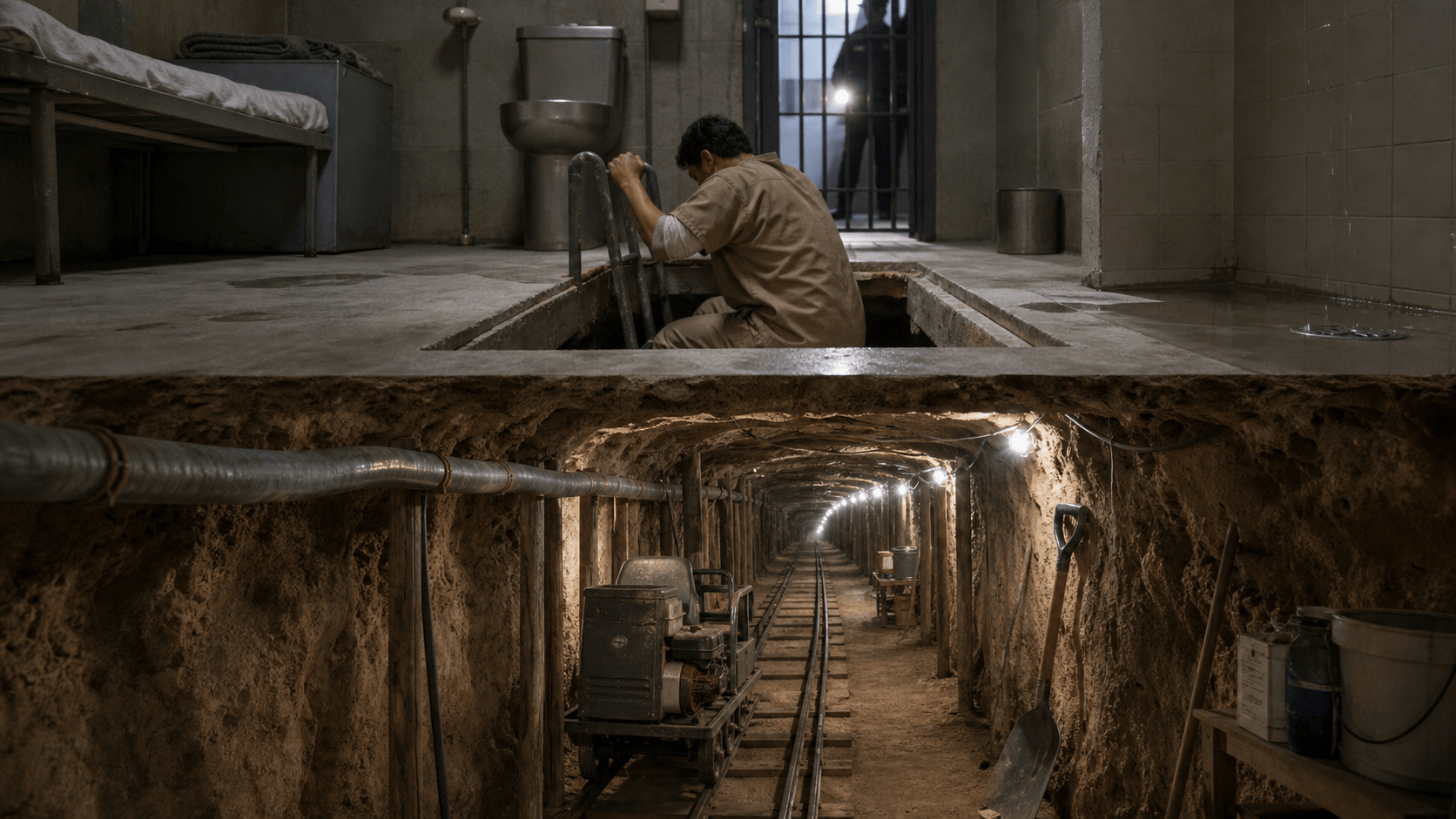
El Chapo’s 2015 escape sounds like someone misunderstood the phrase “maximum security” as a suggestion.
Joaquín “El Chapo” Guzmán was being held at Altiplano prison in Mexico, one of the country’s most secure facilities. Cameras watched him. Guards monitored him. The prison was supposed to be built for exactly this kind of inmate.
Then he disappeared through the shower.
Not metaphorically. Literally.
Investigators later found a hole in the shower area of his cell. That hole led to a tunnel stretching roughly a mile long. And this was not just a sad dirt crawlspace with bad lighting. The tunnel reportedly had ventilation, electricity, a modified motorcycle on rails, and enough engineering confidence to make the prison above it look deeply embarrassed.
That is what makes this escape so wild.
It was not just that he got out. It was that an entire underground route had been built to reach him, right under one of the most secure prisons in Mexico. A tunnel with lights. Airflow. Transportation. At that point, you are not escaping prison so much as opening a deeply illegal subway extension.
The planning must have been enormous. Someone had to dig in the right direction, avoid detection, manage noise, move dirt, build supports, and land the tunnel exactly where it needed to go.
Meanwhile, prison officials were watching the cell from above, apparently unaware that the real action was happening below their feet.
El Chapo was eventually captured again, but the 2015 tunnel escape became one of the most infamous prison breaks in modern history.
Because a ladder under a shower is already bad.
A mile-long escape tunnel with a motorcycle track is the kind of thing that makes every security meeting afterward extremely uncomfortable.
#2 The Great Escape
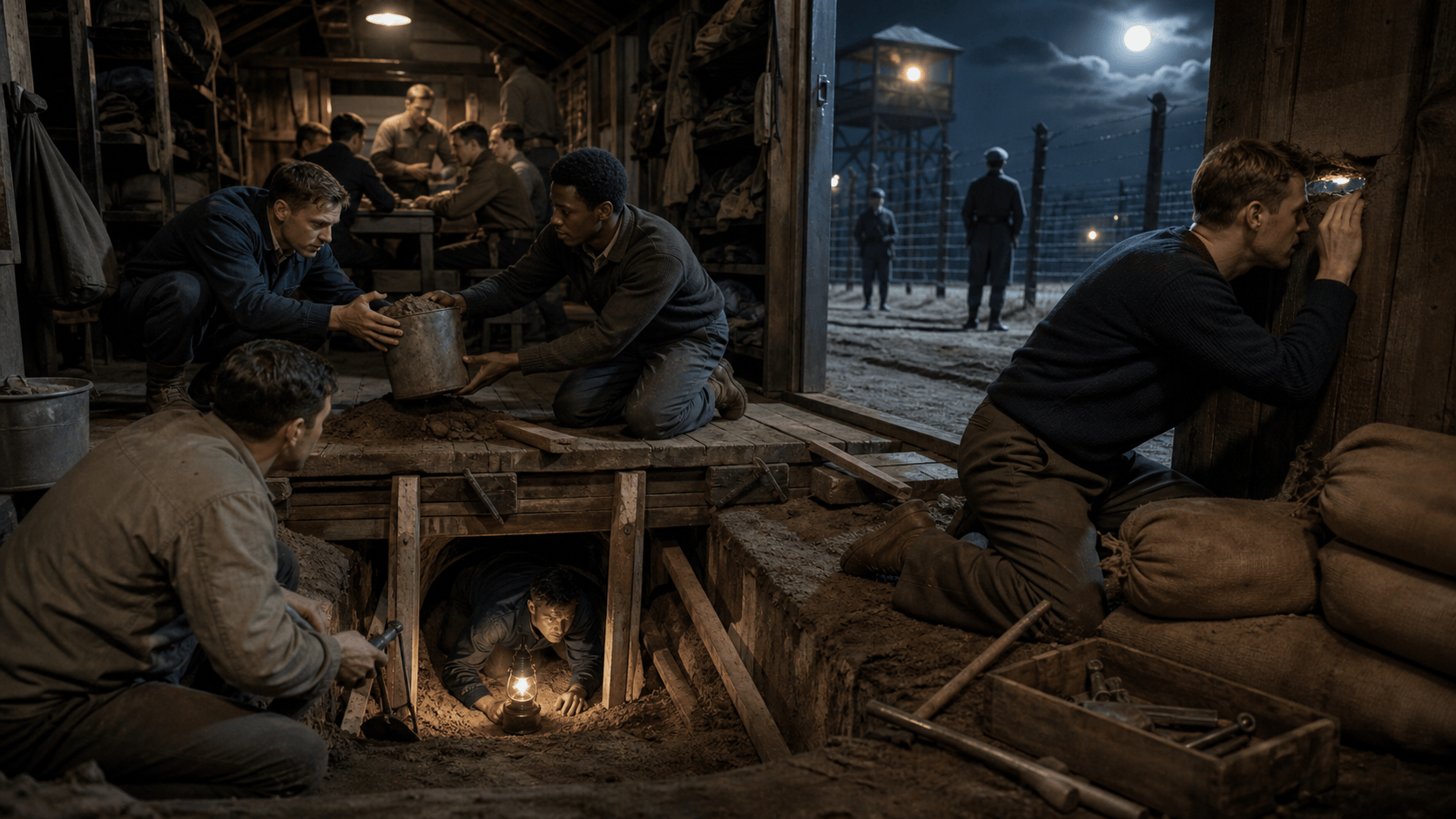
The Great Escape was not called that because it involved a polite misunderstanding at the gate.
In 1944, Allied prisoners at Stalag Luft III, a German prisoner-of-war camp, carried out one of the most famous escape plans of World War II. The plan was massive. Not “hide behind a laundry cart” massive. Actual engineering project massive.
The prisoners dug tunnels.
Not one tunnel. Three.
They named them Tom, Dick, and Harry, because apparently if you are going to risk your life digging under a prison camp, you may as well give the dirt holes casual little names.
The idea was to create escape routes under the camp’s fences, with enough distance to get prisoners beyond the guarded perimeter. The work was dangerous, cramped, and slow. Dirt had to be hidden. Air had to be pumped in. Wooden supports had to be built. Guards had to be distracted. The whole operation was basically a construction site pretending to be a prison hobby.
Eventually, the escape happened through the tunnel known as Harry.
Seventy-six prisoners made it out.
That number is incredible on its own. But the tunnel came up short of the tree line, which meant the men had to exit closer to the guards than planned. That is the kind of discovery you make and immediately wish the ground had a comment section.
Most of the escapees were recaptured. Tragically, fifty of them were executed on Hitler’s orders, making the story far darker than the movie version many people remember.
Still, the escape itself remains astonishing. The prisoners built a hidden tunnel system under a heavily guarded camp using stolen materials, homemade tools, patience, and a level of coordination that would make most office group projects collapse in shame.
It should not have worked as well as it did.
But for one night, seventy-six men slipped under the wire.
#1 The Alcatraz Escape
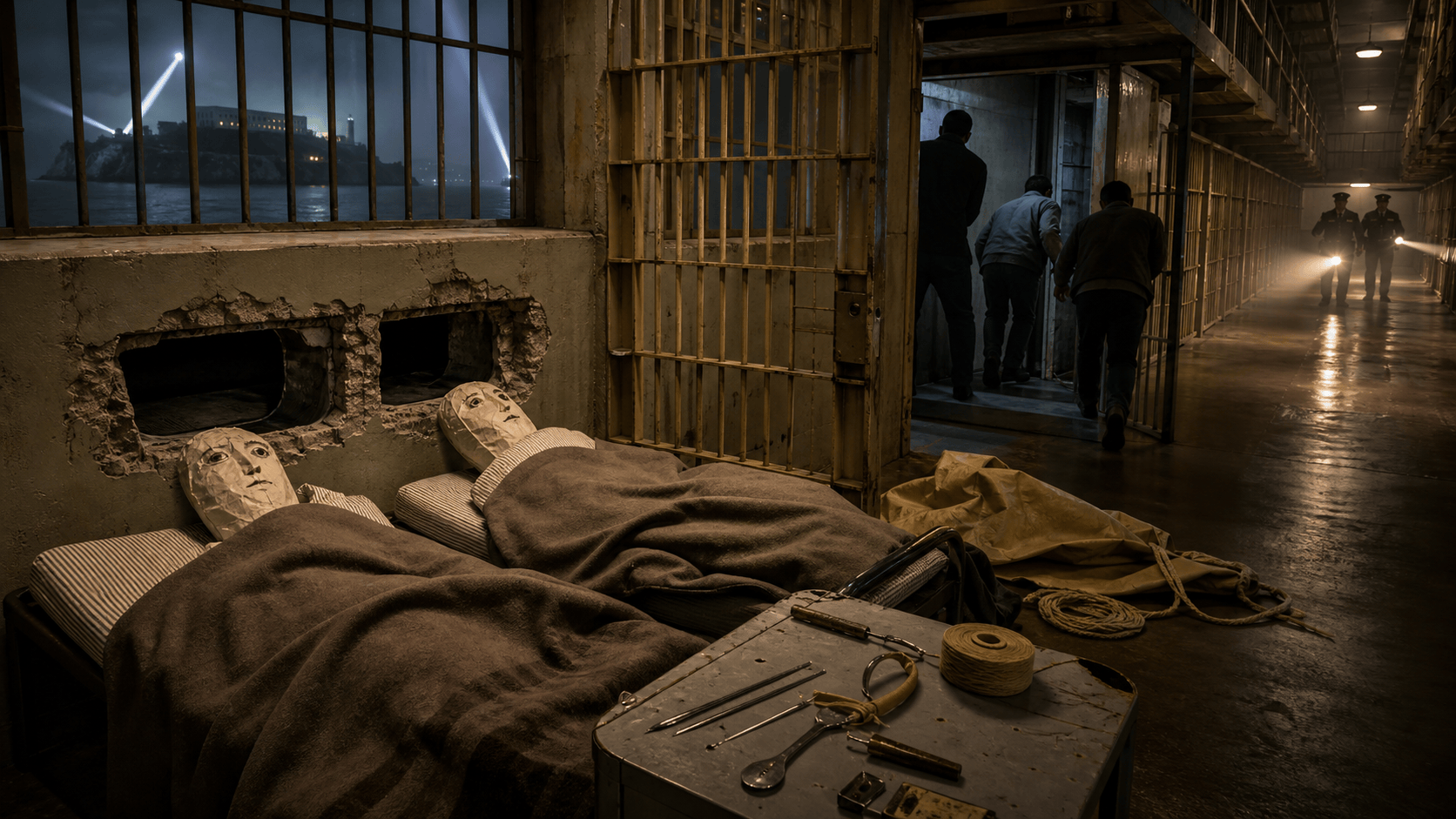
Alcatraz was supposed to be the prison that ended the conversation.
Cold water. Strong currents. Guards. Towers. Locked cells. An island sitting in the middle of San Francisco Bay like it had been designed by someone who really did not want visitors leaving early.
And yet, in 1962, three inmates disappeared from it.
Frank Morris and brothers John and Clarence Anglin spent months preparing one of the most famous prison escapes in history. They chipped away at the walls behind their cells using homemade tools. They built fake wall covers to hide the damage. They made a raft and life vests from prison raincoats.
Then came the part everyone remembers.
The dummy heads.
The men made fake heads out of materials like soap, toilet paper, and concrete dust, then painted them and added real hair from the prison barbershop. They placed the heads in their beds so guards would think they were sleeping.
That is either brilliant or deeply unsettling, depending on whether you are the one doing the bed check.
When the guards finally realized what had happened, Morris and the Anglin brothers were gone. They had slipped through the vents, climbed out, reached the roof, made their way down toward the water, and launched into San Francisco Bay.
What happened after that is still debated.
Officially, the men were presumed to have drowned. The bay was cold, rough, and dangerous. But no bodies were ever found, and over the years, rumors, alleged sightings, and family claims kept the mystery alive.
That is why the Alcatraz escape deserves the top spot.
It had everything: patience, planning, fake heads, homemade tools, a raincoat raft, and one of the most intimidating prisons in America somehow being beaten by three men who turned basic supplies into a full escape kit.
Maybe they died in the water.
Maybe they made it out.
Either way, Alcatraz was supposed to be escape-proof.
Three empty beds said otherwise.
Leave a Reply