

Some childhood memories are sweet. Others come with a recall notice.
Some toys are dangerous because a kid uses them wrong. These were dangerous because adults looked at them, approved them, packaged them nicely, and sent them home with children.
That is the part that makes the whole thing feel worse. These were not random mistakes. They were birthday presents, Christmas gifts, and “educational” products with a little too much confidence built in.
Here are five dangerous toys parents actually bought their kids.
#5 Clackers
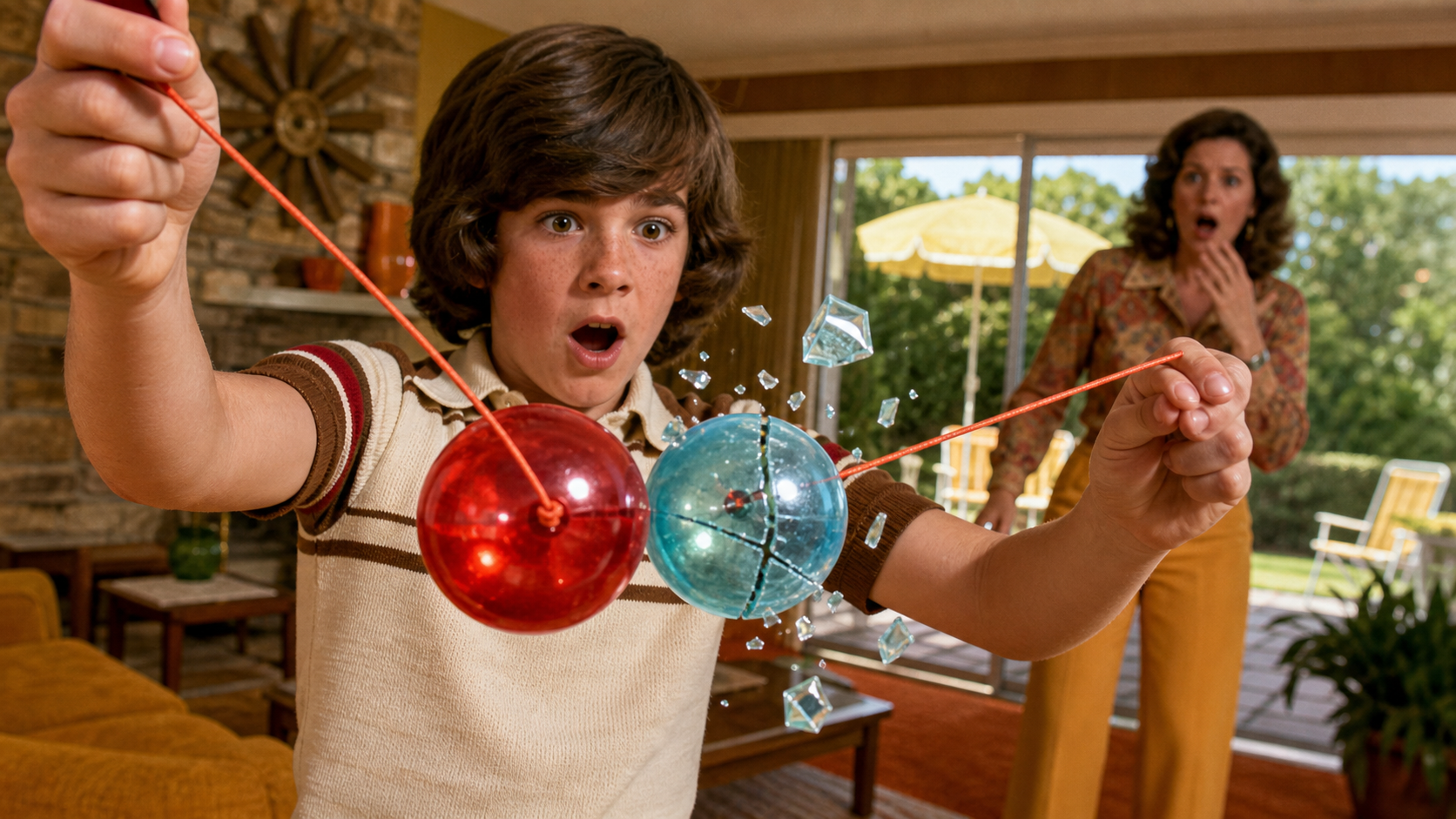
Clackers looked simple enough: two hard acrylic balls attached to strings, swung up and down until they smacked into each other with a loud clack.
That was basically the whole toy.
And to be fair, kids loved them. They were noisy, easy to understand, and gave everyone within earshot the peaceful feeling of being trapped near a tiny construction site. In the late 1960s and early 1970s, clackers became a huge fad.
The problem was the material. Early clackers were often made from hard acrylic plastic, and when those balls hit each other over and over again, they did not always stay friendly. Some cracked. Some shattered. And when a toy’s main feature is “slam these two hard balls together as fast as possible,” shattered plastic is not a small design flaw. It is the design flaw waving both arms.
The danger was not imaginary either. U.S. safety regulators treated clacker balls as a real hazard because the balls could crack, shatter, or come apart during use, sending pieces flying. In 1985, the Consumer Product Safety Commission announced the seizure of about 4,600 banned clacker-style toys called “KER BANGERS” after testing found that the supposedly “shatterproof” balls cracked or shattered.
Later versions were made with safer materials or redesigned, but the classic version earned its reputation.
Clackers were fun, loud, and strangely satisfying. They were also a reminder that sometimes a toy only needs one moving part to become a problem.
#4 Lawn Darts

Lawn darts were exactly what they sounded like, which is part of the problem.
They were large weighted darts with sharp metal tips, meant to be tossed in a high arc toward plastic rings placed on the grass. In theory, this was a calm backyard game. In practice, it involved children throwing pointed objects into the sky and trusting everyone nearby to understand physics, distance, timing, and basic self-preservation.
That is a lot to ask during a barbecue.
For years, lawn darts were sold as family entertainment. The game had rules, packaging, and the cheerful energy of something that belonged next to badminton and horseshoes. But the darts were heavy enough and sharp enough to cause serious injuries if they missed the target and hit a person instead.
The danger eventually became impossible to treat like a rare accident. In the United States, lawn darts were connected to thousands of injuries and several child deaths before the Consumer Product Safety Commission banned the sale of the sharp-tipped version in 1988.
Modern versions usually use rounded or safer tips, which feels less exciting until you remember the old version was basically asking kids to weaponize recess.
That is what made lawn darts so strange. The game looked harmless, but the original design gave a bad throw way too much power.
#3 Gilbert Glass Blowing Set

A.C. Gilbert built a whole brand around educational toys, and to be fair, some of them were genuinely brilliant. The company wanted kids to build things, test things, understand science, and maybe grow up believing the world was something they could take apart and figure out.
Then there was the glass blowing kit.
The Gilbert Glass Blowing Kit taught children how to heat and shape glass using an alcohol lamp. The Smithsonian has one in its collection, and the related manual, Experimental Glass Blowing for Boys, was first published in 1920. That title alone tells you the era was not exactly drowning in safety meetings.
The idea was educational. Kids could learn how test tubes, bends, bulbs, and simple glass lab equipment were made. That is actually interesting. The uncomfortable part is that the learning process involved hot glass, open flame, and the kind of steady hands most children usually reserve for spilling juice three inches from the cup.
The manual instructed young users to hold glass tubing in the flame of an alcohol lamp. In a science classroom, with supervision, that might make sense. As a children’s activity set, it feels like the kind of thing a modern parent would discover in the attic and immediately check whether the house insurance was paid.
That is what makes the Gilbert Glass Blowing Set so perfect for this list. It was not some cheap throwaway toy. It came from a famous educational toy company with real ambition behind it.
It just also asked children to casually bend glass over fire.
#2 Creepy Crawlers Thingmaker

Creepy Crawlers had one of the best toy ideas ever: let kids make their own rubbery little bugs.
That part was genius. You poured colorful liquid plastic called Plasti Goop into metal molds shaped like insects, monsters, flowers, or whatever strange little thing Mattel had decided children needed to peel out of a tray that week. Then the mold went into the Thingmaker, where heat turned the liquid into a bendy toy.
It was creative. It was hands on. It smelled like childhood and probably a small chemistry incident.
The original Mattel Thingmaker came out in the 1960s, and the issue was not the fake bugs. The issue was how you made them. The toy used die-cast metal molds and an open heating plate that could reach around 390 to 400 degrees Fahrenheit. That is not “warm.” That is “please do not let your child casually touch this while excited about a rubber spider.”
Kids had to pour the goop, heat the mold, wait for it to cure, remove it, cool it, and then pry out the finished creature. Anyone who has ever watched a child wait for anything knows exactly where the danger entered the room.
Later versions of Creepy Crawlers used safer enclosed heating systems, including lightbulb-style ovens and designs that made it harder to touch the hot parts too soon. Which makes sense. The original version was fun, but it also depended on children treating hot metal with the patience of a trained lab assistant.
Creepy Crawlers still deserves credit for being wildly imaginative. It let kids make their own toys before 3D printers were even a dream.
It also made the phrase “wait for it to cool” do an incredible amount of work.
#1 Gilbert U-238 Atomic Energy Lab

The Gilbert U-238 Atomic Energy Lab is one of those toys that sounds fake until you realize museums have the receipts.
Released in 1950 by the A.C. Gilbert Company, the same company behind Erector Sets, this was not a pretend science kit with a plastic lab coat and a few harmless powders. It was a full atomic energy set for children. And yes, it came with real radioactive material.
The kit included uranium-bearing ore samples, a Geiger counter, an electroscope, a spinthariscope, a cloud chamber, manuals, and even a comic book called Learn How Dagwood Splits the Atom. That is an incredible sentence to write about a toy without stopping halfway through to ask what decade everyone’s survival instincts were on vacation.
To be fair, the early 1950s were deep in atomic-age optimism. Nuclear science was the future. Educational toys were supposed to inspire children to become engineers, scientists, and inventors. A.C. Gilbert was not trying to sell a horror prop. The company was selling ambition in a red case.
But the contents are still hard to look past.
This was a children’s kit that let kids use a Geiger counter to measure radiation from actual uranium ore. Some versions also included radiation sources and tools meant to demonstrate atomic science at home. Even the instructions warned users not to remove ore samples from their jars because the material could flake or crumble and spread radioactive dust around the “laboratory.”
That laboratory, of course, might have been a bedroom desk.
The set was expensive, selling for about $50 at the time, and it only lasted for a short run around 1950 to 1951. That probably kept it from ending up in every neighborhood. Still, the basic idea remains wild: a company looked at children, science, and radioactive ore and decided the missing ingredient was packaging.
The Gilbert U-238 Atomic Energy Lab gets the number one spot because it was not just sharp, hot, loud, or messy. It was a children’s toy built around real radioactive materials.
The strangest part is that it was not sold as a stunt. It was sold as the future.
Leave a Reply