

What happens when an experiment lasts longer than the scientist who created it?
How long should an experiment last? A week? A year? Maybe until everyone involved has forgotten why it seemed like a good idea in the first place?
These five experiments kept going. Their original creators died, new researchers took over, and the waiting continued.
#5 The Harvard Study of Adult Development
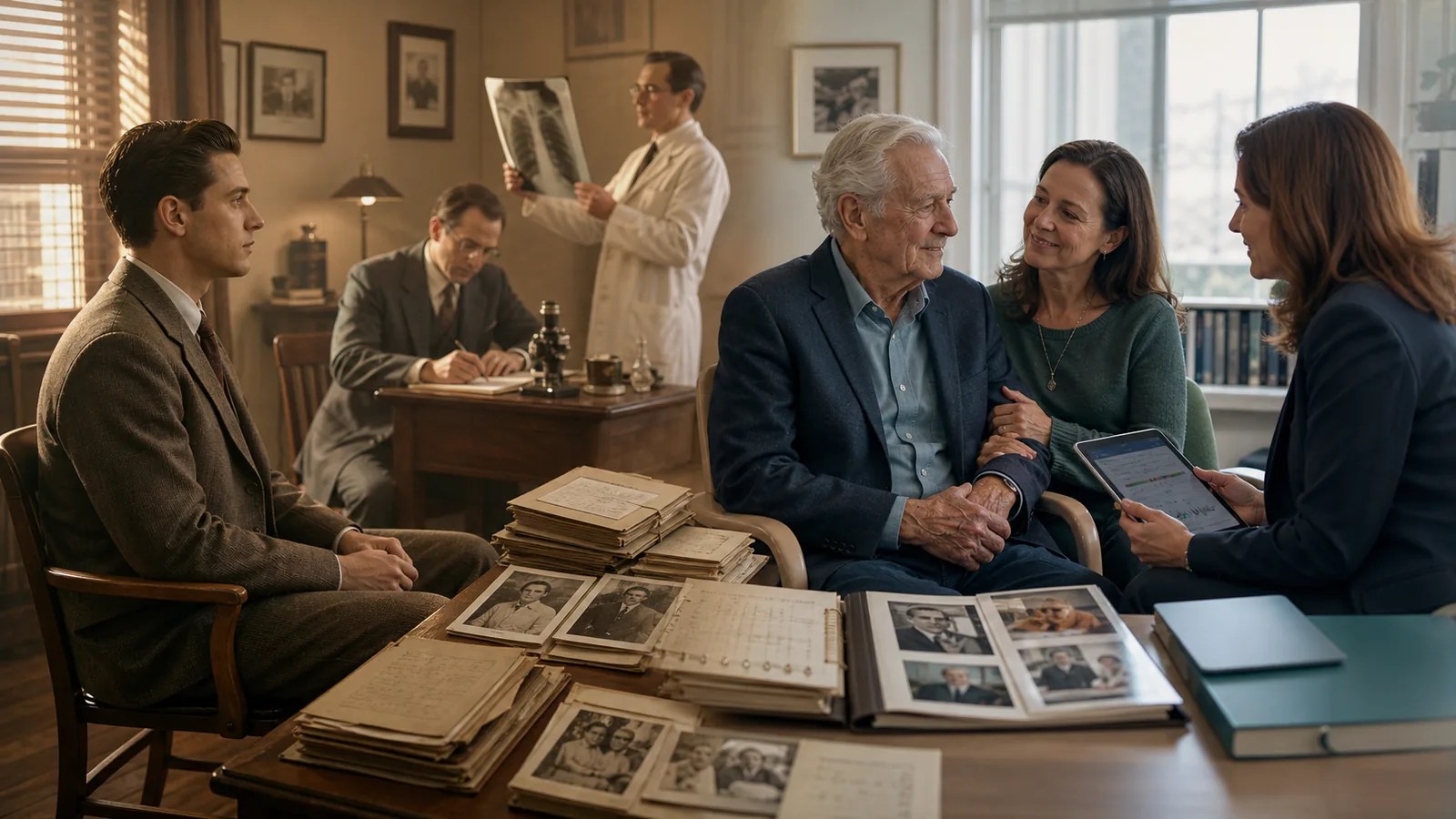
In 1938, researchers began following 268 Harvard students to understand what helped people remain healthy and successful throughout adulthood.
A second project followed 456 boys from working-class neighborhoods in Boston. The two groups were eventually combined, creating a study of 724 men whose lives would be documented for decades.
Researchers did much more than send the occasional questionnaire. They collected medical records, conducted interviews, studied careers and marriages, and asked participants about their physical and emotional health. Family members were interviewed too.
The original sample had obvious limitations. Every participant was male, and the groups did not represent the full racial or social diversity of the United States. Still, the amount of information gathered across entire lifetimes made the study unusually valuable.
The researchers who began the project are long gone. Many of the original participants lived into their 80s and 90s, while the study passed between generations of scientists. It has since expanded to include the children of the original men, allowing researchers to examine how childhood experiences can affect health decades later.
After following people through relationships, careers, illness, success and disappointment, one conclusion kept appearing: strong personal relationships were closely connected to healthier and happier lives.
The study began by asking what makes a person thrive. More than eight decades later, it is still collecting answers.
#4 The Broadbalk Wheat Experiment

In 1843, English landowner and agricultural scientist John Bennet Lawes began growing wheat on a field at his Rothamsted estate. Working with chemist Joseph Henry Gilbert, he divided the land into separate plots and treated each one differently.
Some received animal manure. Others were given various combinations of chemical fertilizers. One section received no fertilizer at all.
The goal was straightforward: determine which treatments produced the best wheat harvest. What began as a practical farming experiment never officially ended.
More than 180 years later, wheat is still grown on parts of the same field. Researchers continue comparing the plots, including land that has received similar treatments since the Victorian era. The experiment has survived new farming equipment, two world wars and several generations of scientists who inherited an unusually demanding gardening schedule.
Broadbalk now provides information Lawes and Gilbert could never have anticipated. Scientists have used its soil samples and harvest records to study pollution, crop diseases, weeds, soil chemistry and the long-term effects of fertilizers.
The original researchers died in the 1800s, but the field continued producing data. Its oldest records were written by hand. Today, the results are stored digitally and studied by researchers around the world.
Broadbalk began with a question about growing better wheat. It became one of the longest-running scientific experiments in history.
#3 The Beal Seed Experiment
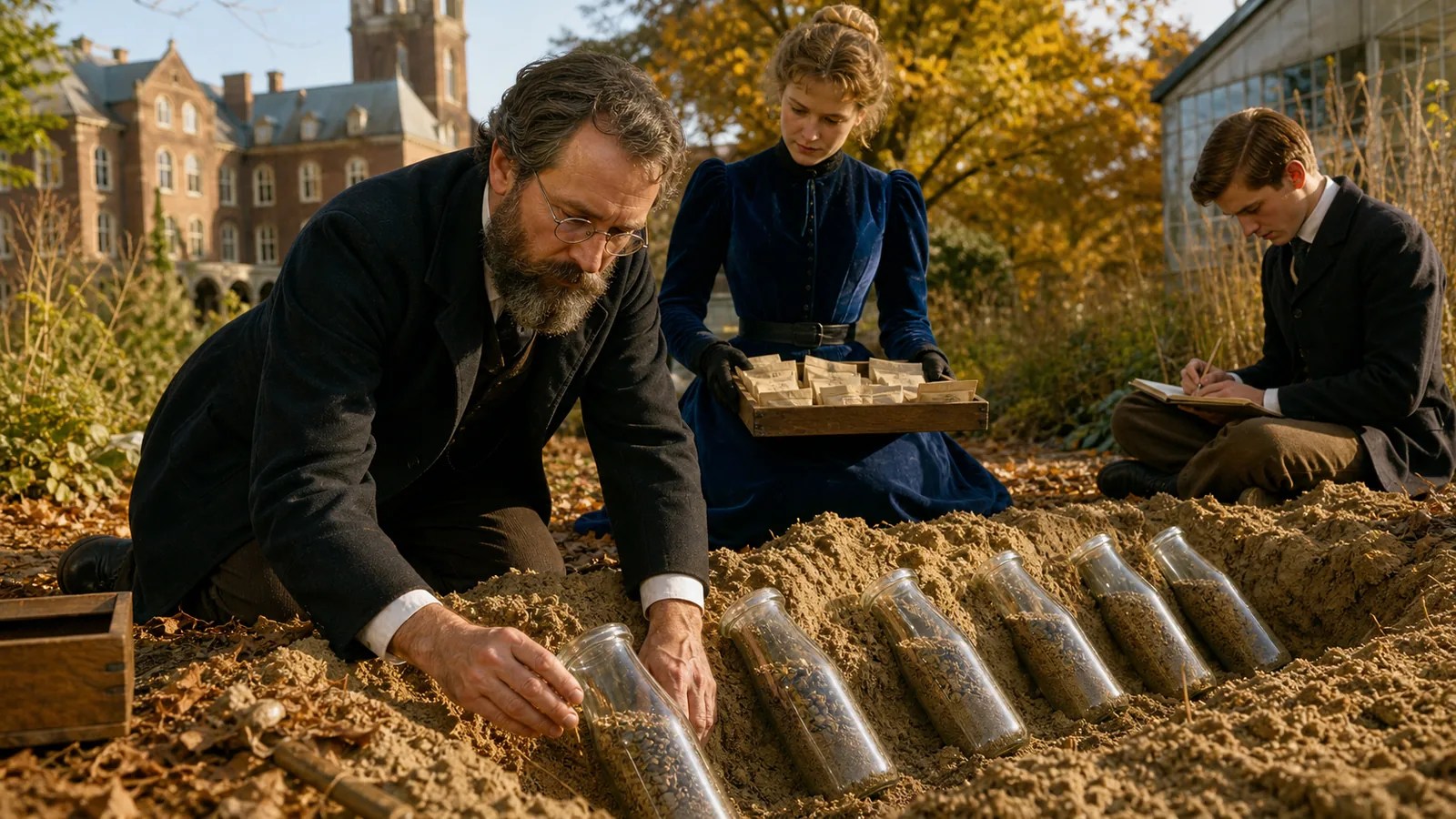
In 1879, Michigan botanist William James Beal wanted to know how long seeds could remain buried and still grow.
He collected seeds from 23 common plant species, mixed them with damp sand and placed them inside 20 glass bottles. Each bottle was left uncorked and buried with its opening angled downward so water would not collect inside.
Beal then created instructions for future scientists to dig up the bottles one at a time and test whether the seeds were still alive.
The original plan called for a bottle to be opened every five years. Later researchers extended the waiting period, first to ten years and eventually to twenty, allowing the experiment to continue far beyond anything Beal could have personally observed.
The location of the remaining bottles is kept secret to prevent curious visitors from finding them first. When researchers recovered one in 2021, they worked at night using old maps and careful measurements. Some of the seeds still germinated after spending 142 years underground.
Four bottles remain buried on the Michigan State University campus. If the current schedule continues, the last one will not be opened until 2100.
Beal died in 1924. The experiment he started will still be waiting beneath the ground more than 175 years after he planted it.
#2 The Oxford Electric Bell

Inside a glass case at Oxford University, a tiny metal ball has been swinging between two bells since 1840.
The device is powered by two early batteries known as dry piles. Each time the ball touches one bell, it receives an electrical charge that pushes it toward the other. The process repeats about twice every second.
It has repeated quite a few times.
Oxford estimates that the bells have been struck roughly ten billion times. Visitors cannot hear them because the sound is muffled by the display case, but the metal ball can still be seen moving back and forth.
The exact construction of the batteries remains uncertain. Scientists believe they contain thousands of alternating layers of metal foil and specially treated paper, sealed beneath sulphur. Opening them would answer the question, but it would also destroy one of the world’s longest-running scientific demonstrations.
The apparatus was set up by Oxford physics professor Robert Walker, who died in 1865. Even the instrument maker responsible for its construction is not known with complete certainty.
The bell is sometimes described as perpetual motion, but it is not. The batteries are slowly losing energy, and eventually the movement will stop.
Nobody knows when. After more than 185 years, Oxford is still waiting to find out.
#1 The Pitch Drop Experiment

In 1927, University of Queensland physicist Thomas Parnell poured heated pitch into a sealed glass funnel.
Pitch looks solid. You can strike it with a hammer and shatter it. Parnell wanted to demonstrate that it is actually an extremely viscous liquid, meaning it flows so slowly that watching it happen requires an unreasonable amount of commitment.
He allowed the material to settle for three years. In 1930, the funnel’s stem was opened and the experiment officially began.
The first drop took eight years to fall. Later drops required roughly seven to twelve years each. Only nine have descended so far, and nobody has directly witnessed the exact moment one separated from the funnel.
Parnell died in 1948 without seeing a drop fall. Physicist John Mainstone later became the experiment’s custodian and watched over it for more than half a century. He repeatedly missed the crucial moment. In 2000, a camera was positioned to capture a drop, but a badly timed technical failure prevented the event from being recorded.
Modern cameras now monitor the funnel continuously, although even the ninth drop refused to cooperate normally. Instead of falling cleanly, it slowly touched the drop beneath it.
The experiment is still running in a display case at the university, with another drop gradually forming. There is reportedly enough pitch remaining for the process to continue for decades.
That earns it the number one spot. Scientists have kept this experiment alive for nearly a century, and the main event still seems determined to happen when nobody is looking.
Sources & Image Credits
Harvard Study of Adult Development: Official Study Website
Rothamsted Research: The Broadbalk Wheat Experiment
Michigan State University: The Beal Seed Experiment
University of Oxford: The Clarendon Dry Pile
University of Queensland: The Pitch Drop Experiment
Image Credits
The images in this article are AI-assisted scientific illustrations. The Broadbalk and Pitch Drop illustrations also incorporate genuine archival images.
Historical Broadbalk harvest photograph, Rothamsted Research e-RA, licensed under CC BY 4.0.
Authentic Pitch Drop Experiment image, University of Queensland.
AI-assisted scenes are visual reenactments and should not be interpreted as original historical photographs.
Leave a Reply