

Some of the biggest discoveries in space were never part of the mission.
A spacecraft can reach its destination, complete its assignment, and still surprise everyone watching from Earth.
These six missions uncovered discoveries nobody had planned for, including hidden oceans, alien volcanoes, and some of the most powerful explosions in the universe.
#6 Mariner 10 Finds Mercury’s Magnetic Field

When Mariner 10 reached Mercury in 1974, scientists expected to find a small, battered planet that had gone geologically quiet a very long time ago.
Mercury is not much larger than Earth’s Moon, and smaller worlds lose internal heat quickly. The leading assumption was that its iron core had already cooled and solidified. Without a moving liquid core, Mercury should not have been able to generate its own magnetic field.
Then Mariner 10 detected one.
It was weak, roughly one percent as strong as Earth’s, but it appeared to come from inside the planet. That suggested at least part of Mercury’s core was still molten, which was difficult to explain using the models scientists had at the time.
Mariner 10 made three flybys of Mercury between 1974 and 1975. Along with detecting the magnetic field, it photographed the planet’s heavily cratered surface and revealed a world that looked deceptively inactive from the outside.
The discovery created a mystery that lasted for decades. Later observations from NASA’s MESSENGER mission confirmed the magnetic field and provided stronger evidence that Mercury still has an active internal dynamo.
Mariner 10 had gone to examine the closest planet to the Sun. It returned with proof that Mercury was doing something scientists thought a planet that small should no longer be capable of doing.
#5 OSIRIS-REx Finds Bennu Throwing Rocks Into Space
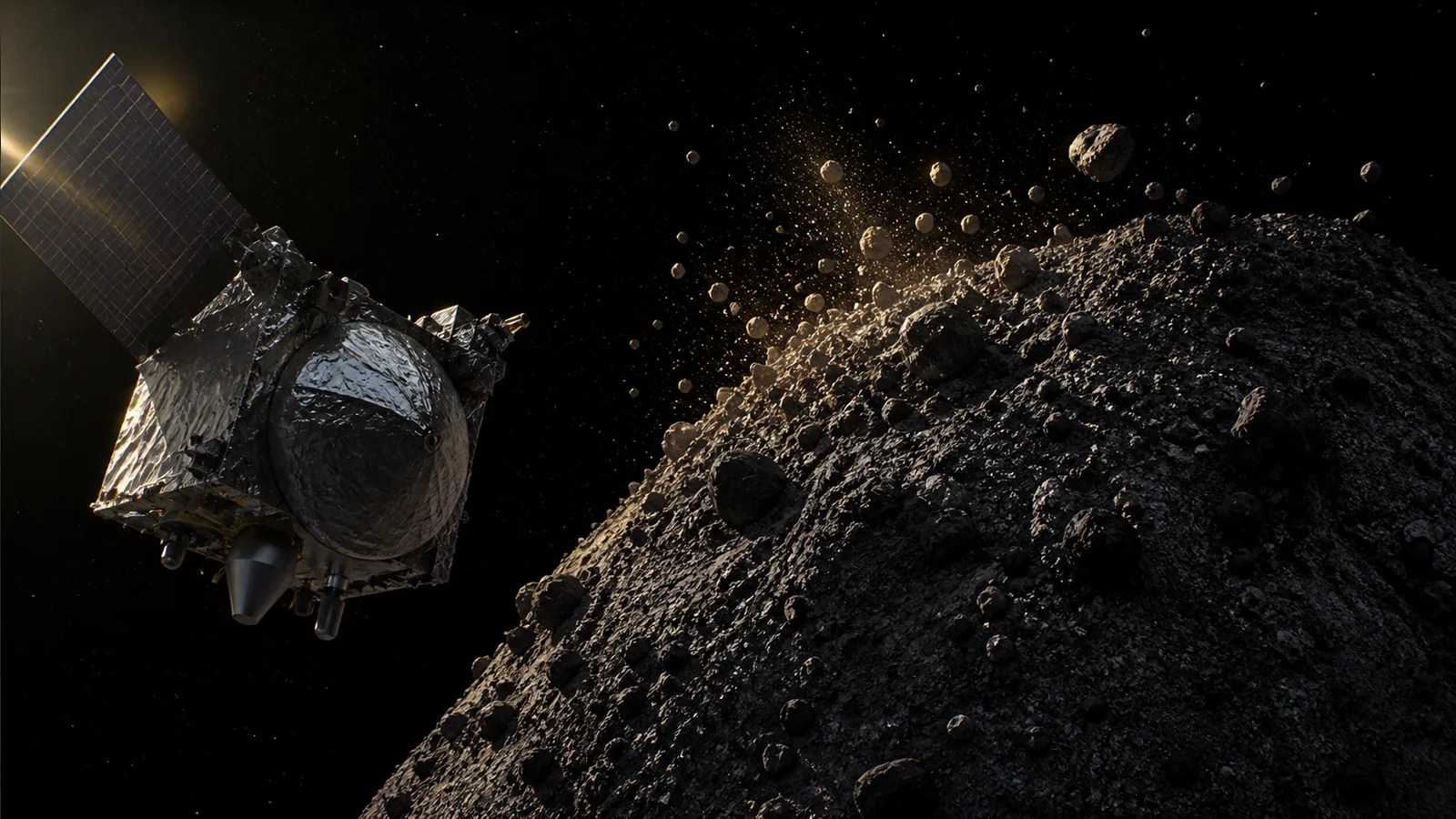
OSIRIS-REx was a NASA spacecraft sent to study the asteroid Bennu, collect material from its surface, and bring that sample back to Earth. Its name stands for Origins, Spectral Interpretation, Resource Identification, Security-Regolith Explorer, which explains why everyone wisely shortened it.
The spacecraft arrived at Bennu in late 2018. Soon afterward, its navigation cameras captured bright specks surrounding the asteroid. Mission scientists initially assumed they were stars in the background. A closer look revealed that some of them were moving away from Bennu.
The asteroid was ejecting pieces of itself into space.
The first major event was recorded on January 6, 2019. More followed over the next several weeks. During the largest eruption, scientists observed roughly 200 particles, with some pieces measuring up to about four inches across.
Not every particle escaped. Some briefly entered orbit around Bennu before falling back to the surface, leaving the asteroid temporarily surrounded by its own debris.
Scientists considered several possible causes. Small meteoroid impacts may have knocked material loose. Rapid temperature changes could have cracked surface rocks, while released water vapor may also have played a role. More than one process could be responsible.
OSIRIS-REx eventually collected material from Bennu and delivered it to Earth in 2023. The mission accomplished exactly what NASA sent it to do, but not before revealing that its supposedly quiet target was regularly launching rocks into space.
#4 SOHO Becomes the Most Successful Comet Hunter in History

SOHO stands for the Solar and Heliospheric Observatory. Launched in 1995 as a joint mission between NASA and the European Space Agency, it was built to study the Sun from its deep interior to its outer atmosphere and solar wind.
Finding comets was not the main assignment.
One of SOHO’s instruments, called LASCO, uses a solid disk to block the Sun’s overwhelming glare. This allows its cameras to observe the much fainter corona around it. It also happens to reveal small comets passing dangerously close to the Sun.
Scientists expected SOHO might spot a few. They did not expect it to find more than 5,000.
Most are sungrazing comets, small objects that pass extremely close to the Sun. Many brighten briefly before breaking apart or disappearing completely. Because they are difficult to see from Earth, some had traveled through the solar system unnoticed until they crossed SOHO’s images.
The discoveries were not made by professional astronomers alone. Through the NASA-funded Sungrazer Project, volunteers around the world began searching publicly available SOHO images from their own computers. Many of the mission’s comets were first identified by these citizen scientists.
SOHO eventually became the most prolific comet finder in astronomical history, responsible for discovering more than half of all known comets. A spacecraft built to watch one star accidentally became very good at spotting thousands of smaller objects falling toward it.
#3 Cassini Finds an Ocean Inside Enceladus

Cassini was a spacecraft sent to study Saturn, its rings, and its many moons. The joint mission involving NASA, the European Space Agency, and the Italian Space Agency entered orbit around Saturn in 2004.
One of those moons was Enceladus, a small, bright ball of ice that scientists expected to be frozen solid. At only about 310 miles across, it did not seem large enough to retain much internal heat.
Cassini quickly found reasons to reconsider.
During a close flyby in 2005, the spacecraft detected something disturbing Saturn’s magnetic field near Enceladus. Its instruments also recorded dust-sized particles around the moon, while its cameras found unusual fractures near the south pole.
Then Cassini photographed enormous plumes of water vapor and ice erupting from the surface.
The material was escaping through deep cracks nicknamed “tiger stripes.” Later flybys allowed Cassini to pass directly through the plumes and analyze what they contained. Scientists detected water, salts, organic compounds, and other evidence pointing toward liquid water beneath the frozen crust.
Further observations revealed that Enceladus was not hiding a small pocket of melted ice. It appeared to contain a global, salty ocean, with signs of hydrothermal activity where that water meets the moon’s rocky core.
A moon once expected to be little more than a frozen lump became one of the most promising places to investigate whether conditions suitable for life might exist beyond Earth. Cassini had gone to explore the Saturn system. Enceladus gave the mission an entirely new reason to keep coming back.
#2 Voyager 1 Discovers Active Volcanoes on Io

Voyager 1 launched in 1977 to explore Jupiter and Saturn. During its Jupiter encounter in March 1979, the spacecraft photographed Io, one of the planet’s largest moons.
The most important discovery appeared in an image that was not originally taken to search for volcanoes.
Linda Morabito, an optical navigation engineer at NASA’s Jet Propulsion Laboratory, was examining a photograph used to determine Io’s position against the background stars. She noticed a bright curved shape extending beyond the moon’s edge.
It was a volcanic plume rising more than 150 miles above the surface.
Scientists examined additional Voyager images and found several more eruptions. Io was not the quiet moon many had expected. It was covered with active volcanoes blasting material into space, making it the most volcanically active body known in the solar system.
The activity comes from the immense gravitational forces surrounding Io. Jupiter pulls on the moon while nearby moons tug it in other directions. This constant flexing generates enormous heat inside Io, melting material beneath its surface and feeding repeated eruptions.
It was the first time humanity had directly observed active volcanoes anywhere beyond Earth. The discovery began with one engineer noticing that a small bright shape in a navigation photograph did not belong there.
#1 The Vela Satellites Detect Explosions From Deep Space

The Vela satellites were launched by the United States during the Cold War to watch for secret nuclear tests. Beginning in 1963, they carried detectors capable of identifying the bursts of X-rays and gamma rays produced by nuclear explosions in Earth’s atmosphere or in space.
On July 2, 1967, those detectors recorded a powerful six-second flash.
It did not behave like a nuclear test. The signal reached multiple satellites at slightly different times, allowing researchers to compare the readings and determine that it had not come from Earth. It had not come from the Sun either.
The good news was that nobody had secretly detonated a nuclear weapon. The more confusing news was that something far beyond the solar system had produced an enormous burst of gamma radiation.
Scientists at Los Alamos National Laboratory continued examining similar events recorded by later Vela satellites. By studying the timing of the signals, they identified 16 bursts that appeared to come from different directions in space. The discovery remained classified for several years before the results were published in 1973.
Astronomers now call them gamma-ray bursts. Some are produced when massive stars collapse and form black holes. Others occur when dense objects such as neutron stars collide. For a few seconds, a burst can release more energy than the Sun will produce over billions of years.
The Vela satellites were built to detect weapons hidden on or near Earth. Instead, they uncovered a new class of cosmic explosion and opened an entire field of astronomy. Nothing else on this list wandered further from the original assignment.
Sources & Image Credits
NASA: Mariner 10; NASA: Mercury’s Magnetic Field; NASA: Bennu’s Particle Events; NASA and ESA: SOHO’s Comet Discoveries; NASA: Enceladus; NASA/JPL: Volcanoes on Io; NASA Goddard: Vela and Gamma-Ray Bursts.
AI-assisted scientific visualizations created for ListImmerse using NASA, NASA/JPL, NASA Goddard, and ESA mission material as visual references.
Leave a Reply