

What would you do if you were the only person who noticed?
Most strange details turn out to be nothing.
For these five people, they led to a fugitive, a kidnapping, a hidden bomb and a public health crisis. All because someone decided to look twice.
#5 The Neighbor Who Recognized John List
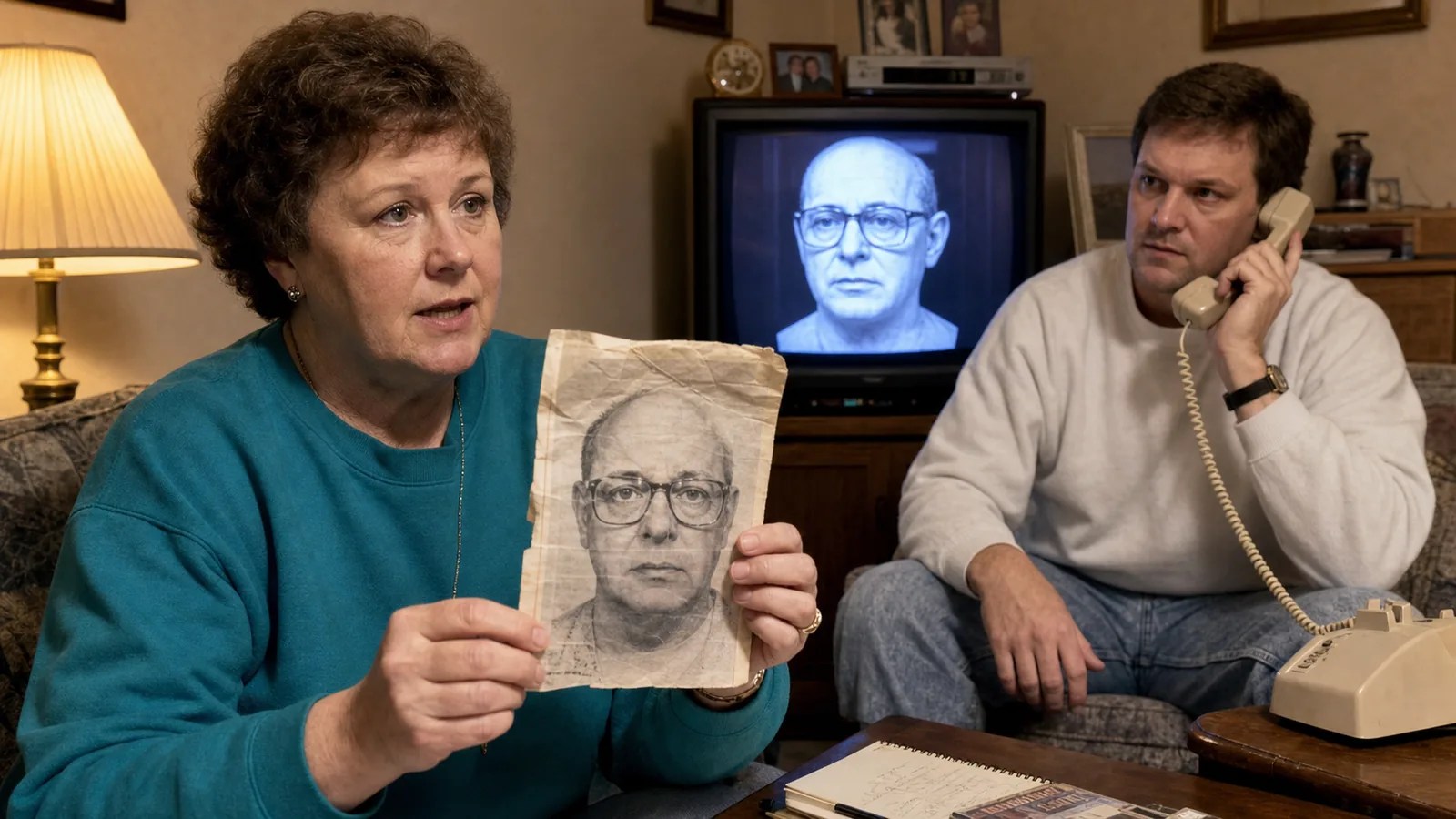
In 1971, John List murdered his wife, his mother and his three children inside their New Jersey home. He then disappeared and spent nearly 18 years living under the name Robert Clark.
In 1987, the FBI produced an age-enhanced image showing how List might look after years on the run. When the picture appeared in a supermarket tabloid, Wanda Flannery recognized the man as her former neighbor. She even challenged Clark’s wife to confront him about the resemblance, but nothing came of it.
Two years later, America’s Most Wanted featured the case. Forensic artist Frank Bender created a plaster bust of an older List, complete with thinning hair and the heavy glasses he was expected to wear.
Flannery was still convinced. By then, List had moved to Midlothian, Virginia, but she knew his new address and asked her son-in-law to contact the FBI.
Agents arrested List at the Richmond accounting office where he worked on June 1, 1989. He initially denied his identity, but fingerprints from an old gun permit application confirmed the truth.
Flannery had recognized him two years before the television broadcast. The difference was that this time, someone made the call.
#4 LeeAnne Walters Tested Flint’s Water

After Flint, Michigan, changed its water source in 2014, residents began reporting foul smells, strange colors and painful skin problems. Officials repeatedly told them the water was safe.
LeeAnne Walters was not convinced. Her young son developed rashes, another became seriously ill and tests showed elevated lead levels in one of her children. Water from the family’s home was later found to contain dangerously high concentrations of lead, including one sample measured at more than 13,000 parts per billion.
Walters contacted EPA (Environmental Protection Agency) water expert Miguel Del Toral and eventually connected with researchers at Virginia Tech. She learned how to collect proper samples, helped distribute testing kits across Flint and worked with residents to gather evidence from throughout the city.
The results showed that the problem went far beyond one household. Flint’s untreated river water had corroded aging pipes, allowing lead to enter the drinking supply while residents were being assured there was no serious danger.
Walters was a mother asking why her tap water looked wrong. Her refusal to accept an easy answer helped expose one of the worst public health failures in recent American history.
#3 Charles Ramsey Heard a Woman Calling for Help

On May 6, 2013, Charles Ramsey was at home in Cleveland when he heard screaming from the house next door. He went outside and saw a woman desperately trying to escape through the front door.
The woman was Amanda Berry, who had disappeared nearly ten years earlier. She was trapped inside with her young daughter and needed help breaking through the locked storm door.
Ramsey and another neighbor, Angel Cordero, rushed over and helped force open the lower section of the door. Accounts later differed over which man arrived first, but both were involved in the rescue. Berry escaped with her daughter and immediately called 911.
Police entered the house and discovered Michelle Knight and Gina DeJesus, two other missing women who had also been held captive by Ariel Castro for years. All three had been living inside an ordinary house in a busy neighborhood.
Berry created the opportunity to escape. Ramsey and Cordero heard her, recognized that she was in real trouble and acted. By the end of that afternoon, three disappearances that had haunted Cleveland for years finally had an answer.
#2 Richard Jewell Found an Abandoned Backpack

Just after midnight on July 27, 1996, Centennial Olympic Park in Atlanta was packed with people enjoying a concert during the Summer Games. Security guard Richard Jewell noticed a green military-style backpack sitting unattended beneath a bench near a sound tower.
Jewell alerted police and helped establish a perimeter while officers examined the bag. Inside were three pipe bombs surrounded by nails and screws. A warning call had already been made, but confusion over the location delayed the response.
Jewell and other officers began moving people away. The crowd was large, noisy and not particularly interested in being told to leave. Before the evacuation could be completed, the bomb exploded.
One woman was killed and more than 100 people were injured, but investigators agreed that Jewell’s decision to report the backpack prevented a much larger loss of life. He had noticed the danger and done exactly what he was supposed to do.
Within days, however, Jewell became the focus of the investigation and was publicly treated as a suspect. He was later cleared completely. The actual bomber, Eric Rudolph, was captured in 2003 and eventually pleaded guilty.
Jewell found the bomb, helped clear the area and probably saved dozens of lives. He then spent months defending himself for a crime committed by someone else.
#1 Linda Patrik Suspected the Unabomber Was Family

For 17 years, the Unabomber mailed homemade bombs across the United States, killing three people and injuring 23 others. Despite one of the largest investigations in FBI history, authorities still did not know his name.
In September 1995, newspapers published a 35,000-word manifesto written by the bomber. Investigators hoped someone would recognize its ideas, vocabulary or unusual phrasing. Linda Patrik did.
The writing reminded her of Ted Kaczynski, the estranged older brother of her husband, David. Linda had never met Ted, but she knew about his isolation, his anger toward modern technology and the letters he had sent David over the years. She urged her husband to read the manifesto.
David was understandably reluctant to consider that his brother might be a serial bomber. Once he compared the manifesto with Ted’s letters, however, the similarities became difficult to dismiss. The couple hired an attorney and provided investigators with examples of Ted’s writing.
Those comparisons helped the FBI obtain a search warrant. On April 3, 1996, agents arrested Ted Kaczynski at his remote Montana cabin, where they discovered bomb-making materials, journals and a completed explosive device.
Thousands of investigators had searched for the Unabomber. The lead that finally identified him began with Linda Patrik recognizing the beliefs and language of someone she had never even met.
Leave a Reply