

Rescue seemed impossible. Survival looked even less likely. These five people managed both.
Here at ListImmerse, “bad day” can mean anything from an awkward lawsuit to falling from a burning plane without a parachute. This list leans toward the second kind.
These five people survived the original disaster, then faced the much harder question of how to get out.
#5 Tami Oldham Ashcraft
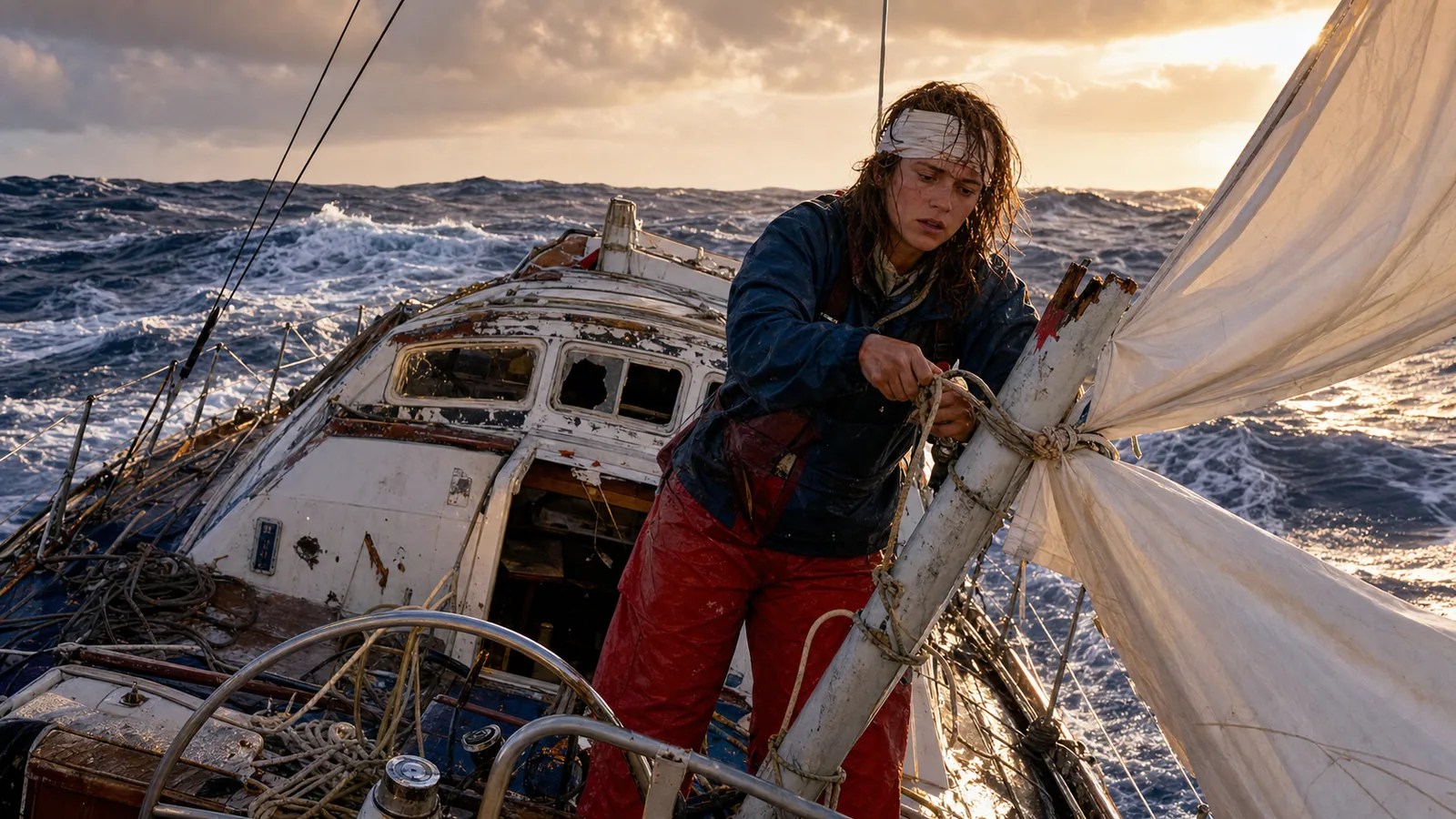
In September 1983, 23-year-old Tami Oldham and her fiancé, Richard Sharp, left Tahiti aboard the Hazaña, a 44-foot yacht they had been hired to deliver to San Diego.
Three weeks into the journey, Hurricane Raymond caught up with them. Sharp sent Oldham below deck as the storm battered the yacht with towering waves and violent winds. The boat capsized, throwing her against the cabin wall and knocking her unconscious.
Oldham woke roughly 27 hours later. The cabin was flooded, the masts were gone, and the radio and navigation equipment no longer worked. Sharp had been swept overboard and was never found.
Still suffering from a serious head injury, Oldham created a makeshift sail from a storm jib and broken pole. She pumped water from the cabin, rationed the remaining food, and used a sextant and watch to calculate her position.
Reaching San Diego was no longer possible, so she aimed for Hawaii instead. One small navigational error could have sent her past the islands and deeper into the Pacific.
After 41 days alone at sea and roughly 1,500 miles of improvised sailing, Oldham reached Hilo. She had escaped the hurricane, but only after navigating a wrecked yacht across an ocean while grieving the person who should have been beside her.
#4 Nicholas Alkemade

On the night of March 24, 1944, RAF rear gunner Nicholas Alkemade was flying over Germany in a Lancaster bomber when the aircraft was attacked and caught fire.
Alkemade tried to reach his parachute, but it was already burning. With flames spreading through the aircraft and the bomber falling out of control, he faced two options. He could remain inside and burn, or jump from roughly 18,000 feet without a parachute.
He jumped.
Alkemade fell more than three miles toward a snow-covered forest. Pine branches slowed his descent before he landed in a deep snowdrift. Somehow, he remained conscious and suffered no broken bones. His most serious injury was reportedly a sprained leg.
German soldiers captured him soon afterward. When Alkemade explained how he had arrived, they assumed he was lying. Investigators searched the wreckage, however, and found his burned parachute exactly where he said it would be.
The German authorities eventually gave him a document confirming that his account was true. The Royal Air Force Museum preserves the story and the official statement corroborating his fall.
Alkemade spent the remainder of the war as a prisoner. Under the circumstances, being taken into custody may have been the first remotely normal thing to happen to him that night.
#3 Joe Simpson

In 1985, British climbers Joe Simpson and Simon Yates completed the first ascent of the west face of Siula Grande, a 20,813-foot mountain in the Peruvian Andes.
The climb up succeeded. The descent nearly killed them both.
Simpson fell and drove his lower leg through his knee joint. On a remote mountain without rescue teams nearby, an injury that severe was usually fatal. Yates refused to abandon him and began lowering Simpson down the mountain using their ropes.
During one descent, Simpson was lowered over an unseen cliff and left hanging in midair. Yates could not pull him back up, and the weight was slowly dragging Yates from his position. Unable to see or communicate with Simpson, Yates eventually cut the rope to avoid both men falling.
Simpson dropped into a deep crevasse.
Yates searched for him the following morning but found no sign that he had survived. Believing Simpson was dead, he returned to their base camp.
Simpson was still alive. He lowered himself deeper into the crevasse, found another route onto the glacier, and began crawling toward camp with his shattered leg. He moved by setting small targets and dragging himself forward before the time he had allowed himself expired.
Days later, severely dehydrated and close to death, Simpson reached the edge of camp shortly before Yates was due to leave. He escaped the mountain with only hours to spare.
#2 Harrison Okene
On May 26, 2013, Harrison Okene was working as a cook aboard the Jascon-4, a tugboat operating off the coast of Nigeria. Shortly before dawn, heavy waves overturned the vessel and sent it nearly 100 feet to the ocean floor.
Okene was in the bathroom when the ship capsized. In complete darkness, he moved through the flooded vessel until he found a small pocket of trapped air. He climbed onto a platform above the rising water and waited.
The tugboat’s other eleven crew members died. Okene had no way to contact the surface, and the rescue teams believed they were conducting a recovery operation rather than searching for survivors.
For roughly 60 hours, he remained inside the overturned ship with no food, almost no fresh water, and no idea whether anyone would reach him before the air became unbreathable.
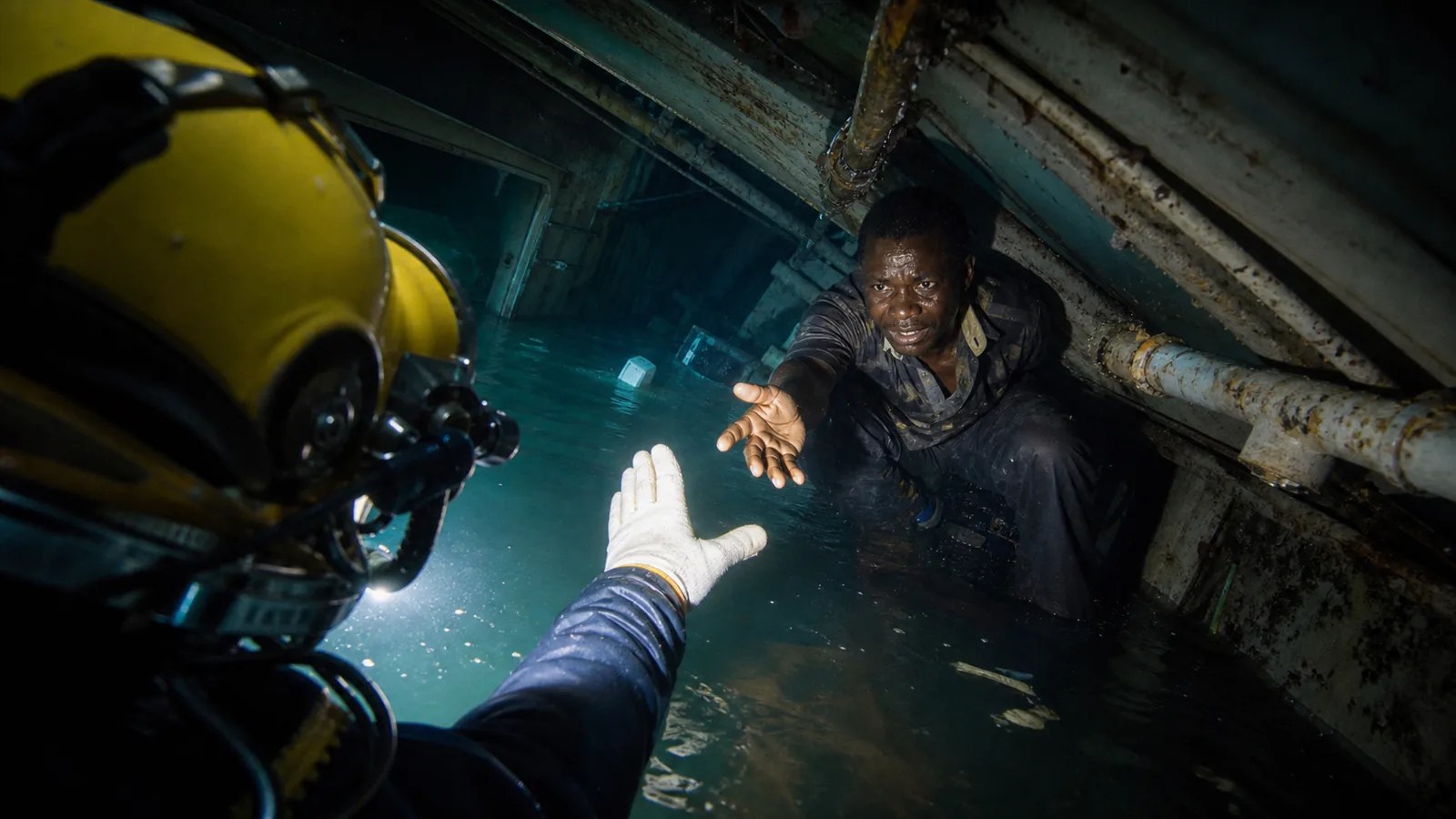
A team of saturation divers eventually entered the wreck to recover bodies. As one diver moved through the darkness, Okene reached out and grabbed his hand. The diver recoiled before realizing that the person touching him was alive.
The remarkable encounter was captured by the diver’s camera and can be seen in the rescue footage released by DCN Diving.
Because Okene had spent so long under pressure, he could not simply return to the surface. He was transferred to a diving bell and spent about another 60 hours decompressing before finally emerging alive.
#1 Beck Weathers

On May 10, 1996, a powerful storm trapped several climbing teams high on Mount Everest. Eight people died during what became one of the mountain’s most infamous disasters.
American pathologist Beck Weathers had already abandoned his summit attempt after problems with his eyesight. While descending with other climbers, he became lost in the whiteout and eventually collapsed on the South Col.
Rescuers found Weathers lying in the snow beside Japanese climber Yasuko Namba. Both appeared to be beyond saving. Namba died, and Weathers was left where he had fallen because the others believed moving him would only endanger more lives.
He remained exposed for roughly fifteen hours in hurricane-force winds and extreme cold.
Then Weathers regained consciousness.
His vision was nearly gone. His face and hands were badly frozen, and one arm had stopped functioning. With no clear explanation for how he was still able to move, Weathers stood and began stumbling through the storm.
About an hour later, he walked into Camp IV.
The climbers inside initially struggled to recognize him. Even after reaching shelter, Weathers was still in critical condition. He survived another night on the mountain before descending far enough to be evacuated by helicopter in a dangerous high-altitude rescue.
Doctors later amputated his right hand, most of his left hand, and parts of both feet. His nose required reconstruction.
Weathers earns the number one spot because his survival was not simply a matter of holding on until rescuers arrived. He had already been examined, declared beyond help, and left behind. His escape began when he stood up anyway.
Leave a Reply