

They were buried with strict opening dates. None of us are invited.
What would you leave behind if you knew nobody would see it for thousands of years?
These six time capsules contain everything from secret manuscripts to toys, recordings and ordinary pieces of daily life. Their creators carefully selected what the distant future should know about us, sealed the doors and accepted that they would never see them opened.
#6 The Future Library
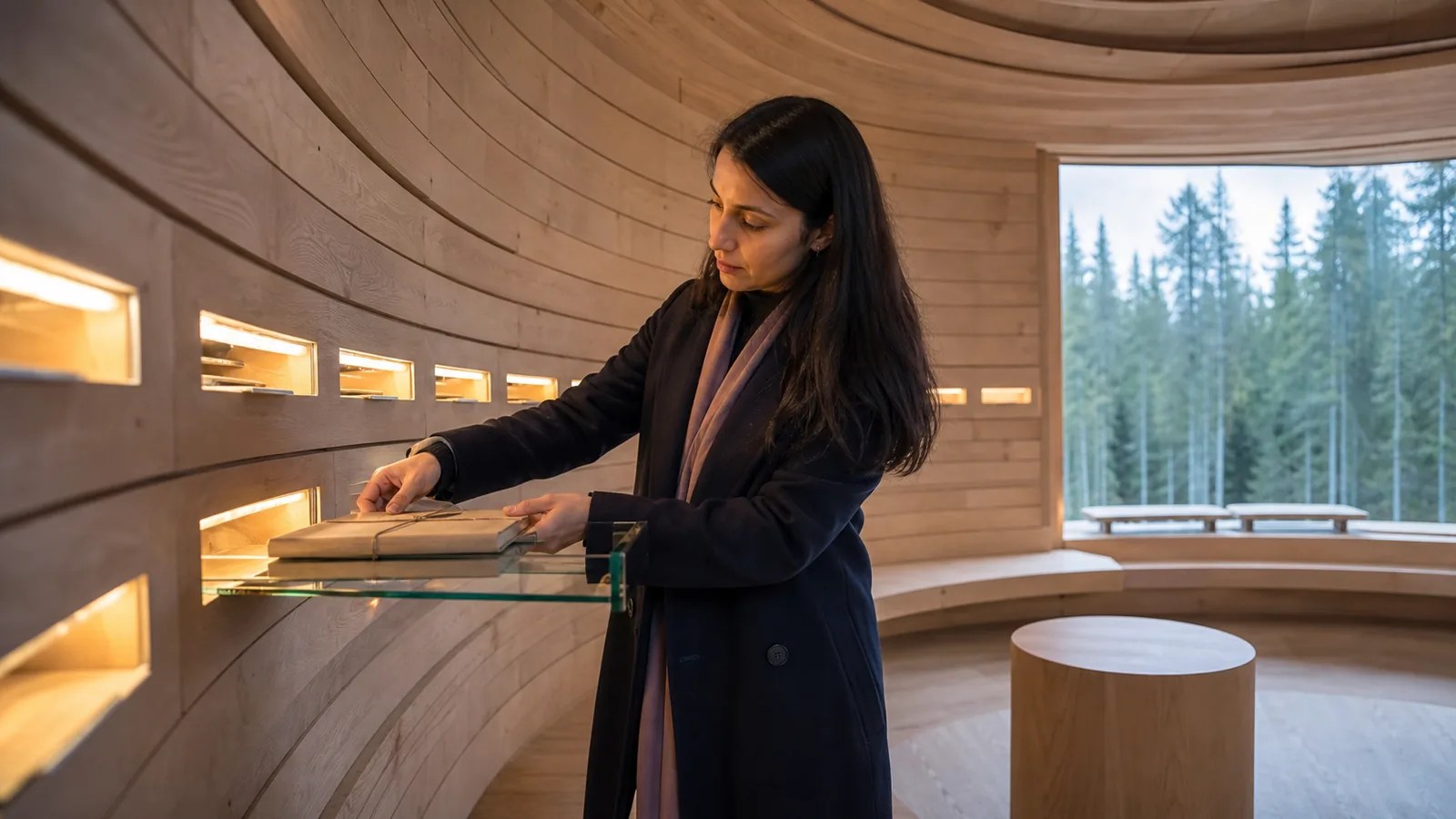
In 2014, Scottish artist Katie Paterson planted 1,000 spruce trees in a forest outside Oslo and asked Margaret Atwood to write a book that nobody could read.
Atwood handed over a manuscript titled Scribbler Moon. Its contents remain secret. Since then, another author has contributed an original work each year, with every manuscript stored inside the specially constructed Silent Room at Oslo’s Deichman Bjørvika library.
The project will continue for a century. In 2114, the trees planted at its beginning are supposed to be harvested and turned into paper for publishing all 100 manuscripts.
None of the participating writers is allowed to reveal what they submitted. Many will never know how readers respond, and most people alive when the project began will not be around for the release either.
For now, visitors can enter the Silent Room and stand near the manuscripts. They just cannot read them, which may be the most elaborate use of “coming soon” ever attempted.
#5 America’s 250th Anniversary Time Capsule

In 2026, the United States celebrated its 250th anniversary by sealing a time capsule that will remain closed until 2276.
This was not a decorative box filled during a lunch break. The capsule weighs roughly 900 pounds and was engineered by the National Institute of Standards and Technology to survive 250 years underground. Its cylindrical stainless steel shell includes multiple barriers against water, pressure and changing temperatures.
Inside are objects representing every state and territory, along with historical records preserved in synthetic DNA. That technology can store enormous amounts of information in a space smaller than a grain of sand, although the capsule also contains instructions explaining how to decode it. Apparently, its creators considered the possibility that people in 2276 may have forgotten our file formats.
Everyone who watched it being sealed knew they would never see it opened. The contents were chosen for Americans who have not been born yet, living in a country that may look completely different.
We left them history, technology and a carefully protected collection of objects. They will probably still spend the first ten minutes looking for a charger.
#4 The MIT Time Capsule
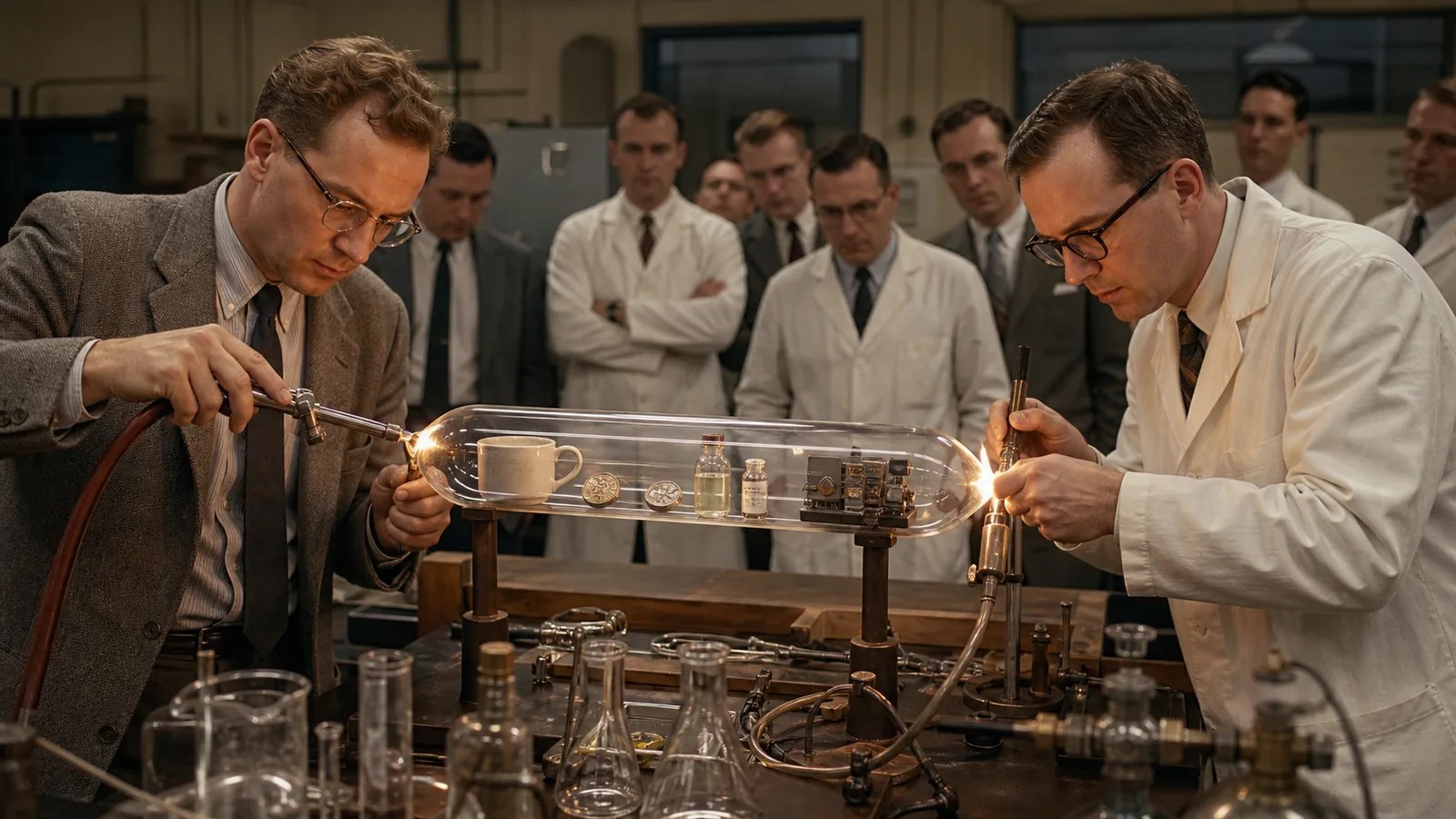
In 1957, MIT buried a glass time capsule beneath its campus and marked it with an opening date of 2957.
The cylinder was created in the university’s glassblowing laboratory, filled with argon gas and sealed using blowtorches. Its contents included coins, a commemorative mug, an empty tonic bottle, synthetic penicillin and a cryotron, a tiny electronic component that researchers believed could help shape the future of computing.
The creators even placed carbon-14 inside. If the glass cracked and everything else was destroyed, future scientists could still determine approximately when it had been buried.
There was just one problem. Construction workers accidentally uncovered the capsule in 2015 while excavating for MIT.nano. It had completed only 58 years of its planned 1,000-year wait.
MIT resisted the obvious temptation and left the capsule sealed. After being unexpectedly dragged into the present, it still has more than nine centuries to go.
#3 The Westinghouse Time Capsule

The phrase “time capsule” became popular because Westinghouse needed a name for a seven-and-a-half-foot metal tube it planned to bury beneath the 1939 New York World’s Fair.
The capsule was made from a corrosion-resistant alloy called Cupaloy and lowered 50 feet underground. Inside were objects chosen to represent ordinary life in the 1930s, including seeds, textiles, microfilm, a fountain pen, a slide rule and a Mickey Mouse watch.
Its scheduled opening date is 6939, exactly 5,000 years after the fair.
Westinghouse understood that building a durable capsule was only half the problem. Future people also needed to know it existed. The company produced more than 3,000 copies of a record book describing the capsule, its location and instructions for recovering it. Those books were distributed to libraries, museums and monasteries around the world.
A second Westinghouse capsule was buried nearby after the 1964 New York World’s Fair, and both are meant to be opened together.
The containers may survive underground for five millennia. The harder part is making sure somebody remembers why they are there.
#2 The Expo ’70 Time Capsule

When Japan hosted Expo ’70 in Osaka, organizers decided to preserve a detailed record of modern civilization for people living 5,000 years in the future.
They filled two matching stainless steel capsules with 2,098 carefully selected items. The collection included seeds, medicines, tools, photographs, recordings, clothing, household products and examples of technology from the period. There was even an electric rice cooker, because future humanity deserved to know that we had at least mastered dinner.
Both capsules were buried near Osaka Castle. The upper capsule serves as a kind of test copy and can be opened periodically so experts can inspect how the materials are aging. The lower capsule is the one meant for the distant future. It is not scheduled to be opened until 6970.
That arrangement gives future caretakers a chance to study the upper collection without disturbing the original. It also means people will spend nearly five millennia protecting a sealed container beneath Osaka while civilization changes around it.
By the time the lower capsule is finally opened, the rice cooker may require the longest instruction manual in history.
#1 The Crypt of Civilization

The other entries on this list are capsules. This one is an entire room.
Hidden beneath Oglethorpe University in Atlanta, the Crypt of Civilization measures roughly 20 feet long, 10 feet wide and 10 feet high. Its walls were lined for protection, and its stainless steel door was welded shut in 1940. The instructions are very clear: do not open it until May 28, 8113.
University president Thornwell Jacobs created the crypt after becoming frustrated by how little reliable information survived from ancient civilizations. He wanted future historians to receive a deliberate record of everyday life instead of piecing everything together from whatever happened to survive.
The room contains books, newsreels, voice recordings, household appliances, toys, seeds, dental floss and a sealed container of Budweiser. It also holds a wind-powered generator and a machine designed to teach English in case the language is no longer understood.
The date was chosen to place the opening as far into the future as the beginning of the ancient Egyptian calendar seemed from Jacobs’s own time. More than 6,000 years would pass between the sealing and the planned opening.
Nobody knows whether Oglethorpe University, the English language or even our current civilization will still exist by then. That uncertainty is exactly what earns the crypt the number one spot. It was not created for the grandchildren of its builders. It was created for a world they could barely imagine.
Sources & Image Credits
Future Library: Official Project Information
National Institute of Standards and Technology: America250 Time Capsule
MIT News: MIT’s 1957 Time Capsule
Bureau International des Expositions: The Westinghouse Time Capsule
Panasonic: The Expo ’70 Time Capsule
Oglethorpe University: The Crypt of Civilization
Image Credits
The images in this article are AI-assisted historical illustrations. The Westinghouse illustration also incorporates a genuine archival photograph from the New York World’s Fair records.
AI-assisted scenes are visual reenactments and should not be interpreted as original historical photographs.
Leave a Reply