

What gets left behind when an entire place shuts down?
When an entire place is abandoned, not everything makes it out.
Sometimes it is furniture or paperwork. Sometimes it is a passenger plane, a valuable painting, or enough fish to turn a shopping mall into an aquarium.
These five places were left behind with something incredible still inside.
#5 Hashima Island’s Abandoned Apartments

From a distance, Hashima Island looks less like a town and more like a concrete battleship stranded off the coast of Japan. That is where its nickname, Battleship Island, comes from.
For decades, the island supported an undersea coal mine operated by Mitsubishi. Apartment blocks, schools, shops, a hospital, and other facilities were packed into a space of about 16 acres. At its peak in 1959, more than 5,000 people lived there, making it one of the most densely populated places in the world.
Life on Hashima was not equally prosperous for everyone. During the years surrounding World War II, Korean and Chinese laborers were forced to work in brutal conditions connected to the island’s mining industry. That history remains an important and disputed part of how the site is presented today.
The mine closed in January 1974 as Japan moved away from coal. Residents departed soon afterward, and by April the entire island was empty.
They took what they could. Plenty remained.
Inside the decaying apartment blocks, rooms still contained televisions, bottles, furniture, newspapers, appliances, and children’s belongings. Schools and medical buildings held old equipment and paperwork. None of it was arranged as an exhibit. It was simply left where everyday life had stopped.
Decades of saltwater, storms, and neglect have since damaged much of the island. Walls have collapsed, vegetation has pushed through concrete, and many interiors are too dangerous to enter. Limited tours eventually began, but visitors are kept to designated routes away from the most unstable buildings.
Hashima is striking because it was not a small settlement that slowly faded away. It was a crowded vertical town where thousands of people worked, studied, shopped, and raised families.
Then the mine closed, everyone left within a few months, and their belongings were left to age without them.
#4 The Fish Inside New World Mall

New World Mall in Bangkok did not close quietly.
The shopping center opened in the early 1980s, but developers reportedly built far more floors than local regulations allowed. Authorities ordered the illegal upper levels demolished, leaving much of the building exposed. A fire later damaged the structure, and the mall was eventually abandoned.
Then the rain came in.
With no proper roof, the lower floors filled with water. The flooded building became a breeding ground for mosquitoes, which was an obvious problem for everyone living nearby.
Local residents reportedly responded by releasing fish into the water to eat the mosquito larvae.
It worked a little too well.
The fish multiplied until thousands of koi, catfish, carp, and other species were swimming through what had once been a shopping center. Broken columns rose from the water. Staircases led down into a murky indoor lake. Visitors leaned over the ruined floors to feed fish where people had once gone shopping.
For a while, New World Mall became an accidental tourist attraction. Photographs of the flooded interior spread online because it looked less like an abandoned building and more like nature had opened a business without filing any paperwork.
The arrangement could not last. Officials were concerned about the unstable structure, water quality, and the safety of people entering the condemned mall. In 2015, thousands of fish were removed and transferred elsewhere as authorities drained the building.
The fish were not originally abandoned with the mall. They arrived afterward because the empty structure had created a new problem.
That is what makes New World Mall so strange. A failed shopping center became a mosquito pond, then a giant aquarium, all because some local residents found a practical solution and the fish took it from there.
#3 The Paris Apartment Frozen in Time

In 2010, auctioneer Olivier Choppin Janvry entered a Paris apartment that had been closed for decades.
What he found looked less like an abandoned home and more like someone had locked the door during the Belle Époque and expected to return after lunch.
The rooms were crowded with antique furniture, old books, perfume bottles, letters tied with ribbon, paintings, and a taxidermied ostrich. Dust covered almost everything. A vintage Mickey Mouse toy sat among objects that belonged to a much older Paris.
The apartment had once belonged to Marthe de Florian, a French actress and prominent social figure. It later passed to her granddaughter, who left Paris for southern France during World War II and never permanently returned. She continued paying for the apartment until her death at the age of 91.
The biggest discovery was a portrait of Marthe wearing a pale pink evening dress.
The unsigned painting was believed to be the work of Italian artist Giovanni Boldini, who had known Marthe personally. Experts found letters and other evidence connecting the two, helping establish the painting’s history and authenticity.
When the portrait went to auction in 2010, it sold for €2.1 million, setting a record for a Boldini painting at the time.
Some versions of the story describe the apartment as completely untouched for 70 years. The full timeline is less certain. Papers dated after World War II were reportedly found inside, suggesting someone may have entered during those decades.
Still, the important part remains true. A Paris apartment stayed closed for an extraordinary amount of time, filled with the possessions of another era, while its rent continued to be paid.
Then someone finally opened the door and found a painting worth millions waiting in the dust.
#2 The Passenger Plane at Nicosia Airport

Nicosia International Airport was once the main gateway into Cyprus.
Its modern terminal opened in 1968, carrying tourists and residents through check in counters, departure lounges, restaurants, and a runway that connected the island to cities across Europe and the Middle East.
Then fighting reached the airport in 1974.
Following a coup backed by the Greek military government and the subsequent Turkish invasion of Cyprus, the airport became a major point of conflict. Commercial operations stopped, United Nations forces took control of the site, and the surrounding area became part of the buffer zone separating the island’s Greek Cypriot and Turkish Cypriot communities.
The terminal never properly reopened.
Inside, departure boards, counters, advertisements, documents, and equipment remained as the building slowly deteriorated. Outside sat a Cyprus Airways Hawker Siddeley Trident passenger plane that could no longer leave.
The aircraft’s engines were removed during the crisis and used to help repair another Cyprus Airways plane. That second aircraft was eventually flown out, but the stripped Trident stayed behind.
It is still there.
For decades, the damaged plane has remained beside the terminal while sunlight, dust, and weather have worn away its exterior. The runway is empty. Seats gather dirt. Signs still point passengers toward flights that stopped boarding more than 50 years ago.
More recently, researchers entering former airport offices recovered old flight plans, company records, and other documents left behind when operations suddenly ended.
Nicosia Airport is not simply an old building that became unprofitable. It is a place where ordinary travel was interrupted by a conflict that remains unresolved.
The stranded plane makes that history impossible to miss. It was built to carry people away, and it has spent half a century going nowhere.
#1 The Soviet Shuttles Inside Baikonur’s Forgotten Hangar
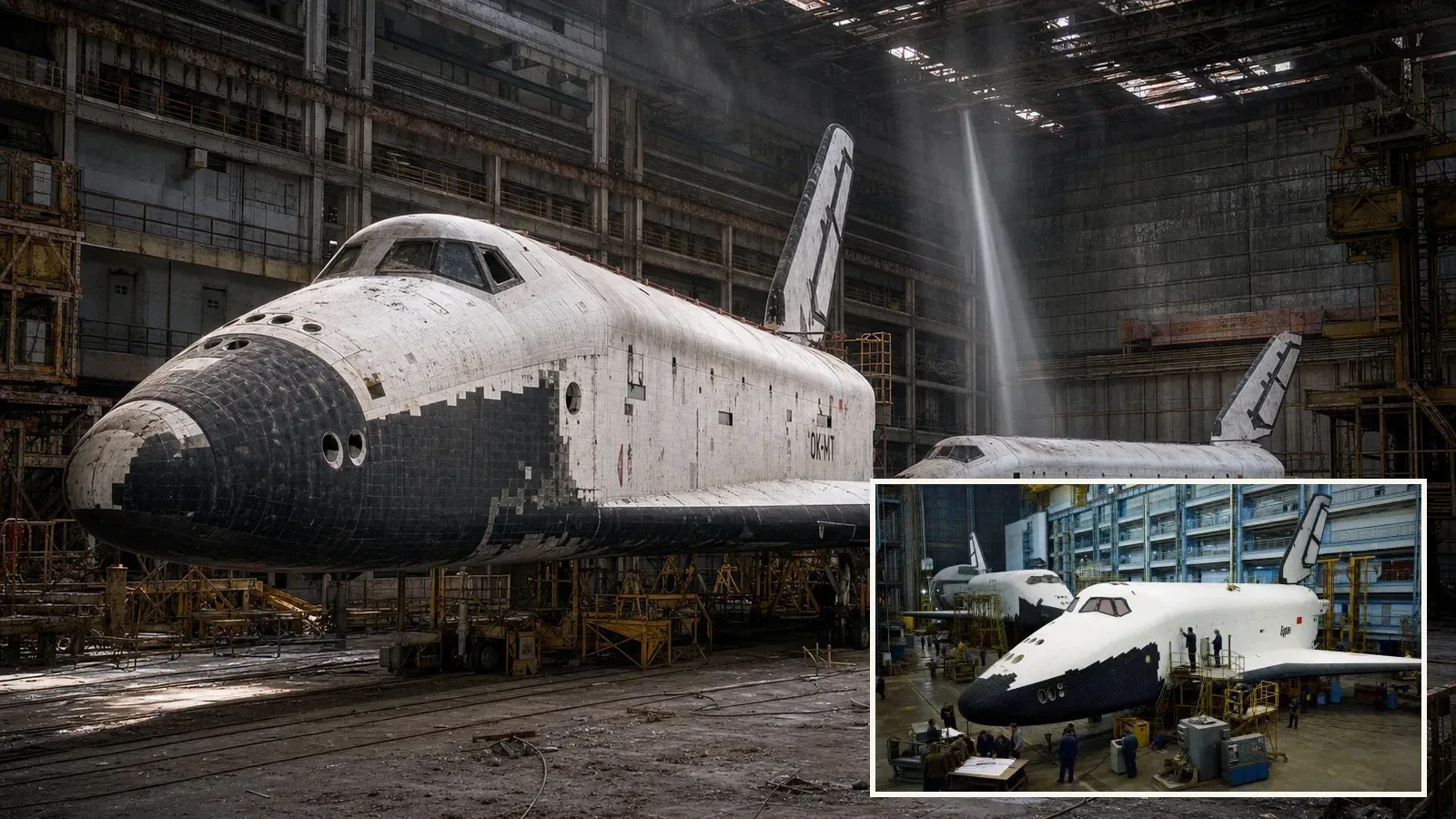
Baikonur Cosmodrome is not abandoned. Rockets still launch from the enormous facility in Kazakhstan.
But hidden among its active areas is a deteriorating building from a space program that ended with the Soviet Union.
Inside sit two enormous spacecraft from the Buran program.
The Soviet Union developed Buran during the Cold War as its answer to the American Space Shuttle. The similarities are obvious, but the Soviet design included important differences. Most impressively, Buran could complete a mission without anyone aboard.
In November 1988, the only Buran orbiter to reach space launched from Baikonur, circled Earth twice, returned through the atmosphere, and landed automatically. It remains the program’s only orbital flight.
The achievement should have marked the beginning of something much larger. Instead, costs rose, funding disappeared, and the Soviet Union collapsed. The Buran program was formally cancelled in 1993.
The orbiter that completed the 1988 mission was stored at Baikonur until 2002, when the roof of its building collapsed. The spacecraft was destroyed, along with an Energia rocket model, and eight workers were killed.
The vehicles inside the surviving hangar are different.
One is known as OK 1.02, an orbiter that was reportedly more than 90 percent complete and intended for a future spaceflight. The other, called OK MT, was a full sized test article used for ground operations and training.
Neither ever reached space.
Photographs taken inside the restricted building show the two vehicles coated in dust beneath a rusting roof. Tiles are damaged. Graffiti covers parts of the bodies. Equipment, platforms, and machinery remain scattered around them.
Urban explorers have repeatedly attempted to enter the facility, and several have been detained. The vehicles may look forgotten, but the hangar is still part of a controlled space complex, not an attraction open to anyone carrying a camera and poor judgment.
This earns the number one spot because of the scale of what remains. These are not chairs, documents, or old appliances. They are full sized spacecraft built for a future that ended before they could leave the ground.
Now they sit inside the same hangar, unfinished and slowly deteriorating beneath the dust.
Leave a Reply