

These confessions closed cases that should have stayed open.
Why would anyone confess to a crime they did not commit? It sounds impossible until fear, exhaustion, isolation, promises, or hours of relentless questioning enter the room.
These five confessions did not happen for the same reason. Some were pressured out of vulnerable people. Others came from people who wanted attention or special treatment. In every case, investigators heard the words they wanted and failed to ask whether they were true.
#5 Laverne Pavlinac

In January 1990, 23-year-old Taunja Bennett was found murdered in Oregon’s Columbia River Gorge. Investigators had little to work with until 57-year-old Laverne Pavlinac contacted them with a detailed story.
Pavlinac said her boyfriend, John Sosnovske, had killed Bennett and forced her to help dispose of the body. She later expanded the account, claiming they had met Bennett at a Portland bar before Sosnovske assaulted and murdered her.
None of it was true.
Pavlinac had spent years in an abusive relationship and believed accusing Sosnovske of murder would finally remove him from her life. She studied newspaper reports about the case and gradually placed herself inside the story. Investigators found no physical evidence connecting either of them to the crime, but her confession was detailed enough to convince a jury.
Pavlinac received a sentence of ten years to life. Sosnovske, fearing a possible death sentence after seeing what happened at her trial, pleaded no contest and was sentenced to life.
The case finally unraveled in 1995 when serial killer Keith Jesperson confessed to murdering Bennett. He revealed information that had never been released publicly, including the location of her missing purse.
Pavlinac and Sosnovske were released after spending nearly five years in prison. Her attempt to escape one terrible situation had created another, while the person who actually killed Bennett remained free.
#4 Stefan Kiszko

Stefan Kiszko was 23 when police arrested him for the 1975 murder of 11-year-old Lesley Molseed in northern England.
Kiszko was socially vulnerable, had no criminal record and struggled under pressure. After three days of intensive questioning without a lawyer present, he signed a confession. He later said officers had bullied him and that he believed cooperating was the only way he would be allowed to go home.
Instead, the confession sent him to prison for life.
There were serious problems with the case from the beginning. Four girls who claimed Kiszko had exposed himself to them later admitted they had invented the story “for a laugh.” More importantly, biological material recovered from Lesley’s clothing contained sperm. Kiszko had a medical condition that left him infertile and unable to produce it.
That evidence did not reach the jury in a way that could protect him. Kiszko was convicted in 1976 and spent 16 years in prison before his conviction was overturned in 1992.
The case did not end there. In 2006, DNA recovered from the original evidence was matched to Ronald Castree after his sample entered a police database in connection with another matter. Castree was convicted of Lesley’s murder the following year.
Kiszko never saw that final result. His time in prison severely damaged his mental health, and he died of a heart attack less than two years after being released. He had confessed because he thought it would end the interrogation. It ended up taking most of his adult life.
#3 The Serial Killer Who Never Was
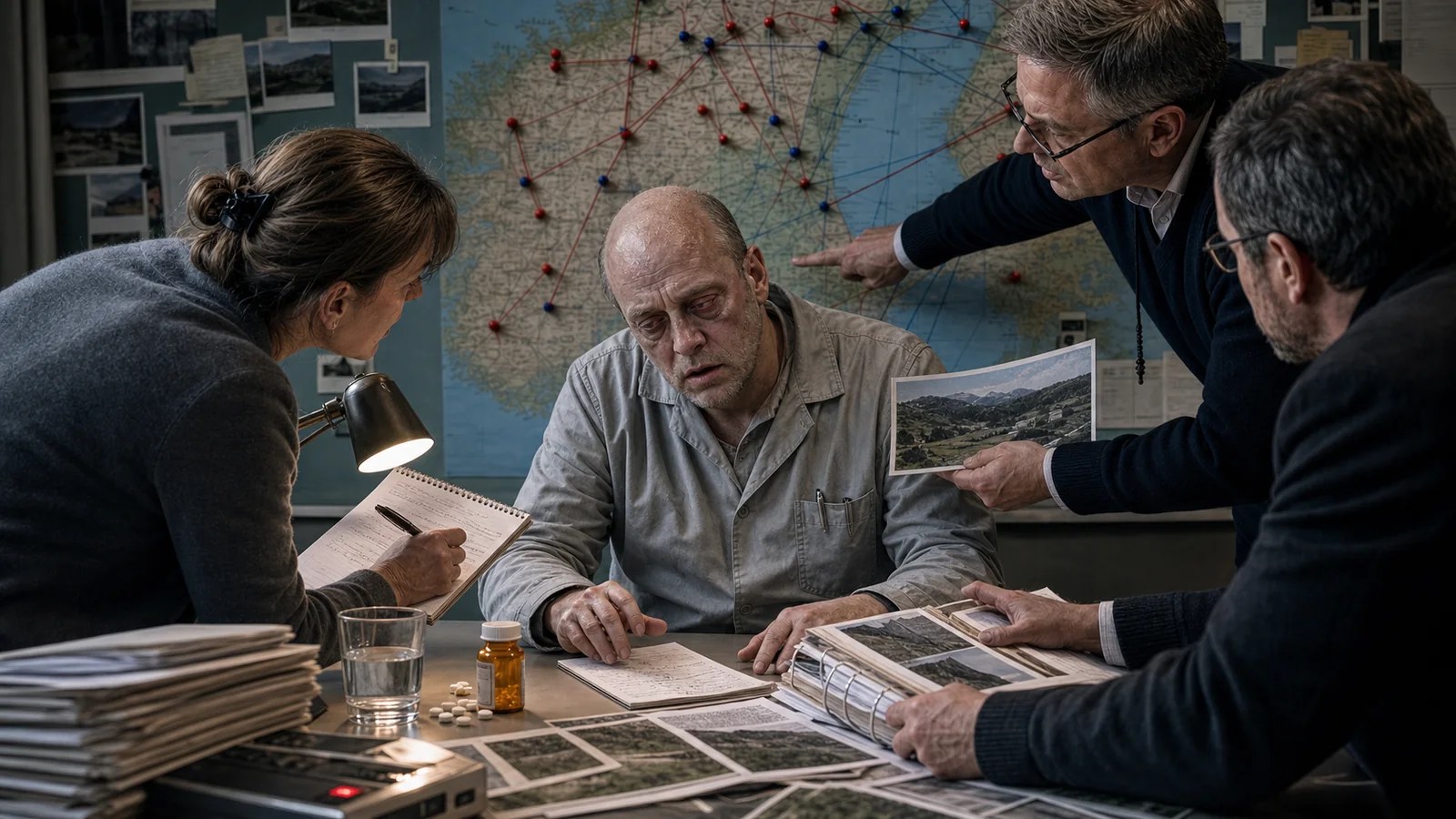
By the early 1990s, Sture Bergwall was already confined to a Swedish psychiatric hospital when he began describing what he claimed were recovered memories of murder.
Using the name Thomas Quick, Bergwall confessed to more than 30 killings across Scandinavia. His stories were horrifying, but they were also inconsistent. Details changed during repeated interviews, crime scene searches produced nothing, and there was no forensic evidence connecting him to the victims.
Still, between 1994 and 2001, he was convicted of eight murders.
At the time, Bergwall was receiving large amounts of benzodiazepines and undergoing therapy built around recovering supposedly buried memories. The more crimes he described, the more attention he received from therapists and investigators. When his account did not fit the evidence, he was questioned again until new details emerged.
Some of those details were plainly wrong. Bergwall misidentified victims, changed murder weapons and confessed to one killing despite a photograph supporting his alibi. In another case, DNA evidence excluded him.
After investigative journalist Hannes Råstam examined the files and challenged the evidence, Bergwall admitted in 2008 that he had fabricated the confessions. By July 2013, all eight murder convictions had been overturned.
Most of the cases did not receive a cleaner ending once Bergwall was cleared. No one else was conclusively convicted, leaving several families with reopened investigations, damaged evidence and years lost to confessions that should never have been trusted.
Sweden had spent years believing it had captured one of Scandinavia’s worst serial killers. In reality, investigators had built the entire case around the changing stories of a heavily medicated psychiatric patient.
#2 Henry Lee Lucas

Henry Lee Lucas was not an innocent man. He had already been convicted of killing his mother and later admitted killing his teenage girlfriend, Frieda “Becky” Powell, and an elderly woman named Kate Rich.
Then the confessions multiplied.
After his arrest in Texas in 1983, Lucas began claiming responsibility for unsolved murders across the United States. The number rose from roughly 100 to more than 300 and eventually reached around 600. Detectives traveled to question him, while Lucas received attention, cigarettes, better food and trips outside prison to visit supposed crime scenes.
Investigators sometimes showed him photographs, reports and maps containing details he later repeated in his confessions. When he gave a wrong answer, he could change it until his story matched the case. Authorities eventually credited him with solving more than 200 murders.
The timeline made that impossible. Lucas confessed to a 1981 murder in Houston even though records placed him inside a Maryland jail. He claimed another killing occurred while employment records showed him working at a Pennsylvania mushroom farm.
Despite those contradictions, Lucas was convicted of 11 murders. He even received a death sentence for killing an unidentified Texas woman known as “Orange Socks,” later identified as Debra Jackson. No physical evidence connected him to her death, and travel records strongly suggested he was in Florida at the time. In 1998, Governor George W. Bush commuted the sentence to life imprisonment.
DNA testing later disproved Lucas’s involvement in at least 20 cases. He was a real murderer, but his endless confessions allowed investigators to close cases he could not possibly have committed, leaving the actual killers free and the victims’ families with answers that were never true.
#1 The Central Park Five

Courtroom scene is an AI reenactment. Photograph of Raymond Santana, Yusef Salaam, and Kevin Richardson by Peabody Awards, licensed under CC BY 2.0. Photograph cropped and incorporated into a composite.

On April 19, 1989, a 28-year-old woman was attacked while jogging through New York City’s Central Park. The crime caused immediate public outrage, and police soon focused on five Black and Latino teenagers: Antron McCray, Kevin Richardson, Yusef Salaam, Raymond Santana and Korey Wise.
They were between 14 and 16 years old.
After hours of intense questioning, police obtained statements implicating the teenagers in the attack. Four appeared in videotaped confessions, but the recordings began only after the lengthy interrogations had taken place. The boys later said they had been frightened, pressured and led to believe they could go home if they cooperated.
Their accounts did not agree on where the attack happened, how it happened or who had done what. None of their DNA matched the biological evidence recovered from the victim. There was also no physical evidence placing any of them at the scene.
The confessions were enough. All five were convicted in 1990 and spent between six and 13 years in prison.
In 2002, convicted murderer and serial rapist Matias Reyes confessed that he had attacked the woman alone. His account contained details known only to the attacker, and his DNA matched the evidence from the crime scene. The five convictions were vacated that December.
The men later became known as the Exonerated Five, and New York City agreed to a $41 million settlement in 2014. By then, the damage extended far beyond the years they had lost. Their names and faces had been presented to the country as proof of guilt before the evidence ever supported it.
Five teenagers had given conflicting accounts of a crime none of them committed. Instead of raising doubts, those contradictions helped send every one of them to prison.
Leave a Reply