

Every history book has a few moments where you have to stop and ask, “Wait, that actually happened?”
We tend to picture history as a long parade of kings, wars, inventions, and people in stiff portraits pretending they had everything under control.
Then you look a little closer.
Suddenly there are politicians being thrown out of windows, armies getting emotional over a bucket, a dead pope placed on trial, people dancing until the city had no idea what to do, and a flood of beer tearing through London streets like the world’s worst happy hour.
These are the kind of historical facts that make you pause for a second, because they sound made up until you realize real people actually had to deal with them.
#5 The Defenestrations of Prague

Most political arguments end with someone storming out of the room. In Prague, history decided that was too boring and started using windows.
The word “defenestration” literally means throwing someone out of a window, which is already a sign that humanity has had some very specific problems. Prague had more than one famous defenestration, but the most important came in 1618, when angry Protestant nobles threw two Catholic officials and their secretary out of a window at Prague Castle.
Somehow, the victims survived the fall. Catholic supporters later claimed angels saved them. Protestant supporters had a less heavenly explanation: they landed in a pile of manure. History rarely gives you a cleaner metaphor than that.
The event helped trigger the Thirty Years’ War, one of the most destructive conflicts in European history. So yes, a fight that involved people being tossed out of a window helped light the fuse on a war that devastated much of Central Europe.
It is the kind of historical fact that sounds like it was added by a bored screenwriter. But no. Real people did this. In a castle. During a political meeting. Which is why, whenever someone says “things were more civilized back then,” it is perfectly fair to ask how close everyone was standing to the windows.
#4 The War of the Bucket

There are plenty of reasons countries and city-states have gone to war. Land. Money. Religion. Power. A long list of very serious things people have been willing to ruin everyone’s day over.
And then there was a bucket.
In 1325, the Italian city-states of Modena and Bologna fought the Battle of Zappolino, a real and bloody clash tied to a much larger rivalry between the two cities. According to the famous story, soldiers from Modena had stolen a wooden bucket from Bologna, and that bucket became the symbol of the whole mess.
To be clear, the bucket was not the only reason people were fighting. Medieval Italy was already packed with political tension, rival factions, and neighbors who seemed constantly ready to turn a disagreement into a helmet situation. But the fact that a plain wooden bucket became attached to the story makes the whole thing feel like history lost a bet.
Modena won the battle, and the bucket became a trophy. Supposedly, it was kept as a symbol of victory, because nothing says “military glory” quite like pointing at a bucket and saying, “We took that.”
The stranger part is not that people fought. People have always been depressingly good at that. The stranger part is that one of the most memorable details from the conflict is an object you would normally use to mop a floor.
#3 A Pope’s Dead Body Was Put on Trial
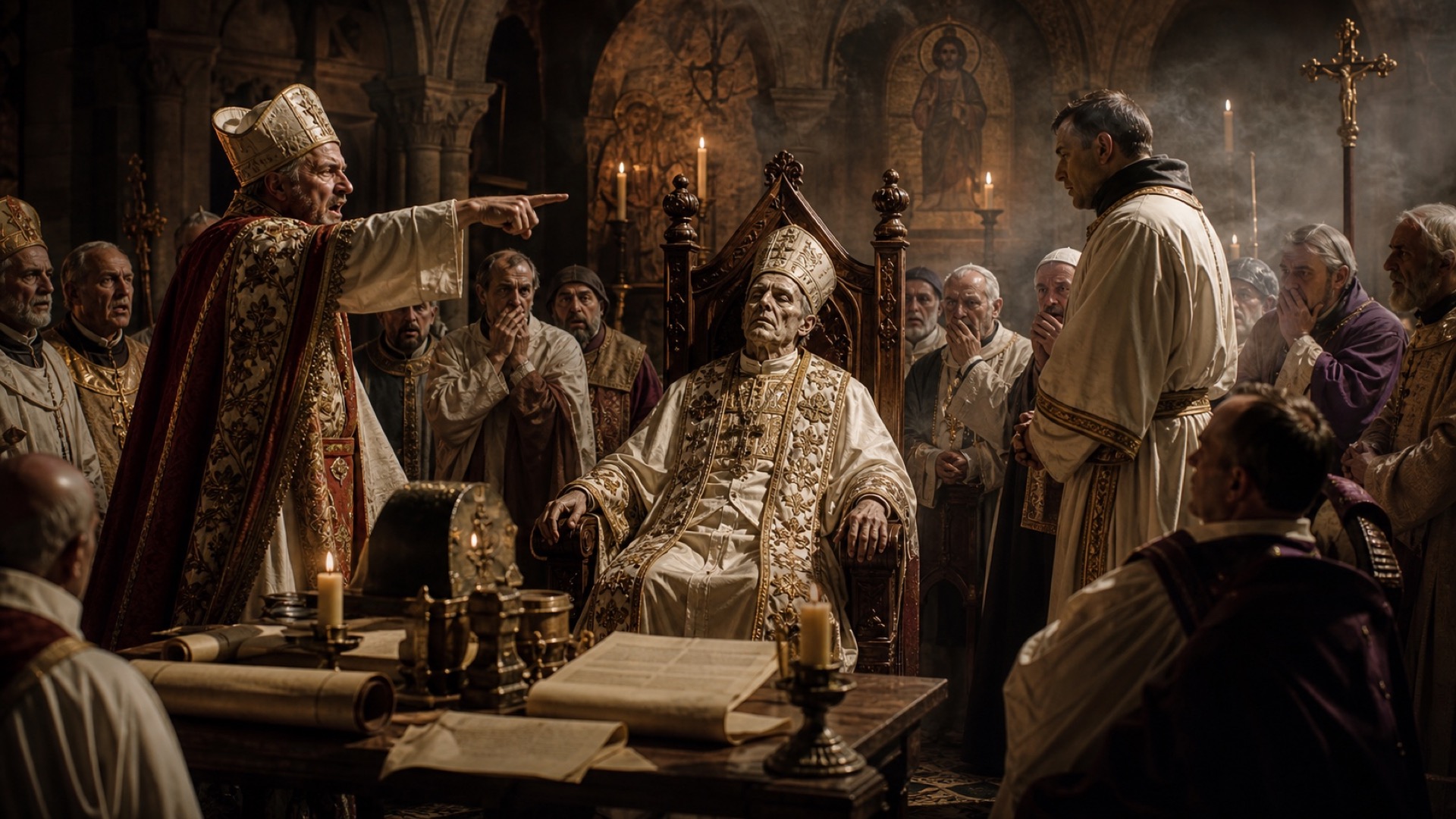
There are political scandals, and then there is digging up your predecessor so you can yell at him in court.
In the year 897, Pope Stephen VI had the body of Pope Formosus exhumed, dressed in papal robes, and placed on trial in Rome. This event became known as the Cadaver Synod, which is already one of the most metal names ever attached to church politics.
Formosus had been dead for months. That did not stop the trial. His corpse was reportedly propped up on a throne while charges were read against him. Since dead people are famously bad at defending themselves, a deacon was assigned to answer on his behalf.
The whole thing was tied to ugly political and religious disputes inside the church. Stephen VI wanted Formosus condemned, and apparently a normal written statement was not theatrical enough. The corpse was found guilty, stripped of its papal garments, and some of its fingers were cut off before the body was thrown into the Tiber River. The Cadaver Synod is a reminder that medieval punishments and power could get disturbingly theatrical, even when the target was already dead.
It is hard to imagine a better example of people taking a grudge way too far. Most leaders settle for insulting the last administration. Stephen VI went with courtroom corpse drama, because apparently medieval Rome had no chill and very strong feelings about paperwork.
#2 The Dancing Plague of 1518

In 1518, a woman in Strasbourg began dancing in the street. That sounds harmless enough, until other people joined her. Then more people. Then enough people that the city had an actual problem on its hands.
This became known as the Dancing Plague of 1518, one of the strangest outbreaks in European history. According to accounts from the time, people danced for days, seemingly unable to stop. Some reports say the dancing became so intense that people collapsed from exhaustion.
The city’s response did not exactly inspire confidence. Officials reportedly decided the best solution was to give the dancers more room and even hire musicians, because apparently the answer to a mysterious dancing outbreak was to upgrade it into a festival with medical consequences.
Modern explanations vary. Some historians have suggested mass psychogenic illness, stress, religious fear, or social pressure. Strasbourg had been dealing with hunger, disease, and anxiety, so the whole city was already sitting on a pile of misery with shoes on.
Whatever caused it, the image is hard to shake: a medieval street full of exhausted people dancing while everyone else tried to figure out whether this was illness, possession, punishment, or just the worst public health strategy ever accidentally sponsored by city officials.
#1 The London Beer Flood

In 1814, London experienced a disaster that sounds like it was invented by someone who had just learned irony existed.
At the Horse Shoe Brewery in St. Giles, a massive vat of porter burst. That collapse triggered other vats, sending a huge wave of beer crashing through the surrounding neighborhood. Streets flooded. Walls broke. Homes were damaged. People were killed.
It sounds funny for about half a second, because beer is not usually treated like a natural disaster. Then you remember this was not a spilled drink at a tavern. It was an industrial accident involving an enormous amount of liquid moving with real force through a poor, crowded part of London.
The flood hit nearby homes and buildings, including basement dwellings where people had very little chance to react. Several people died, turning what could have been a strange pub story into something much darker.
That is what makes the London Beer Flood so memorable. The headline sounds ridiculous. The reality was grim. A neighborhood was hit by a wave of beer because a brewery vat failed, and somewhere in the middle of that sentence, history becomes very hard to take seriously and very hard to laugh at for long.