

Some heists end with arrests, confessions, and evidence bags. These mostly ended with everyone staring at a wall and asking how that just happened.
A good heist story usually has a plan, a target, a getaway, and at least one person who thought they were much smarter than they probably were.
But the strangest heists are the ones that never fully close.
Sometimes the thieves vanish. Sometimes the money disappears. Sometimes investigators catch a few people but never recover the loot, which has to be one of the more annoying ways to win only half the game.
These cases are not just famous because something valuable was stolen. They are famous because pieces of the story are still missing.
Here are five mysterious heists that were never fully solved.
#5 The Baker Street Robbery
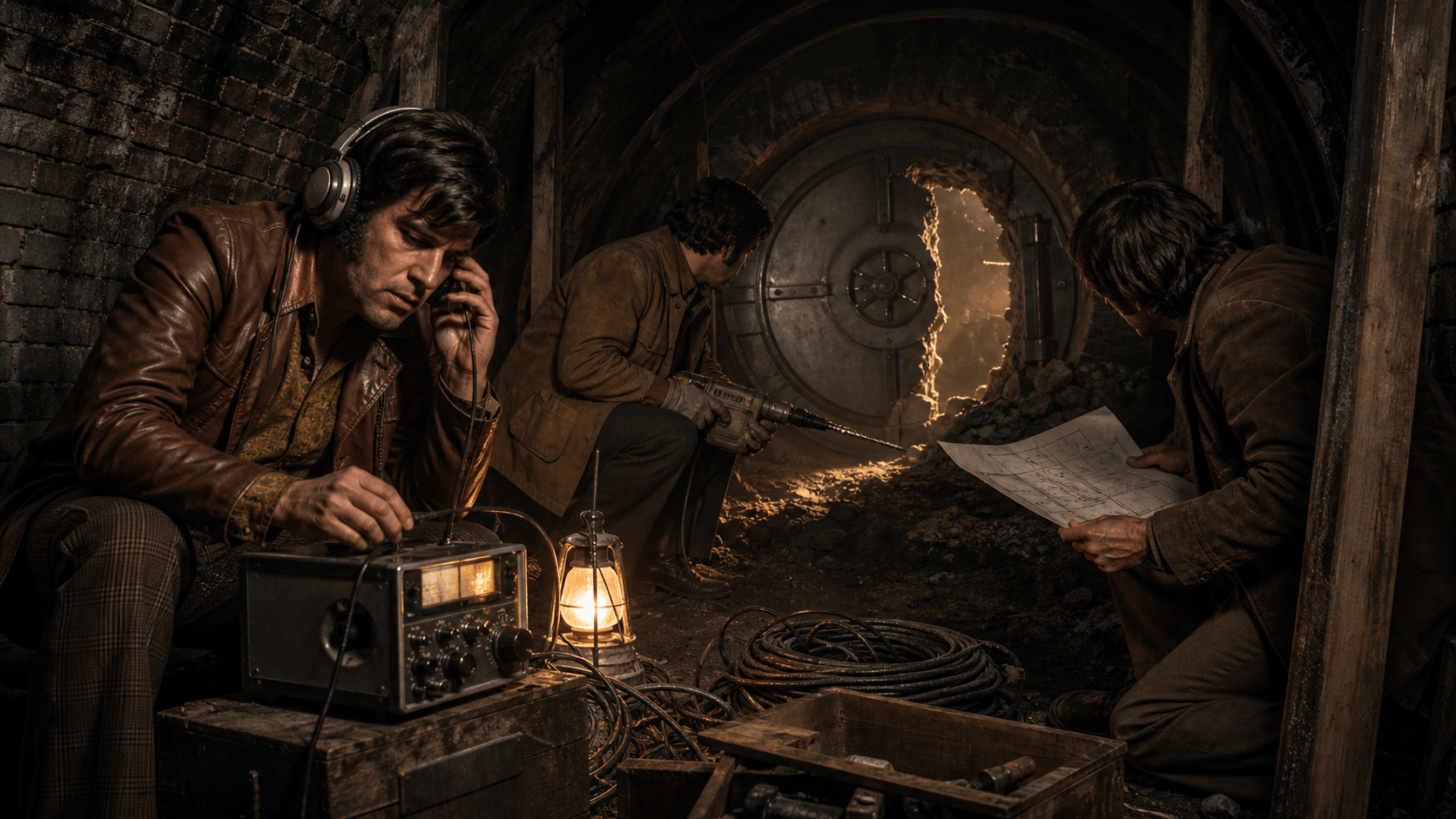
The Baker Street Robbery sounds like a Sherlock Holmes story until you remember Sherlock usually solved things faster and with fewer construction supplies.
In 1971, a group of thieves targeted a Lloyds Bank branch on Baker Street in London. Their plan was not subtle, but it was ambitious. They rented a nearby shop, dug a tunnel underground, and broke into the bank’s vault from below.
That is the kind of plan that makes you wonder how many terrible ideas were rejected before someone said, “What if we simply dig to the money?”
The robbers spent weeks working on the tunnel. They used equipment to break through into the vault, then opened hundreds of safety deposit boxes. Inside were cash, jewelry, and private valuables. The total value has been estimated in the millions.
The strangest part is that someone actually overheard them.
A ham radio operator picked up radio chatter from the thieves during the robbery and contacted police. Officers searched nearby banks, including the right general area, but they did not find the source in time. Which must have been a deeply frustrating day for everyone except the people currently inside a vault.
Some suspects were eventually arrested and convicted, but the full story has never felt neatly closed. Not all of the loot was recovered, and rumors about what was in the safety deposit boxes helped turn the robbery into a legend. There were claims of scandalous photos, secret documents, and powerful people wanting the whole thing to quietly go away.
How much of that is true?
Hard to say.
But the Baker Street Robbery remains famous because it combines a real tunnel, a real bank vault, real radio chatter, and just enough unanswered questions to make the whole thing feel like the police walked into the mystery halfway through.
#4 The Banco Central Burglary

The Banco Central Burglary is one of those crimes that sounds fake until you look it up and realize reality was apparently taking notes from a heist movie.
In 2005, thieves targeted a branch of Banco Central in Fortaleza, Brazil. They did not walk in with masks and demand money. That would have been far too normal.
Instead, they rented a nearby property and pretended to run a landscaping business. Then they spent months digging a tunnel toward the bank vault.
The tunnel was not a desperate little crawlspace either. It was roughly 260 feet long, reinforced, ventilated, and even had electric lighting. At some point, you stop calling that a tunnel and start calling it an illegal infrastructure project.
When the thieves finally broke into the vault, they stole around 160 million Brazilian reais. At the time, that was worth tens of millions of dollars. Because the stolen banknotes were not insured and the bank did not have certain tracking records, recovering the money became even harder.
Some suspects were later arrested, and parts of the money were recovered. But most of the cash disappeared.
That is what keeps the case interesting. It was not just the size of the theft. It was the planning. The patience. The fake business. The tunnel with better amenities than some apartments.
The Banco Central Burglary feels impossible because it required an absurd amount of work.
Which is probably why it worked.
#3 The Antwerp Diamond Heist

The Antwerp Diamond Heist is what happens when a vault built to defeat almost everyone meets the kind of people who took that personally.
In 2003, thieves broke into the Antwerp Diamond Center in Belgium, one of the most secure diamond districts in the world. The vault was protected by layers of security: cameras, motion sensors, heat sensors, magnetic locks, and a combination system.
Basically, the room was saying “no” in several different languages.
The crew still got in.
They emptied more than 100 safe deposit boxes and stole diamonds, gold, jewelry, and other valuables. The total value has been estimated at over $100 million, making it one of the largest diamond heists ever.
The crime was later linked to a group led by Leonardo Notarbartolo, who had rented an office in the building and posed as a diamond merchant. Some members of the crew were arrested, helped in part by evidence found in a discarded trash bag.
Which is a rough way to lose a brilliant criminal reputation.
But here is the part that keeps the story from feeling finished: most of the diamonds were never recovered, and not everyone involved was clearly identified. The vault was beaten, suspects were caught, and yet the treasure itself mostly vanished.
The Antwerp Diamond Heist remains fascinating because it feels both highly professional and oddly human.
Months of planning, elite security defeated, a fortune gone.
And then somebody messed up with the trash.
#2 D.B Cooper

D.B. Cooper pulled off the kind of crime that sounds like it was invented by someone trying to make airports more stressful.
In 1971, a man using the name Dan Cooper boarded a Northwest Orient Airlines flight from Portland to Seattle. A newspaper later misreported the name as D.B. Cooper, and somehow the wrong name became the famous one. Even the legend started with paperwork getting confused.
During the flight, Cooper told a flight attendant he had a bomb. He demanded $200,000 in ransom, four parachutes, and a fuel truck waiting in Seattle.
The plane landed. Passengers were released. Cooper got the money and parachutes. Then the plane took off again with only the crew on board.
Somewhere over the Pacific Northwest, in bad weather, Cooper lowered the rear stairs of the plane and jumped into the night with the ransom money.
Then he vanished.
No confirmed body was ever found. No confirmed parachute was ever found. In 1980, a young boy discovered a small portion of the ransom money buried along the Columbia River, which only made the case stranger. It proved some of the money had ended up out there, but not exactly how, when, or why.
The FBI investigated for decades. Suspects came and went. Theories multiplied. Some people think Cooper died in the jump. Others think he survived and lived quietly under another name.
The case remains famous because the image is almost too clean: a man in a suit, a bag of cash, a stormy night, and a jump into nowhere.
It feels less like an escape and more like someone disappearing through a trapdoor in American history.
#1 The Isabella Stewart Gardner Museum Heist

The Isabella Stewart Gardner Museum heist is one of those crimes where the empty space is almost as famous as what was stolen.
In 1990, two men dressed as police officers arrived at the Isabella Stewart Gardner Museum in Boston. They told the security guards they were responding to a disturbance. The guards let them in.
That was the first bad moment.
The thieves tied up the guards and spent more than an hour inside the museum. They stole 13 works of art, including pieces by Vermeer, Rembrandt, Degas, and Manet. The total value is usually estimated in the hundreds of millions.
Then they left.
No dramatic chase. No recovered masterpiece. No neat ending.
The stolen artwork has never been found.
What makes the case especially eerie is that the museum still keeps the empty frames hanging in place. They are not just decorations. They are placeholders, waiting for art that may never come back. It is a quiet choice, and honestly a very effective one. Nothing says “we remember” like refusing to redecorate around a crime.
Over the years, investigators have looked into organized crime connections, possible suspects, and theories about where the paintings may have gone. There have been leads, rumors, and rewards. Still, no one has been convicted for the theft, and the missing works remain missing.
That is why this heist gets the number one spot.
It was bold. It was strange. It stole masterpieces from a museum and somehow left behind an even bigger mystery.
And after all these years, those empty frames are still doing their job.
Leave a Reply