

Some ancient inventions were so clever, precise, or bizarrely advanced that they still feel like they arrived from the wrong century.
Ancient people do not always get enough credit. We like to imagine history as a long parade of confused humans slowly working their way toward indoor plumbing and decent snacks.
But every now and then, someone from the ancient world built something that feels suspiciously advanced. A machine with gears. A heating system under the floor. A device that detected earthquakes before anyone had a weather app to blame for being wrong.
These inventions were not modern, exactly. Nobody was charging them with USB-C or asking them to connect to Wi-Fi, thank mercy. But they were clever, ambitious, and sometimes so far ahead of their time that they still make modern people stop and squint at the timeline.
Here are five ancient inventions that were weirdly ahead of their time.
#5 Roman Underfloor Heating
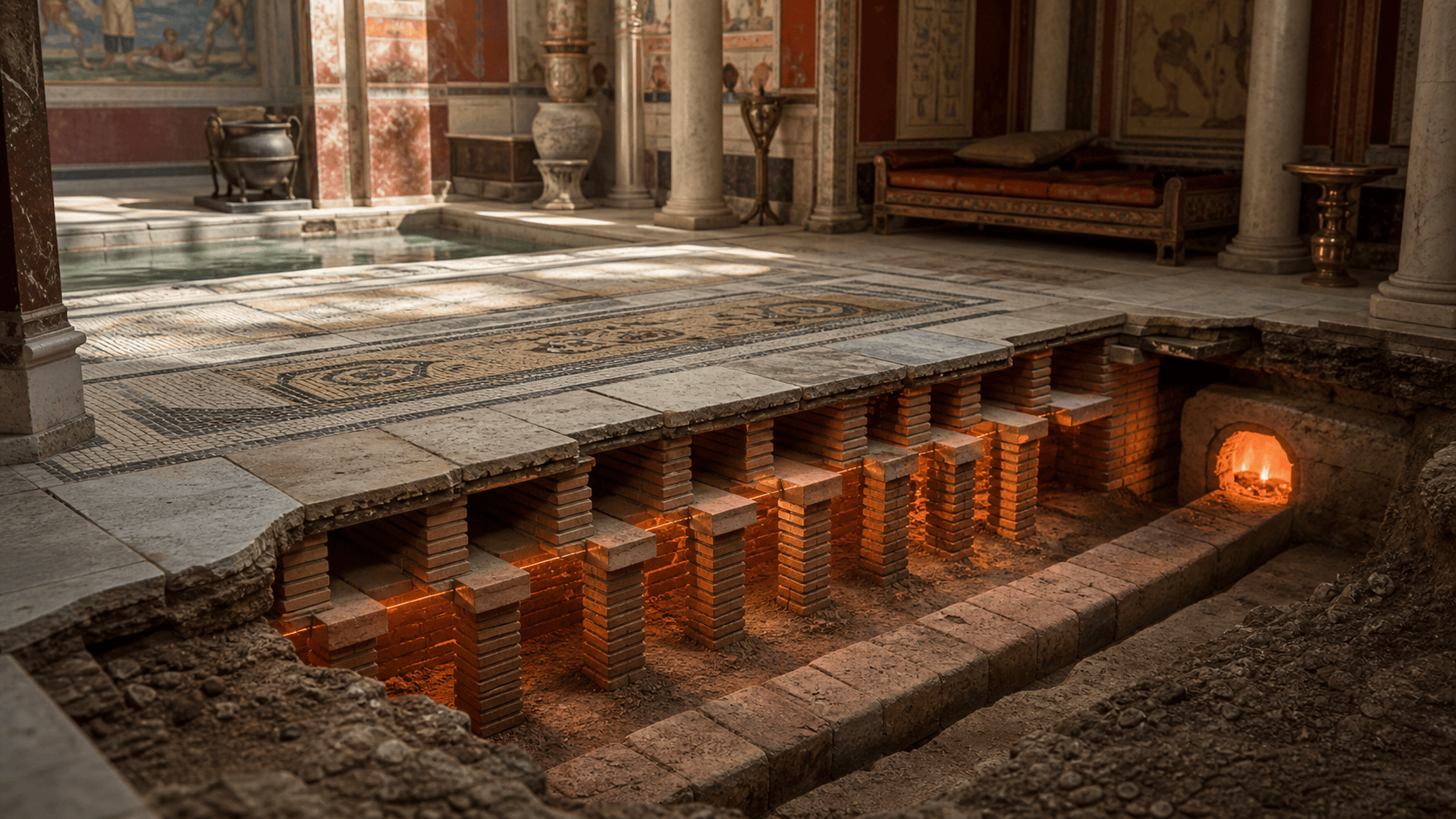
Roman underfloor heating sounds like the kind of luxury feature a modern apartment listing would describe as “rare” before charging you an extra thousand dollars a month.
But the Romans had versions of it thousands of years ago.
The system was called a hypocaust. It worked by raising the floor on small pillars and letting hot air from a furnace move through the empty space underneath. The heat could also travel through channels in the walls, warming rooms from below and around the sides.
Which is honestly impressive. Most of us are still fighting one cold bathroom tile at a time.
Hypocausts were used in bathhouses, villas, and wealthy homes. They were not available to everyone, because ancient comfort still came with a class system, naturally. But as an engineering idea, it was shockingly clever. Instead of just building a fire in the room and hoping smoke did not turn the evening into a lung-based emergency, Roman builders created a controlled heating system hidden under the floor.
It was not modern central heating. It required fuel, labor, maintenance, and a lot of architectural planning. But the basic concept feels familiar: warm air moving through a building to keep people comfortable.
That is what makes it so ahead of its time. Roman underfloor heating was not just a fancy ancient perk.
It was proof that even two thousand years ago, people looked at a cold floor and thought, “Absolutely not.”
#4 Hero Of Alexandria’s Steam Engine

Hero of Alexandria built a steam-powered device nearly two thousand years before steam engines helped transform the modern world, because apparently the ancient world enjoyed dropping spoilers.
The device is usually called the aeolipile. It was a hollow sphere mounted so it could spin. When water was heated, steam escaped through bent tubes on the sphere, causing it to rotate. In simple terms, it used steam pressure to create motion.
Which is very close to the kind of idea that later made factories, trains, and industrial machinery possible.
The strange part is that Hero’s steam engine did not become the start of an ancient Industrial Revolution. It was likely treated more like a demonstration, curiosity, or temple wonder than a practical machine for doing heavy work. Ancient engineers had the concept, but not the full economic, mechanical, and industrial setup to turn it into a world-changing technology.
So the aeolipile sat there being brilliant and underemployed.
That is what makes it so fascinating. It was not a steam locomotive hiding in a toga. It was not ready to run a factory. But the core idea was there: heat water, create steam, use that steam to produce movement.
For something built in the ancient world, that feels almost unfairly early.
Hero basically looked at steam and thought, “This should spin something.”
History took about eighteen centuries to reply, “Actually, yes.”
#3 Zhang Heng’s Seismoscope

In the year 132, Chinese inventor Zhang Heng created a device that could detect earthquakes. Not predict them, to be clear. That would have been a little too powerful, and history was already showing off.
The device is usually called a seismoscope. It was a large bronze vessel decorated with dragon heads around the outside. Each dragon held a small ball in its mouth. Below them sat open-mouthed toads waiting to catch the balls, because ancient engineering apparently had room for drama.
When an earthquake happened, the mechanism inside the vessel caused one of the balls to drop. The direction of the fallen ball was meant to show where the earthquake had come from.
That is the part that feels so ahead of its time. Zhang Heng was not just noticing shaking. He was trying to build an instrument that could detect distant seismic activity and point officials toward the affected region.
According to historical accounts, the device once detected an earthquake that people near the court had not felt. Some doubted it at first. Then messengers arrived from the affected area, proving that something had happened.
Which is a pretty strong moment for any invention. Imagine building a bronze earthquake detector, having people doubt it, and then getting the ancient-world version of a push notification days later.
Modern scientists still debate exactly how the internal mechanism worked. The original device has not survived, and reconstructions are based on written descriptions. But even with those questions, the idea itself is remarkable.
Nearly two thousand years ago, Zhang Heng was already trying to turn invisible geological chaos into data.
That is not just clever.
That is ancient science quietly flexing.
#2 Roman Concrete
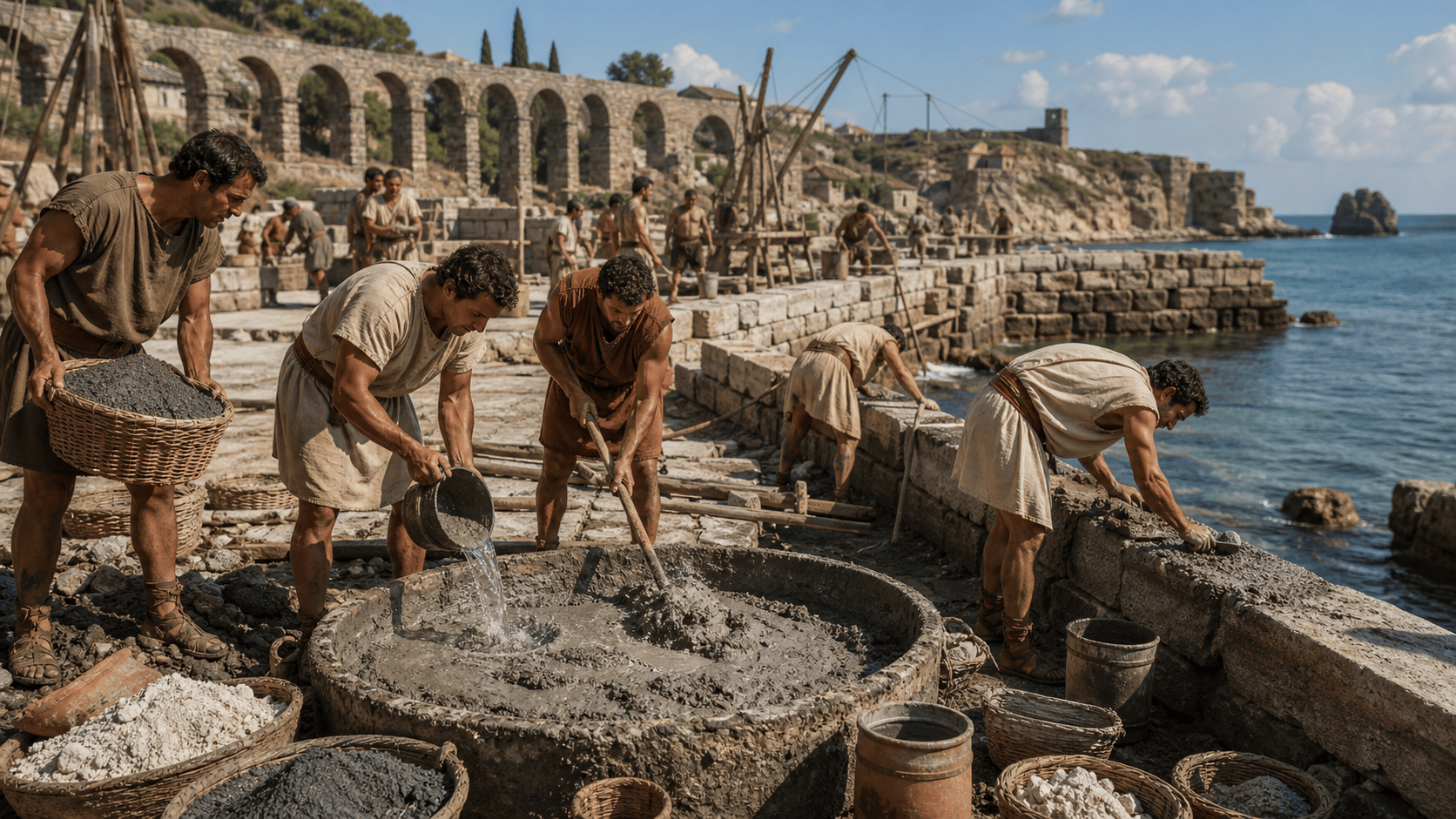
Roman concrete is one of those inventions that sounds boring until you realize it has been quietly embarrassing modern construction for centuries.
The Romans used a mixture that often included lime, volcanic ash, water, and rock fragments. In certain environments, especially around seawater, that mixture became incredibly durable. Some Roman harbors, walls, and buildings have survived for nearly two thousand years, while plenty of modern concrete starts looking personally offended after a few decades.
A big part of the secret was volcanic ash. When mixed with lime and seawater, it could help form strong minerals inside the concrete over time. Instead of simply breaking down, some Roman concrete actually became stronger in certain conditions.
Which feels rude, honestly.
Modern researchers have studied Roman concrete because it may offer clues for making longer-lasting and more sustainable building materials today. That is the part that makes it so ahead of its time. This was not just ancient people stacking rocks with confidence. They created a material that could survive saltwater, weather, and centuries of human nonsense.
Of course, Roman concrete was not magic. It depended on specific ingredients, techniques, and conditions. But the results were real.
The empire fell.
Some of the concrete stayed.
That is a pretty strong product review.
#1 The Antikythera Compass

The Antikythera Mechanism is the kind of object that makes ancient history feel like it is hiding a second browser tab.
It was discovered in a shipwreck near the Greek island of Antikythera in the early 1900s. At first, it looked like a corroded lump of bronze. Not exactly the kind of thing that screams, “Hello, I am about to make historians deeply uncomfortable.”
Then researchers realized it contained a complex system of gears.
The device is now understood as an ancient Greek astronomical calculator. It could track celestial cycles, help predict eclipses, and model the movements of the sun, moon, and possibly planets. In other words, it was doing mechanical astronomy more than two thousand years ago.
That is not just advanced. That is “double-check the date on the museum label” advanced.
What makes it even stranger is how sophisticated the gearing was. Devices with that level of mechanical complexity did not become common again in Europe until many centuries later. The Antikythera Mechanism feels less like a random invention and more like evidence that ancient technology was more developed than we once assumed.
It was not a computer in the modern sense. Nobody was opening spreadsheets on it, which is probably for the best. But it was a machine that processed information through gears, dials, and cycles.
For an ancient artifact pulled from the sea, that is astonishing.
The Antikythera Mechanism did not just survive history.
It made history look underdressed.